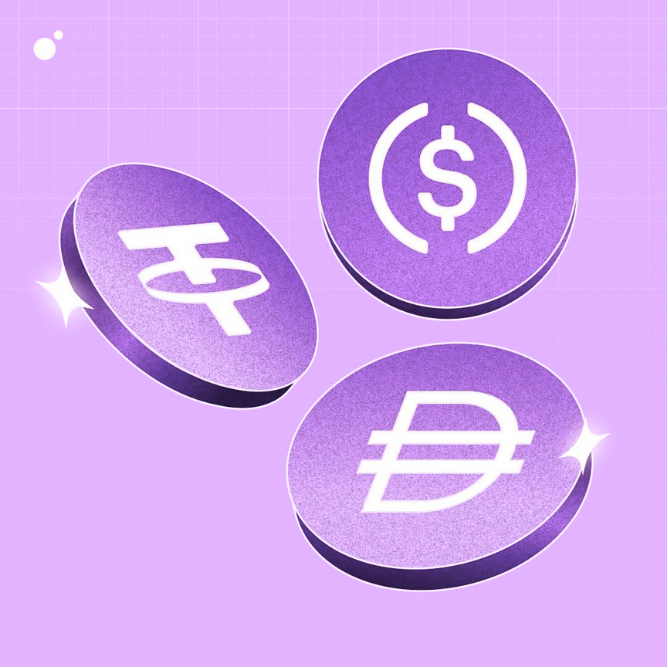
A stablecoin is a cryptocurrency designed to hold a fixed value, most often one US dollar, so you can use it the way you would use cash inside crypto: to park money between trades, to pay someone, or to move money across borders without a bank in the middle.
Cryptocurrencies have been around for well over a decade now, and their popularity has surged in the last few years. This is partly due to the volatility of markets, which can see currencies and assets rise and fall in value by huge percentages in a very short period.
At the same time, cryptocurrency is an intrinsically risky type of digital asset. For example, the Bitcoin price rose by over 300% in just 5 years and then lost over 70% of its value in just over a year.
This volatility is also the reason why most cryptocurrencies are not used for everyday commerce. Enter stablecoins.
The idea is simple and the execution is not, which is why this guide spends most of its time on what actually keeps a stablecoin at a dollar. As of August 13, 2026 there were about $308 billion of stablecoins in circulation according to DefiLlama, roughly 13% of the entire crypto market, and about 82% of that was two coins: Tether's USDT and Circle's USDC. Stablecoins are also the first part of crypto with a US federal law written specifically for it, which changes how they work and who can issue them.
This article explains what stablecoins are, how they work, the different types with current examples, how they are regulated, what they are used for, and the risks they carry.
What is a stablecoin?
A stablecoin is a type of cryptocurrency that aims to maintain a steady value by pegging its price to another asset such as the US dollar or euro. The primary goal of stablecoins is to minimize the price volatility that is prevalent in other cryptocurrencies like Bitcoin or Ethereum.
Stablecoins aim to achieve this stability through various mechanisms, including collateralization (backing by assets) and algorithmic controls that manage the supply and demand of the coin. Their versatility means they can be used in a wide range of financial applications, from everyday transactions to advanced decentralized finance (DeFi) protocols.
How do stablecoins work?
A stablecoin's attempted stability is achieved by pegging its value to a reference asset, such as a fiat currency or a commodity. One of the most common pegs used is the US dollar, where one unit of a stablecoin is designed to be worth $1 USD.
But how is this peg actually maintained?
Stablecoin mechanisms
Depending on the type of stablecoin in question, issuers will employ a combination of collateralization, algorithmic controls, and reserve systems.
Collateralization involves backing the stablecoin with assets that hold value. These assets can include fiat currencies, cryptocurrencies, or other types of financial assets.
For example, a fiat-collateralized stablecoin like Tether (USDT) is backed by reserves of US Treasuries, cash and other assets held by the issuer, Tether. If the reserves are accurate, each unit of the stablecoin can be redeemed for a corresponding unit of the fiat currency, thereby maintaining its stable $1 value.
In some cases, stablecoins are over-collateralized, meaning the value of the collateral exceeds the value of the stablecoins issued. Though it requires greater reserves, it provides an additional layer of security, helping the stablecoin to maintain its peg even in times of market stress and instability.
Minting and burning
Stablecoins are typically issued (minted) and redeemed (burned) through a process that involves smart contracts, which are self-executing contracts with the terms of the agreement directly written into code.
For instance, if a user wants to obtain a stablecoin, they deposit the corresponding amount of collateral, and the smart contract mints the token. Conversely, when a user wants to redeem their stablecoins, they return the coins to the smart contract, which then burns them and releases the corresponding amount of collateral.
The minting and burning process is necessary to help maintain the balance between the supply of stablecoins and the amount of collateral, helping the stablecoin to remain pegged to its underlying asset.
Smart contracts
As previously mentioned, smart contracts play a central role in the operation of stablecoins, particularly in decentralized stablecoins. Some of their functions include automating the issuance and redemption processes, enforcing the rules of the stablecoin system, and ensuring that the system operates transparently and without the need for a central authority.
The role of oracles in stablecoin pricing
Oracles like Chainlink (LINK) are external services that provide real-world data to blockchain networks. In the context of stablecoins, oracles are used to provide accurate and up-to-date price data for the reference asset to which the stablecoin is pegged.
For example, if a stablecoin is pegged to the US dollar, an oracle will provide the current exchange rate between the stablecoin and the dollar. This data is then used by the smart contracts to adjust the supply of the stablecoin, if necessary, to maintain its value.
Reliable data feeds
The reliability of oracles is key to the stability of stablecoins. Inaccurate or delayed data can lead to a loss of the stablecoin's peg, resulting in potential losses for users. For this reason, stablecoin issuers often use multiple oracles and aggregate their data to ensure accuracy and reduce the risk of manipulation.
What are the different types of stablecoins?
Stablecoins fall into four groups, and the word "stable" is doing different work in each: fiat-collateralized, crypto-collateralized, synthetic, and algorithmic. A fifth group, commodity-backed tokens, tracks gold rather than a currency.
Note: Europe's MiCA (Markets in Crypto-Assets) regulation requires stablecoins to comply with strict authorization standards. USDC is authorized under MiCA; USDT and DAI are not, which limits their ability to serve the European market, and most EU exchanges removed USDT for European customers in early 2025.
Fiat-collateralized stablecoins
Fiat-collateralized stablecoins are backed by fiat currencies and short-term government debt held in reserve by the issuer, who redeems tokens for dollars on request. These are the most common and widely used type of stablecoins, with USDT and USDC dominating in terms of market capitalization and volume. PYUSD, USD1, RLUSD and USAT work the same way.
The risks are the issuer's honesty and the banks and funds where the reserves sit. Reserve attestations, and for US issuers the GENIUS Act's reserve rules, exist to address both.
Tether (USDT)
Tether (USDT) is the leading fiat-backed stablecoin by market cap, with roughly 59% of the stablecoin market, and one of the first to be released. USDT is backed by US Treasuries, cash and other assets held in reserve by Tether, with each USDT meant to be worth exactly $1. Tether can be traded on many cryptocurrency exchanges and used in decentralized applications (dApps) as a stable trading pair or in liquidity pools.
USDC
USDC, formerly USD Coin, is second by market capitalization among fiat-backed stablecoins, trailing only USDT. It was first developed by the Centre Consortium and is now issued solely by Circle, which listed on the New York Stock Exchange in 2025. Like Tether, USDC is pegged to the US dollar and fully backed by cash and short-term US Treasuries. USDC has gained popularity for its transparency and compliance with regulatory standards, particularly in comparison to Tether.
Crypto-collateralized stablecoins
Crypto-collateralized stablecoins are backed by reserves that include other cryptocurrencies locked in smart contracts, rather than fiat currencies. These stablecoins are typically over-collateralized to account for the volatility of the underlying digital assets, so the peg survives a fall in the collateral's price. DAI and its successor USDS are the main examples; GHO, crvUSD and BOLD work the same way. The risk is a crash fast enough to outrun liquidations.
Dai (DAI)
DAI is a decentralized stablecoin issued by the MakerDAO protocol, now known as Sky, and is possibly the most prominent example of a crypto-collateralized stablecoin. Dai is pegged to the US dollar, though it is backed by a variety of cryptocurrencies, primarily Ethereum (ETH), along with tokenized real-world assets. Dai's price peg is maintained through smart contracts that manage the stablecoin collateral and ensure that the system remains solvent even during periods of market volatility. Sky's upgraded token, USDS, can be swapped 1:1 with DAI.
Wrapped tokens are another type of crypto-collateralized cryptocurrency, though they are not actually stablecoins themselves. For example, Wrapped Ether (wETH) and Wrapped Bitcoin (WBTC) function in a similar manner to stablecoins because they are backed in a 1:1 ratio to other crypto assets (ETH and BTC, respectively).
Synthetic stablecoins
Synthetic stablecoins are backed by a hedged position rather than by assets that are themselves stable. Ethena's USDe holds staked ETH and Bitcoin and shorts the same amount in futures, so the position's dollar value stays flat while it earns the funding rate. It is the largest of this kind. The risks are the exchanges where the hedge lives and a period of negative funding, when the strategy pays out instead of earning. Its yield-bearing version, sUSDe, passes that income to holders.
Algorithmic stablecoins
Algorithmic stablecoins use algorithms and smart contracts to control the supply of the stablecoin and maintain its peg to a reference asset. Unlike collateralized stablecoins, algorithmic stablecoins do not rely on reserves, or hold very little collateral. Terra's UST was the largest, and its collapse in May 2022 is why almost none remain. Treat any coin in this category as an experiment, not a dollar.
UST: an algorithmic stablecoin tragedy
UST (TerraUSD) was perhaps the most well-known algorithmic stablecoin, developed by the Terra blockchain. UST maintained its peg to the US dollar through a mint-and-burn mechanism involving another cryptocurrency, a governance token called LUNA. In May 2022, UST lost its peg under heavy selling, the mechanism failed, and both cryptocurrencies and the Terra blockchain collapsed, wiping out roughly $18 billion of UST at its peak supply.
Algorithmic stablecoin challenges
Algorithmic stablecoins have faced numerous challenges, primarily due to their reliance on market mechanisms rather than tangible collateral. The collapse of UST highlighted some of the risks associated with these types of stablecoins. This includes the potential for rapid devaluation and loss of investor confidence, even though the blockchain has since rebranded as Terra Classic (LUNC).
Commodity-backed stablecoins
Commodity-backed tokens like Tether Gold (XAUt) and Pax Gold (PAXG) track an ounce of gold rather than a dollar. Each token represents physical gold held in a vault and can be redeemed for it. They are stable relative to gold, not to your rent, so their dollar price moves with the gold market.
How stablecoins are regulated
Until 2025 stablecoins operated under a patchwork of state money-transmitter licenses, New York's trust charter and, in the EU, nothing specific. That has changed in the two markets that matter most.
United States. The GENIUS Act became law on July 18, 2025. It defines a payment stablecoin, says it is neither a security nor a commodity, and sets rules for anyone issuing one in the US: reserves of 100% in cash, insured deposits and short-term Treasuries; monthly public reserve reports; anti-money-laundering obligations like a bank's; and no interest paid to holders simply for holding the coin. Issuers must be banks or approved non-bank entities, and foreign issuers need a Treasury determination that their home rules are comparable. The detailed rules were still in proposal form in August 2026, with regulators expecting to finish late in the year, and US platforms have until July 18, 2028 before they must stop offering stablecoins from issuers that are not permitted. That deadline is why Tether launched USAT through a US bank in January 2026 rather than trying to fit USDT to the law.
European Union. MiCA's stablecoin rules have applied since June 30, 2024. Issuers need authorization as an electronic money institution or credit institution, must hold reserves partly in bank deposits, and face limits on non-euro stablecoins used for payments. USDC and EURC are authorized; USDT is not, and most EU exchanges removed it in early 2025.
What this means for you. A US- or EU-authorized stablecoin publishes what backs it, has a regulator looking at the reserves, and can be redeemed at par through the issuer or its partners. An unauthorized one may be perfectly well run, but you are trusting the company rather than the rules.
Benefits of stablecoins
Stablecoins offer a range of advantages that make them a viable option for both individual users and institutions.
Price stability
In a crypto market characterized by high volatility, stablecoins are intended to provide a way for investors to park their funds without worrying about sudden price fluctuations. Stability helps make stablecoins a preferred choice for traders who want to avoid the risks associated with holding more volatile cryptocurrencies like Bitcoin or Ethereum.
Cross-border transactions
Stablecoins make cross-border transactions faster and cheaper than traditional banking systems. Unlike traditional fiat transfers, which can take several days and incur high fees, stablecoin transactions settle in minutes and cost a fraction of traditional transfer fees.
Accessibility and inclusion
Stablecoins help promote financial inclusion, particularly for the unbanked in regions with limited access to traditional banking services. With just a smartphone and internet connection, individuals across the globe can access stablecoins and participate in the global economy.
DeFi and traditional finance integration
Stablecoins are integral to the DeFi ecosystem, where they are used in various financial applications such as lending, borrowing, and yield farming. Their stability makes them a more reliable medium of exchange than other crypto tokens within DeFi protocols. Through them, users can earn yield, provide liquidity, and engage in other financial activities with less risk of price volatility (though they still carry risk of loss).
Stablecoins also serve as a bridge between crypto and traditional financial systems. They provide a way for users to move in and out of the crypto market without having to convert their assets back into fiat currency. Their ease of conversion adds to the liquidity of the cryptocurrency markets and enables smoother integration with traditional financial services.
What are stablecoins used for?
Understanding how to use stablecoins helps you get the most out of them in applications like payments, DeFi, and trading within the digital economy.
Buying and holding
Stablecoins can be purchased on most cryptocurrency exchanges using fiat currencies or other cryptocurrencies. They can also be bought via on-ramp providers like MoonPay using a card or bank transfer. It's important to choose a reputable exchange and follow best practices to secure your digital assets.
Hardware wallets, such as Ledger or Trezor, are considered some of the safest options for long-term storage. For short-term use, software wallets or exchange wallets can be convenient, but users should always be aware of the security risks and take steps to mitigate them. This includes regularly updating their software, keeping private keys safely offline, and learning how to avoid phishing attacks and other crypto scams.
Payments and transfers
Stablecoins like USDT and USDC are increasingly being used for everyday transactions like purchasing goods and paying for services. Their stability makes them a potentially viable option for merchants who want to accept cryptocurrency payments without exposing themselves to the volatility of other cryptocurrencies.
Stablecoins can also be used for international remittances, providing a faster and cheaper alternative to traditional remittance services. Individuals can send money across borders in minutes, with significantly lower transaction fees than some traditional methods. This could be particularly beneficial for people in developing countries who rely on remittances as a source of income.
Decentralized finance (DeFi)
Users can deposit their stablecoins into DeFi platforms and earn interest through lending and yield farming. They can also be used in DeFi as collateral for borrowing other assets or lending to earn interest.
For instance, decentralized applications (dApps) like Aave and Compound allow users to deposit stablecoins into lending pools, which are then borrowed by other users. The interest earned from these loans is distributed to the lenders, providing passive rewards for stablecoin lenders.
You can also trade stablecoins like USDC (SOL) on MoonPay for supported Solana tokens in seconds and with low fees.
Trading and swapping
Stablecoins can be traded or swapped for other crypto tokens on many cryptocurrency exchanges. For example, during a period of market volatility, traders can convert their digital assets into stablecoins to preserve their value.
This added flexibility makes stablecoins a useful tool for both short-term traders and long-term investors, since anyone can move in and out of positions without having to convert their assets back into fiat currency.
Stablecoin payments
Stablecoins started as a trading tool. Payments is the use that banks and payment companies are now building for. Of the tens of trillions of dollars in stablecoin transfers in 2025, most was trading and moving money between wallets and exchanges, but a few hundred billion dollars was payments for actual goods, services and salaries.
The reasons are practical. A stablecoin transfer settles in minutes at any hour and costs cents on most networks. The recipient does not need a bank account in the sender's country. That makes it useful for freelancers paid from abroad, companies paying suppliers in several countries, remittances, and merchants who want to settle in dollars without a card processor's fees and chargebacks.
The use cases in 2026 include:
- Payroll and contractor payouts, where a business converts local currency to USDC and pays people who cash out locally.
- Cross-border business payments, replacing correspondent-bank wires that take days.
- Merchant checkout, where a customer pays in crypto and the merchant receives stablecoins or local currency.
- Remittances into countries where dollars on a phone are more useful than the local currency.
- Payments by software agents, which can hold and spend USDC without a bank account. Our agentic payments article explains how that works.
MoonPay's business products cover the pay-in, conversion and payout steps for companies building on stablecoins, and the guide to accepting crypto payments explains what happens at the merchant end.
Risks and challenges of stablecoins
While stablecoins offer many benefits, they are not without risks and challenges.
Centralization and trust
Many stablecoins, particularly fiat-collateralized ones like Tether (USDT), are centralized, meaning they are controlled by a single entity. This centralization raises concerns about transparency, as users must trust that the issuer is holding sufficient reserves to back the stablecoins in circulation.
If a stablecoin issuer lacks such transparency, it can lead to doubts and mistrust about the stability of the stablecoin. To address these concerns, stablecoin issuers must provide regular audits and transparent reporting of their reserves. Tether was initially reluctant to publish such audits, though it now releases consolidated financial and reserve reports quarterly and daily reserve data.
Regulatory scrutiny
Stablecoins have attracted significant attention from regulators worldwide. Certain governments have expressed concern about the potential for stablecoins to disrupt traditional financial systems, evade regulations, and facilitate illegal activities. That scrutiny has now produced law: the GENIUS Act in the US and MiCA in the EU, covered above.
Regulation can have both positive and negative impacts on stablecoin adoption. On one hand, clear regulatory guidelines can provide legal certainty and encourage broader adoption by institutions, which is what happened after the GENIUS Act passed. On the other hand, restrictive rules can push coins off platforms in a region, as MiCA did to USDT in the EU.
De-pegging risks
What happens when a stablecoin loses its peg?
De-pegging occurs when a stablecoin loses its fixed exchange rate with its underlying asset, and can occur for several reasons. Some of the main de-peg causes include a lack of sufficient collateral, technical issues, or market manipulation. When a stablecoin de-pegs, its value can fluctuate significantly, leading to potential losses for holders.
The most notable case of de-pegging was the collapse of TerraUSD (UST) in May 2022, when the token fell from $1 to a few cents and did not recover. Fiat-backed coins are not immune either. In March 2023, USDC fell to about $0.87 after Silicon Valley Bank, which held $3.3 billion of its reserves, failed; it returned to $1 within three days once regulators guaranteed the deposits. USDT briefly traded around $0.95 in May 2022 during the Terra panic. De-pegging events such as these highlight the risks associated with all stablecoins and the importance of sound mechanisms to maintain a stable value.
Market and liquidity risks
Liquidity risk arises when there is not enough demand to buy or sell a stablecoin at its pegged value. This can happen during periods of market stress or when there are concerns about a stablecoin's backing. When this occurs, it can cause the stablecoin to deviate from its peg and create challenges for users trying to trade or redeem their stablecoins at the correct value, if at all.
To help combat disruptions, liquidity providers (LPs) play a central role in maintaining the stability of stablecoin markets. Capitalizing on the decentralized nature of cryptocurrency, LPs serve to supply sufficient liquidity to support stablecoin transactions and help maintain the peg during periods of high demand.
However, liquidity providers face the additional risk of impermanent loss. This can occur when the price of one cryptocurrency diverges from the other paired token by the time the user withdraws funds from the liquidity pool (thus making the loss permanent). This risk is more prevalent when using stablecoins, since there is more likely to be a price divergence when one digital asset is restricted in price movement.
Where to buy stablecoins
Owning stablecoin assets allows users to remain in the cryptocurrency ecosystem without needing to cash out to fiat money during periods of market volatility.
MoonPay allows you to easily buy stablecoins including USDT, USDC, DAI, PYUSD, USD1 and RLUSD using your credit card or any other preferred payment method, and you choose the network at checkout.
You can also add funds to your wallet in euros, pounds, or dollars and use your MoonPay Balance to purchase USDC, USDT, DAI, and more stablecoin assets. Make your transactions smoother and more affordable, all with higher approval rates. And when cashing out, enjoy zero-fee withdrawals directly to your bank account.
How to sell stablecoins
MoonPay also makes it easy to sell stablecoins like USDT and USDC for fiat currency when you decide it's time to cash out your crypto.
Simply enter the amount of USDT, USDC, or another stablecoin you'd like to sell and enter the details where you want to receive your funds.
Swap stablecoins for more tokens
Want to exchange stablecoins like USDT and USDC for other cryptocurrencies such as Ethereum and Bitcoin? MoonPay allows you to swap crypto cross-chain with competitive rates, directly from your non-custodial wallet.
Frequently asked questions about stablecoins
Which stablecoin is the biggest?
Tether's USDT, with roughly 59% of all stablecoin value as of August 2026, followed by Circle's USDC at about 23%. Our stablecoin list covers 31 coins, and our USDT vs USDC comparison goes deeper on the two largest.
Is XRP a stablecoin?
No. XRP is the native token of the XRP Ledger and its price moves with the market. Ripple, the company most associated with XRP, does issue a stablecoin, RLUSD, which is a separate token pegged to the dollar.
Is USDC a stablecoin?
Yes. USDC is a fiat-backed stablecoin issued by Circle, backed by cash and short-term US Treasuries and redeemable one for one for dollars.
Do stablecoins pay interest?
Holding a stablecoin in your wallet earns nothing, and under the GENIUS Act US issuers are not allowed to pay you for holding one. Some platforms and DeFi protocols pay yield on stablecoin deposits by lending them out or by wrapping a strategy around them, as sUSDe and sUSDS do. The yield is payment for taking that platform's or strategy's risk, which is different from the risk of holding the coin.
Are stablecoins safe?
Safer than most crypto, but not risk-free. A regulated, fiat-backed coin with published reserves has held its peg through most market shocks, though USDC's March 2023 dip shows that even those depend on the banks holding the cash. Algorithmic coins have a poor record, and any yield product adds the risk of the strategy behind it. Only use reputable platforms and never hold more than you can afford to lose.