

Send a wire at 5:01pm on a Friday and your money enters a small purgatory until Monday morning. The web page that took your instruction is open all night. The rails underneath it are not.
That gap, between an internet that never closes and a money system that does, is the opening stablecoins walked through. In the twelve months to October 2025, stablecoins settled roughly $9 trillion in adjusted payment volume, up 87% in a year, according to a16z's State of Crypto report. Card networks are plugging them in and processors settle them like any other balance. Even central banks publish explainers about them now. This article covers what a payment rail actually is, why stablecoins qualify as one, how a payment moves across them, and where the honest limits sit.
In short: A payment rail is the network a payment travels on, like the card networks or the bank transfer system. Onchain payments use public blockchains as that network, and stablecoins, tokens pegged to currencies like the dollar, are the money that rides them. The result is settlement that runs in minutes, around the clock, across borders, with tradeoffs in reversibility and in the final step back into local currency.
What is a payment rail?
A payment rail is the infrastructure a payment actually travels on. Tap a card and the payment rides the card networks. Get paid by a US employer and the money rides ACH, the bank-to-bank batch system. Send money abroad and it usually rides SWIFT messages between correspondent banks, hopping from institution to institution until it lands.
Each rail has its own physics. Cards authorize in seconds but settle to the merchant days later, minus a percentage. ACH is cheap and slow, with cutoff times and no weekends. International wires are the long-haul flight with layovers: one to five business days, fees taken at several stops, and limited visibility in between. Real-time systems like FedNow in the US and Faster Payments in the UK have modernized domestic transfers, but they stop at the border.
None of this is broken, exactly. It's built around banking hours, national borders, batch schedules, and layers of intermediaries, because that's what was possible when it was designed. A payment rail built on the internet's schedule would look different.
What are onchain payments?
Onchain payments are payments where the settlement itself happens on a public blockchain. Not a bank database updated later, not a message instructing other institutions to move money. The transfer of value and the record of it are the same event, finalized on a ledger anyone can check.
That property is why the term matters. Plenty of fintech feels instant at the interface while the money crawls behind the scenes. An onchain payment is instant, or close to it, at the settlement layer itself: on major networks, a transfer typically finalizes in seconds to a couple of minutes, at any hour, on any day.
For years the catch was the money. Settling in an asset that can move 10% overnight makes for exciting savings and terrible invoices. Which is where stablecoins come in.
Why stablecoins fit the job
A stablecoin is a token designed to hold a fixed value against a currency, usually the US dollar, with reserves backing the peg. The two largest, USDT and USDC, carry most of that volume. A stablecoin aims to takes the volatility out of the asset and keep the settlement properties of the chain underneath.
Those properties do the work. Transfers normally finalize in minutes rather than batch windows. The networks don't close for weekends, which matters more than it sounds when your counterparty is nine time zones away. Fees are typically a flat network cost, often under a dollar, rather than a percentage of the amount. And because a stablecoin is software, payments can carry rules: funds that release when a delivery confirms, treasury that sweeps itself on a schedule, a payout that splits itself between recipients, a subscription that charges without anyone storing card numbers.
Dollars, in other words, finally got the internet's operating hours. That's the whole pitch, and it turned out to be enough.
How a stablecoin payment actually moves
Follow one payment end to end. A client in Berlin owes a design studio in Manila $2,000.
On the old rails, the payment enters the correspondent chain: the client's bank, an intermediary or two, the studio's bank, a currency conversion somewhere in the middle. Days pass. Fees come out at stops the sender never sees.
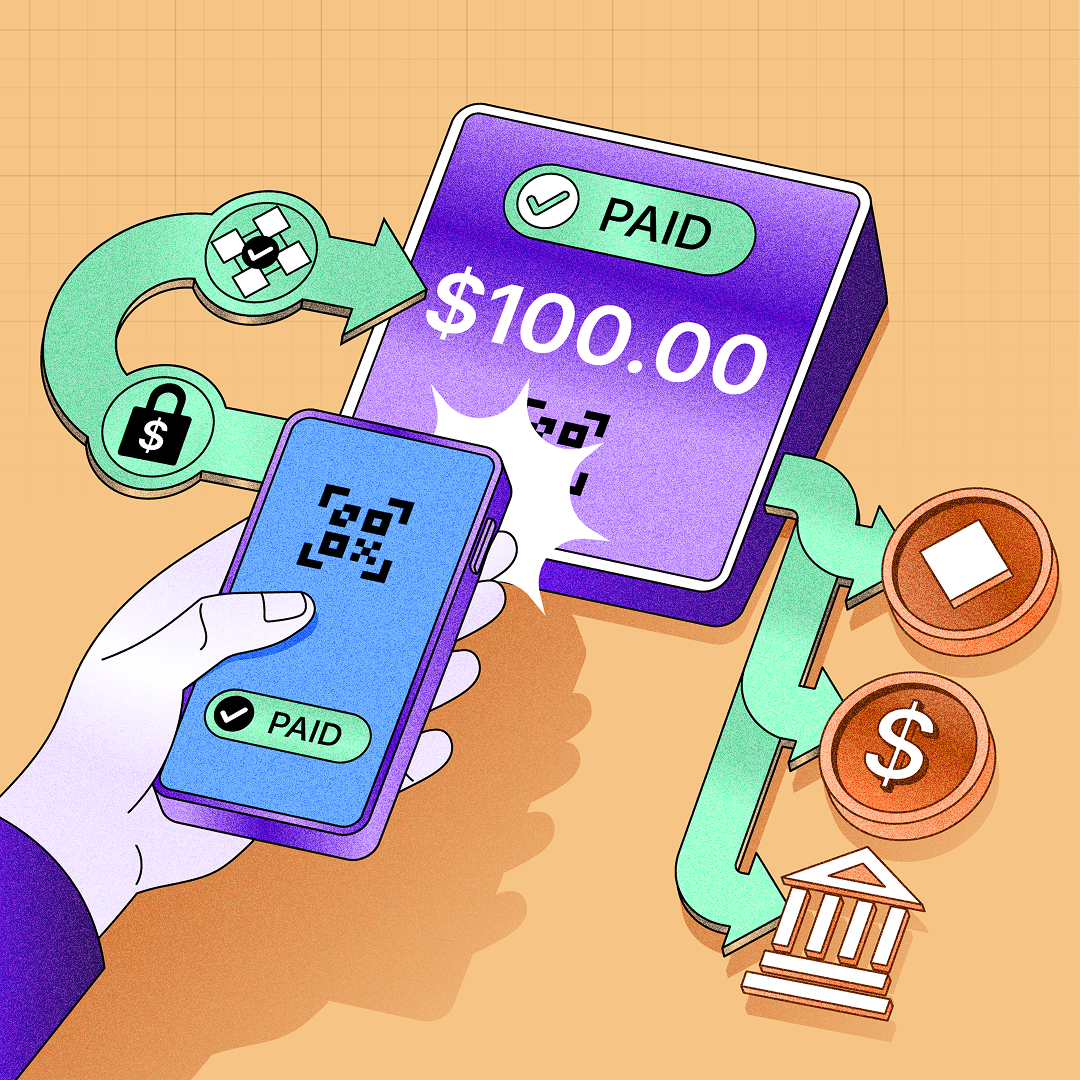
On stablecoin rails, the journey has a different shape, and the interesting parts are the ends. The client's money starts as euros in a bank account, so the first step is an on-ramp: a regulated provider converts euros into a dollar stablecoin that lands in a wallet. The transfer itself is the boring part, in the best way. The tokens move to the studio's address and settle onchain in about a minute, at 11pm on a Sunday if that's when the invoice got paid. Then the last step runs the first one in reverse: the studio can hold digital dollars, spend them onward, or off-ramp into pesos with a local provider.
Notice where the complexity lives. The chain does the settling; the ramps do the translating. On-ramps and off-ramps are the bridge between the rails the world already runs on and the one that never closes, which is why every serious stablecoin payment flow is really three systems working together: fiat in, chain across, fiat out. Some business flows hold the stablecoin only for the seconds the settlement takes, so neither side ever carries a crypto balance at all.
One more mechanical difference worth knowing: there are no chargebacks onchain. A confirmed payment can't be pulled back by a bank or a network. Refunds exist, but they're new payments in the other direction. That's a feature for the person getting paid and a responsibility for the person paying.
Stablecoin rails vs the rails you know
Settlement speed
Card networks authorize in seconds but take days to settle to the merchant. ACH and bank transfers clear in 1 to 3 business days, same day in some cases. International wires take 1 to 5 business days cross-border. Stablecoin rails settle in seconds to minutes.
Operating hours
Card networks are always on for authorization, with batch settlement running behind it. ACH processes on business days and has cutoff times. International wires clear during banking hours. Stablecoin rails run 24/7, every day.
Typical cost
Card networks charge roughly 1.5 to 3.5% of the sale, paid by the merchant. ACH costs cents to a few dollars. International wires stack flat fees, FX spread, and intermediary deductions, often adding up to 1 to 3% or more. Stablecoin rails charge a flat network fee, often under a dollar, plus ramp fees at either end.
Reversibility
Card networks have chargebacks built in. ACH is reversible in limited windows. International wires are effectively final, and recalls are manual. Stablecoin transfers are final, so a refund is a new transaction.
Cross-border reach
Card networks have broad reach, with FX surcharges. ACH is domestic only. International wires are global, routed through correspondent chains. Stablecoin rails are global by default, though the last mile varies.
The pattern above is the whole strategy. Stablecoins win hardest exactly where the old rails are weakest: across borders and outside business hours. They don't beat a domestic instant-payment system on its home turf, and they don't try to.
Who's already running on them
The least ambiguous evidence is who's building. Visa runs stablecoin-linked cards that let people spend digital dollars anywhere cards are accepted, and has wired stablecoin settlement into its own network products. Mastercard went further and bought a stablecoin infrastructure company outright in 2026. Major online payment processors now let businesses accept stablecoins and settle the proceeds into an ordinary balance. And regulators like the Federal Reserve and the Bank of England are both actively engaging in the development of regulatory frameworks for payment stablecoins, which is its own kind of milestone. When the incumbent rails start hiring the new one, the legitimacy argument is mostly over.
Under the headlines, the traffic clusters in a few places.
B2B settlement is the quiet giant. Suppliers invoicing across borders, marketplaces paying out sellers, platforms funding card programs over a weekend, treasury teams moving money between subsidiaries without pre-funding bank accounts in every country they operate in. The working-capital math is blunt: money that used to sit in transit for three days now arrives in minutes and goes back to work.
Remittances are the human version of the same story. The average cost of sending money home is still above 6% of the amount, per the World Bank, which compounds into tens of billions of dollars lost to fees every year. Stablecoin corridors with good off-ramps cut that to a fraction, which is why crypto remittances keep growing through every market cycle.
Payroll and contractor payouts run on the same logic: a company pays a global team in digital dollars on a Friday and everyone has money the same day, not in one to five business days depending on geography. We compare the approaches in our crypto vs stablecoin payroll guide.
And merchant checkout is arriving through processors rather than through wallets, so the customer experience looks normal while the settlement changes underneath. If you run a business and want the practical setup, our guide to accepting crypto payments walks the whole flow, checkout to bank account.
The regulation unlock
For most of stablecoins' first decade, the missing ingredient wasn't technology. It was rules. Banks, processors, and corporate treasurers don't adopt instruments their regulators haven't “recognized”.
That changed on both sides of the Atlantic. In the EU, MiCA's stablecoin rules took effect in mid-2024, with the full licensing regime for crypto service providers following at the end of that year. Issuers operating in Europe now hold licenses and keep segregated reserves, answering to supervisors like any other e-money business. In the US, the GENIUS Act passed in 2025 and phases in through 2027, setting federal rules for payment stablecoins: who can issue, what has to back the tokens, who supervises the issuers, and how redemption works.
The details matter less than the effect. A regulated category now exists. That is what let card networks plug in and banks run pilots, and it's why "stablecoin" stopped being the word that ended meetings with compliance.
The honest limits
Every rail has failure modes. These are stablecoins'.
Finality cuts both ways. No chargebacks means no chargeback fraud, and also no undo button. Send to the wrong address, or to the right address on the wrong network, and no institution can claw it back. The consumer protections card users take for granted don't exist at this layer; apps have to rebuild them on top.
The last mile is uneven. A stablecoin crosses the middle of the journey almost free, but converting into local currency at the far end depends on the off-ramps and liquidity in that market. In some corridors the last mile hands back a chunk of the savings. The rail is global; the exits aren't equally built out yet.
The networks are plural. USDC on Ethereum and USDC on Solana are the same asset on different tracks, and value sent down the wrong track can strand. Routing layers and bridges are shrinking the problem, but for now the burden of "which network?" still lands on someone, even if it's increasingly software rather than the user.
And pegs are promises. The largest algorithmic stablecoin collapsed to zero in 2022, and even fully reserved tokens have wobbled for a weekend when the banks holding their reserves got into trouble. Regulation raises the bar here, and licensed, reserve-backed issuers are a different risk class from the experiments that failed. Different risk is not zero risk.
Complement, not replacement
So do stablecoins kill the old rails? The boring, correct answer is no. Domestic instant-payment systems already work well where they exist. Card networks own the point of sale and the dispute layer people rely on. Banks aren't going anywhere; they're where the reserves sit and where the off-ramps end.
What's actually happening is quieter. The rails are specializing. Stablecoins are absorbing the traffic the old system handled worst: cross-border, off-hours, programmatic, high-frequency B2B. The incumbents, instead of fighting for that traffic, are connecting to the rail that wins it. That's why the card networks integrated rather than lobbied, and why the likeliest future is one where a payment picks its rail the way data picks a route: automatically, invisibly, based on what's fastest and cheapest for that specific trip.
What it means for you
If you're a regular person, you may already be riding stablecoin rails without noticing, inside a remittance app or a payout from a platform. The tells are settlement at odd hours and fees that look too small. If you freelance internationally or get paid by a global company, digital dollars are increasingly a practical way to get paid faster, not a statement about your feelings on crypto.
If you run a business, the question has moved from whether the rails work to whether your corridors and volumes justify wiring them in. That's an operations decision now, not a research project.
Either way, the direction is set. Payments are becoming something the internet does natively rather than something it asks the banking system to do on its behalf.
Start where the old rails meet the new ones
Every stablecoin payment begins and ends at a ramp, and that's the layer MoonPay builds. You can buy USDC or other stablecoins with a card, bank transfer, Apple Pay, or Google Pay and land them on the network you actually need, then cash out to your bank account whenever you want dollars back in the old system. Businesses can run the same bridge at infrastructure scale: MoonPay's ramps put fiat-to-stablecoin conversion inside hundreds of apps, and MoonPay Commerce handles the merchant side, checkout to settlement.
Stablecoins don't change what money is but they do change what it rides on.