Somewhere in your wallet right now there is probably money you can't easily spend. Not lost, not stolen. Just on the wrong network. USDC on Arbitrum when the app you want takes USDC on Base. ETH on mainnet when the game you're playing lives on a rollup.
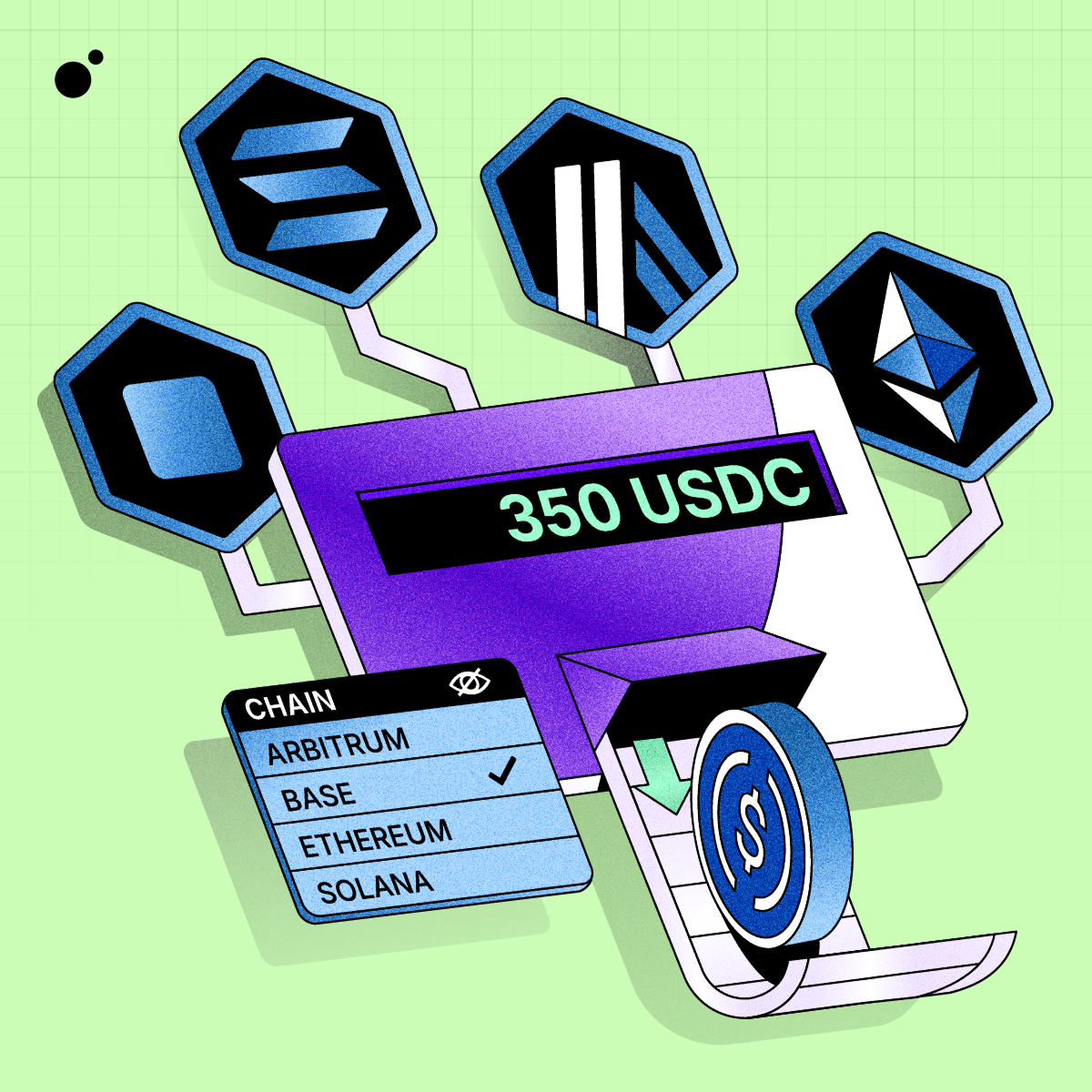
Crypto in 2026 runs across hundreds of networks, and it still expects you to know which one you're standing on at all times. Chain abstraction is the push to end that. You see one balance, you say what you want to do, and software figures out which chains need to be involved. This article covers what chain abstraction is, how it differs from bridges and account abstraction, and how much of it you can already use today.
In short: Chain abstraction hides blockchain networks from the user. Instead of picking chains, bridging assets, and holding a separate gas token for every network, you get one balance and one confirmation. The routing happens backstage.
What is chain abstraction?
Chain abstraction is a design approach that makes individual blockchains invisible to the person using them. Your wallet shows one balance instead of ten. When you buy, send, or swap, the app decides which networks to use and handles any bridging in the background. You approve the outcome and let the software pick the route.
Your phone already works this way. Land in another country and it connects to a local carrier you have never heard of. You didn't pick the carrier and you didn't sign anything new. Your messages still arrive. Roaming is network abstraction for phones. Chain abstraction wants the same deal for blockchains.
One thing worth knowing up front: chain abstraction is not a single product or protocol. It's a family of techniques (unified balances, intents, cross-chain messaging, gas abstraction) that different teams combine in different ways. That's part of why you'll see the term used loosely.
The problem it solves
The multi-chain world crept up on everyone. L2Beat tracks around 110 scaling networks on top of Ethereum alone, and that's before you count separate ecosystems like Solana, Tron, or Stellar. Each network has its own fees and its own gas token. Each keeps its own copy of your assets, too.
For users, that fragmentation shows up in specific, annoying ways:
- Your USDC on one network can't be spent on another without bridging it first.
- Your wallet makes you switch networks manually, and shows the wrong balances until you do.
- Bridging means finding a bridge, approving it, paying it, and waiting. Sometimes half an hour.
- You can hold $500 in stablecoins on a network and still be stuck, because you don't have a few cents of that network's gas token to move them.
- Sending to the wrong network remains one of the most common ways beginners lose funds.
Most of what crypto newcomers name “confusing” is actually this. The coins aren't confusing. The map is.
How chain abstraction works
No two chain abstraction stacks are identical, but most combine four ingredients.
One balance across chains
Instead of showing you ten balances on ten networks, the wallet reads them all and presents one number: what you can spend. Projects like OneBalance and Particle Network's Universal Accounts do this today. They read balances across a dozen or more chains and hand you one figure. Spend from the total, and the system works out which pockets the money actually leaves.
Intents instead of transactions
A normal crypto transaction is a set of driving directions: call this contract, on this chain, with this gas. An intent is a destination: "I want 100 USDC on Base, and I'll pay at most this much for it."
You sign the intent. Professional operators called solvers then compete to fulfill it, often by fronting you the asset on the destination chain and settling up across networks afterward. You get speed and simplicity; the solver takes on the routing headache. ERC-7683, a draft standard from engineers at Uniswap and Across, gives apps a shared format for describing these cross-chain orders, and around 70 protocols have signed on to support it.
Messaging between chains
Blockchains can't read each other. For a solver to get paid, or for chains to trust each other's state, something has to carry proof between them. That's the job of cross-chain messaging layers like Chainlink's CCIP and LayerZero. Ecosystems are also knitting themselves together at the protocol level: Polygon's Agglayer and Optimism's Superchain are wiring their member rollups together so they behave more like one network. This layer is what people mean by "interoperability" - chain abstraction is what it feels like when interoperability works behind the scenes.
Gas without the scavenger hunt
Gas abstraction lets you pay transaction fees in the token you're already sending, or lets the app sponsor fees entirely. Technically this piece comes from account abstraction rather than chain abstraction, but users don't experience them separately. It all lands as the same relief: you never again google "how to get gas token for X."
Chain abstraction vs bridges and network switching
Bridges don't disappear in a chain-abstracted world. They move backstage. The difference is who operates them: you, or software acting on your intent.
Today's manual flow | With chain abstraction |
Pick the right network from a wallet dropdown | No dropdown. The app resolves networks for you |
Find a bridge, approve it, pay, wait | Routing is chosen, executed, and settled for you |
Hold a gas token on every chain you touch | Fees come out of the token you're sending, or are sponsored |
Balances live in separate per-network buckets | One spendable balance |
Wrong-network sends can strand funds | Apps pick the destination network for you |
Network switching gets the same treatment. The dropdown in your wallet exists because the wallet needs to know which chain to talk to. Once the wallet talks to many chains at once and routes intelligently, the dropdown is just noise.
Chain abstraction vs account abstraction
These two get mixed up constantly, partly because both promise "crypto that feels normal." They fix different layers.
Account abstraction upgrades what your account can do. ERC-4337 introduced programmable smart accounts: passkey logins, recovery without seed phrases, batched approvals, sponsored gas. EIP-7702, live since Ethereum's Pectra upgrade in May 2025, lets an existing wallet gain those powers without changing its address. A smart wallet is the product you actually download.
Chain abstraction upgrades how many networks you have to think about. Account abstraction fixes the account. Chain abstraction fixes the map.
Account abstraction | Chain abstraction | |
What it fixes | What one account can do | How many networks you must think about |
Where it lives | Your wallet | The routing layer between chains and apps |
Key standards | ERC-4337, EIP-7702 | Intents (ERC-7683, draft), messaging layers, unified balances |
You notice it as | Passkey login, no seed phrase, gas paid for you | One balance, no bridging, no network dropdown |
They stack. Most chain-abstracted flows lean on smart wallet features to batch and sponsor the steps an intent needs. If you're choosing a wallet today and want the abstracted future early, a smart wallet is the on-ramp to it.
Who's building it
The chain abstraction buzzword peaked in 2024 and cooled off hard. The shipping didn't. A few markers:
- NEAR built chain signatures and intents. One NEAR account can sign transactions for Bitcoin, Ethereum, and other networks it doesn't run on.
- Particle Network launched Universal Accounts, one account and balance across chains. The company reported user numbers up 558% in a single quarter of 2025.
- OneBalance and Arcana sell unified-balance and chain-abstracted account tooling to apps, so developers can hide networks without building the plumbing themselves.
- Wallets went quiet and just did it. Coinbase folded its wallet into the Base App, MetaMask shipped smart accounts, and most major exchange wallets now bridge, swap, and route across networks inside one interface, and most of them managed it without ever once saying "chain abstraction" in public.
That last category matters most. As Particle's own team put it in 2025, "Shipping beats storytelling." The feature is winning even as the term fades.
The catch
Chain abstraction moves complexity; it doesn't delete it. Someone still runs all that machinery, and you're trusting them more, not less, because you've stopped watching the route. It's worth remembering that some of the biggest hacks in crypto history were bridge hacks. Abstraction puts that machinery out of sight, not out of existence.
Convenience also has a price tag. Solvers charge for fronting your assets, and a bundled quote is harder to comparison-shop than a route you assembled yourself. An expert doing it manually can sometimes do it cheaper.
And when a cross-chain flow fails halfway, "where is my money" gets harder to answer, because you never knew where it was travelling in the first place. Good chain-abstracted apps invest heavily in status tracking and recovery for exactly this reason.
What it means for you
You don't need to do anything to benefit from chain abstraction. That's the whole point. Over the next few years, expect the network dropdown to fade from wallets the way "which mail server?" faded from email. The chains will still be there. You'll just spend less of your life thinking about them.
If you want the early version now: choose a smart wallet that supports cross-chain swaps and sponsored gas, favor apps that quote you outcomes instead of routes, and be slightly suspicious of any product that still makes you bridge manually in 2026.
The retirement list
None of this is finished. 2026 is the messy middle, where some apps already hide every network and plenty still make you do everything by hand. But the direction is set. Here are five crypto rituals chain abstraction has put on notice.
The network dropdown (2016-soon)
Your wallet made you declare which chain you were standing on before it would show you your own money. Once a wallet can watch every network at once, the question stops meaning anything. A few wallets have already deleted the menu, and no one has asked for it back.
The bridge tab (2020-already fading)
Find a bridge, approve the bridge, pay the bridge, watch a progress bar, refresh a block explorer. Bridges themselves aren't going anywhere; solvers and messaging layers lean on them constantly. What's retiring is you being the one at the controls.
The gas top-up run (2015-not soon enough)
A proud tradition: buying $4 of a token you do not want, from an app you had to go find, so you could move money you already own. Gas abstraction takes the fee out of whatever you're sending. The fee survives. The errand doesn't.
The wrong-network loss
Crypto's most expensive pop quiz. Guess the destination network wrong and you graduate to the support ticket that opens with "so I think I lost..." When apps pick the destination chain themselves, this entire genre of mistake quietly closes.
The homework before your first $50
Nobody should need a working theory of rollups to buy one token. Of all five, this one is already the most optional, and it depends entirely on where you start. Which brings us to the easiest fix of all.
Start on the right chain from day one
The first place people hit the multi-chain wall is the moment they buy. Purchase a token on the wrong network and your first crypto experience is a bridging tutorial.
MoonPay makes it easy to buy crypto directly on the network where you need it, whether that's ETH on Ethereum, SOL on Solana, or USDC on the network your app expects. Pay with card, bank transfer, Apple Pay, or Google Pay, and you land on the right chain from your first purchase. It's chain abstraction in spirit, applied to the moment it matters most: your entry.
Chain abstraction doesn't change what blockchains do. It changes how much of them you have to look at.


.png?w=3840&q=90)