By now, almost everyone has heard of blockchain technology. This breakthrough has completely revolutionized the way we think about digital transactions, providing a decentralized, secure, and transparent platform for everything from cryptoc
By now, almost everyone has heard of blockchain technology. This breakthrough has completely revolutionized the way we think about digital transactions, providing a decentralized, secure, and transparent platform for everything from cryptocurrencies to smart contracts.
However, most people don't fully understand how blockchain works. At the heart of this technology lies a fundamental component: the blockchain node. Without nodes, transactions wouldn't get processed, and the greater network would be left insecure and unable to communicate.
So what are nodes and why are they so important?
This article explores the concept of blockchain nodes, their various types, importance, and the security challenges they face.
What Is a Blockchain Node?
A blockchain node is a connection point within a blockchain network that receives, stores, verifies, and transmits data. A node ensures the integrity of transactions and blocks by maintaining a copy of the entire blockchain ledger, and is responsible for the network's security, decentralization, and consensus processes.
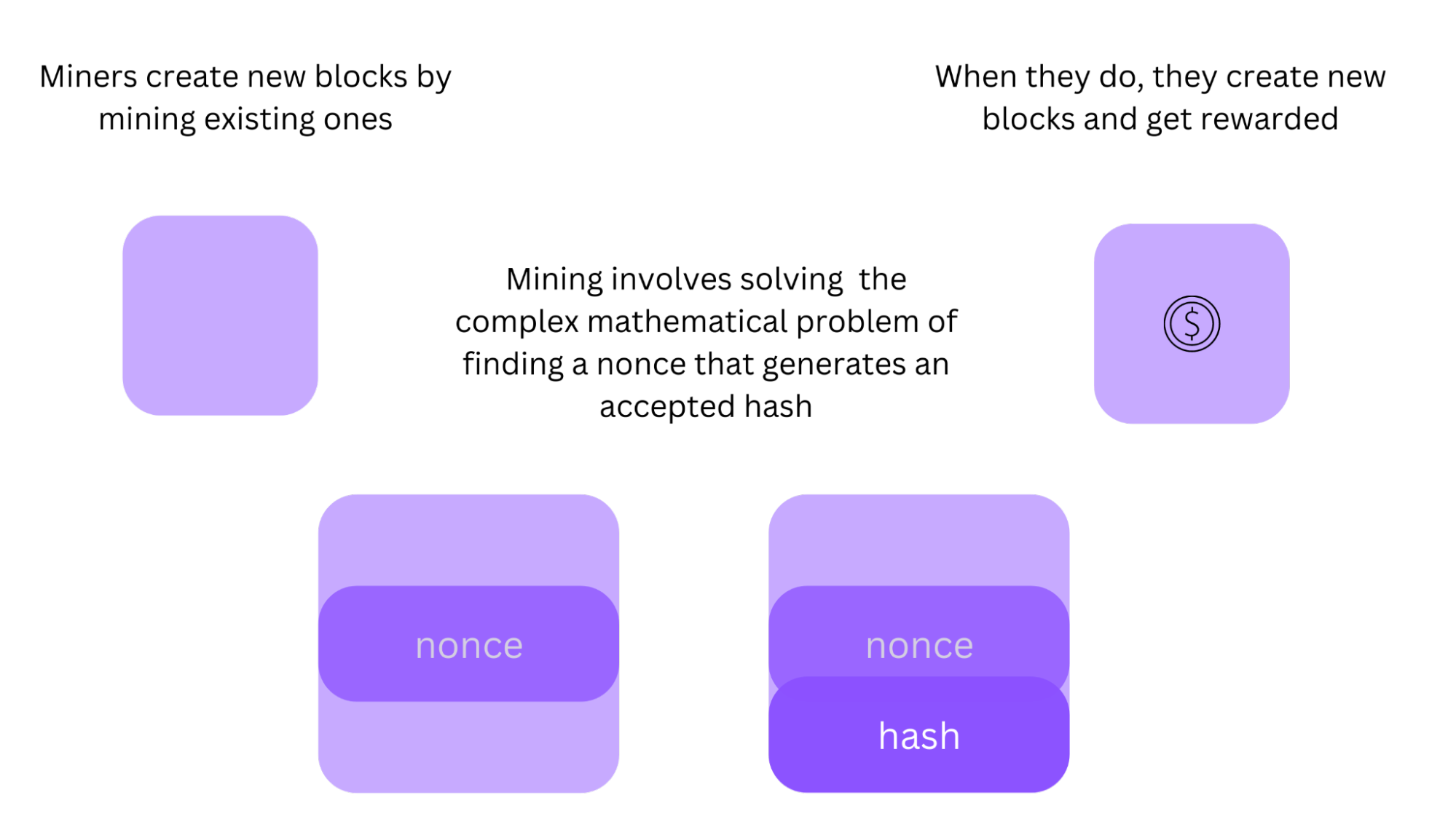
The role of mining nodes
Nodes can come in various forms, with each type serving a specific purpose within a given blockchain ecosystem. For example, while one node validates transactions, another may store data, and some handle the network's consensus mechanism.
How Blockchain Nodes Work
From validating transactions and blocks, to managing consensus and data, blockchain nodes serve specific and diverse functions:
Validating transactions
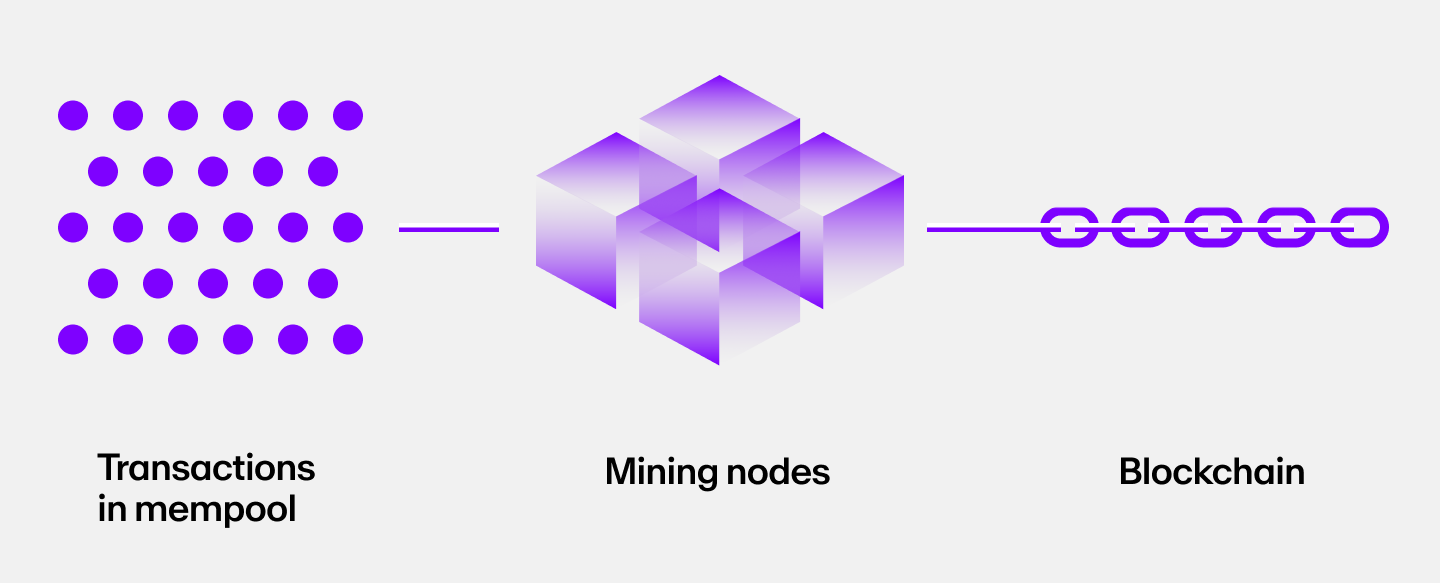
Nodes play a crucial role in validating transactions to increase the integrity and security of a blockchain network. When a transaction is initiated, it is first broadcast to the network and enters the mempool—a temporary storage area for pending blockchain transactions. Nodes then pull transactions from the mempool to validate them.
Transactions in a mempool
Nodes verify each transaction by checking its validity against the blockchain’s rules. This involves confirming that the sender has sufficient funds, that the transaction is correctly formatted, and that it does not involve double-spending. Once a node verifies the transaction, it is marked as valid and remains in the mempool until it is included in a block.
Block verification and propagation
Once a group of transactions is validated and ready for inclusion in the blockchain, they are bundled into a block. Nodes receiving this block verify its validity by checking the accuracy of the transactions within it and ensuring it adheres to the network’s consensus rules.
Once verified, the block is added to the node’s copy of the blockchain and propagated to other nodes. This ensures that all nodes in the network update their blockchain ledgers with the most recent and valid block, maintaining synchronization and consistency across the entire network.
Consensus mechanisms
Consensus mechanisms are protocols that help all nodes agree on the state of the blockchain. Each blockchain network may use different consensus mechanisms, with nodes playing a vital role in these various processes.
PoW and PoS are some of the most well-known consensus mechanisms, however, they are not the only ones. Delegated Proof-of-Stake (DPoS) and Practical Byzantine Fault Tolerance (PBFT) also involve different methods of selecting nodes to achieve consensus.
Data storage and ledger maintenance
Blockchain nodes are also responsible for storing the blockchain's data and maintaining the ledger, which is the historical record of all transactions on the network.
Each node in the network stores a complete or partial copy of the blockchain. As we will see below, full nodes store the entire blockchain, while others, such as light nodes, store only a portion of the data.
Having a more distributed storage space can make the blockchain more resilient to data loss and tampering, as no single point of failure exists. Nodes continuously update their copies of the ledger as new transactions and blocks are added, ensuring that the network remains accurate and up-to-date.
What Are the Different Types of Blockchain Nodes?
Blockchain networks rely on various types of nodes, each serving distinct roles in a network's functionality and security.
The table below summarizes the main types of blockchain nodes, their core functions, and how they support decentralized networks:
Node Type
Main Function
Data Stored
Resources Needed
Example Use
Full Node
Verifies and stores the entire blockchain
Entire ledger
High
Bitcoin, Ethereum
Light Node
Relies on full nodes for data verification
Full nodes
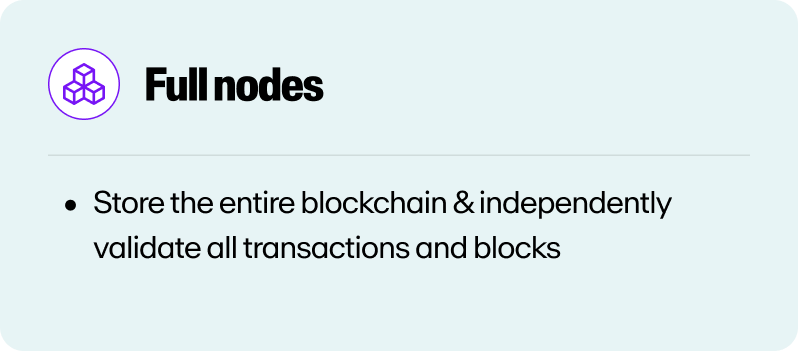
A full node is a device that stores the entire history of the blockchain, from the genesis block to the most recent block. Full nodes are responsible for validating all transactions and blocks independently, without relying on external sources.
Full nodes perform this validation by checking their authenticity against the blockchain's rules. They also validate blocks by ensuring that they contain only valid transactions and that they adhere to the consensus protocol of the network.
For example, Bitcoin full nodes are essential for maintaining the Bitcoin network, as they ensure that all transactions are legitimate and that the blockchain remains tamper-proof. Ethereum full nodes, similarly, validate transactions and smart contracts, ensuring the integrity of the Ethereum network.
Light nodes (Light clients)
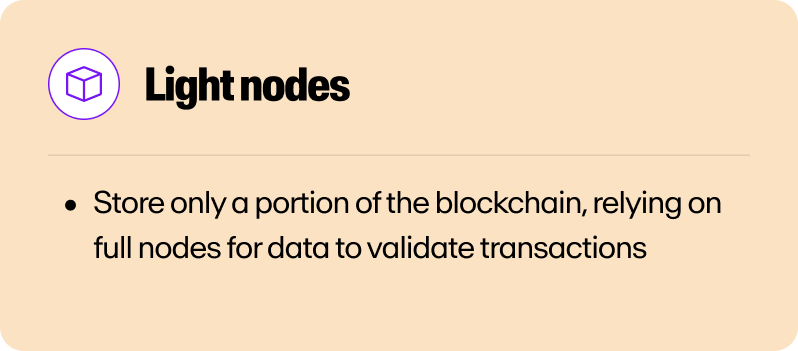
Light nodes, or light clients, are a more resource-efficient alternative to full nodes. Rather than storing the entire blockchain history, light nodes store only a subset of the blockchain, typically just the headers of blocks instead of the full transaction data. This makes them much less resource-intensive and suitable for devices with limited storage space or processing power.
Light nodes cannot operate alone, and rely on full nodes to provide the essential data to validate transactions. When a light node receives a transaction, it requests the relevant transaction history from a full node, which then performs verification on behalf of the light node.
Light nodes are common in mobile devices, wallets, and other applications where full blockchain storage is impractical. They provide the benefits of blockchain node participation without the heavier resource requirements of full nodes.
Master nodes
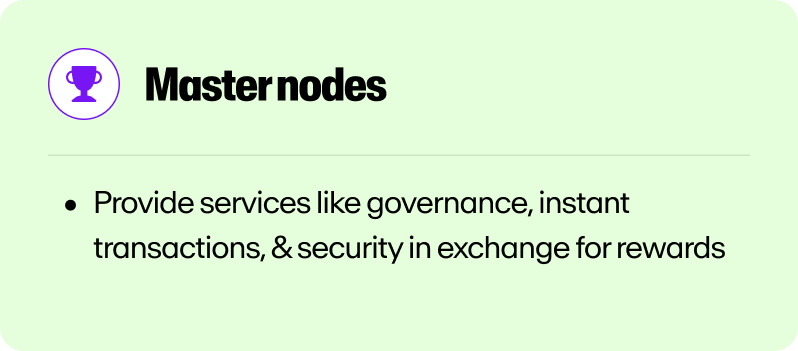
Master nodes (or masternodes) are specialized nodes that offer additional services to the network, often in exchange for rewards. They perform various functions beyond basic transaction validation, such as facilitating instant transactions, participating in governance, and providing additional security features.
More commonly, masternodes are involved in governance processes, where they vote on proposals related to the network's development and policies. They also support instant transactions, enabling faster and more efficient processing compared to regular nodes.
For example, Dash masternodes play a key role in the Dash network's governance and InstantSend feature, allowing for near-instant transactions. Similarly, PIVX masternodes support network governance and privacy features for the privacy-focused blockchain.
Archival nodes
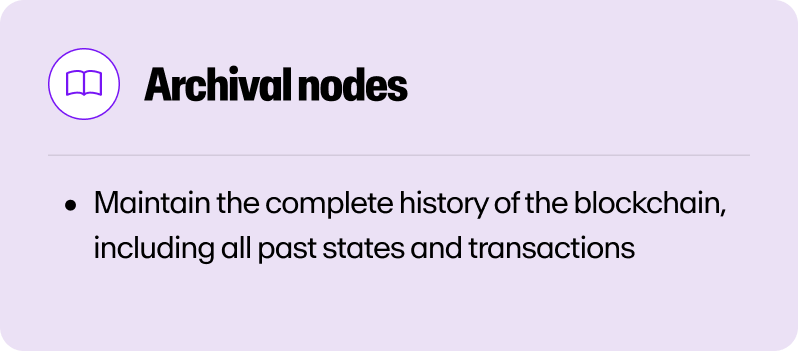
Archival nodes are specialized full nodes that maintain a complete history of the blockchain, including all past states and transactions.
Archival (full) nodes are important for research, auditing, and other applications that require detailed access to a blockchain's transaction history. They ensure that all past data is preserved and accessible, even as the blockchain continues to grow.
For example, in the Ethereum network, archival full nodes store the entire history of the Ethereum blockchain. This includes all smart contracts, transactions, and states, making them indispensable for ETH developers, researchers, and auditors.
Mining nodes
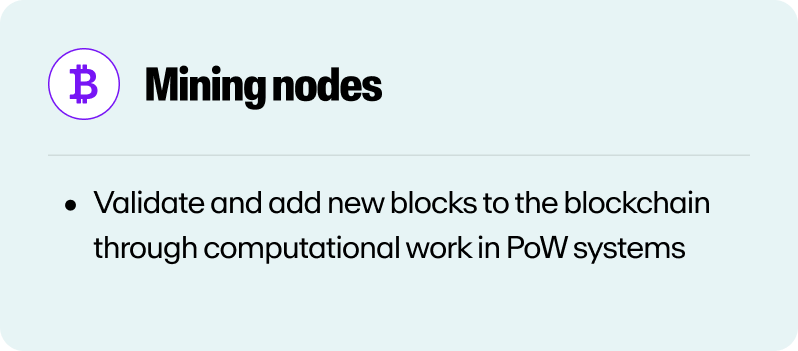
Mining nodes (or miner nodes) are specialized nodes that participate in the Proof-of-Work (PoW) consensus mechanism. They use computational power to compete and solve complex mathematical puzzles, which validates transactions and adds new blocks to the blockchain. In return, miners receive rewards in the form of cryptocurrency.
Through this process, miner nodes also serve the role of securing the network. When they solve these puzzles, they're simultaneously helping to prevent double-spending and ensure that only legitimate transactions are added to the blockchain.
For example, Bitcoin miner nodes are the driving force behind the Bitcoin blockchain. They provide the computational power needed to secure the network and process transactions. Bitcoin miners compete to solve cryptographic puzzles, with the winner adding the next block to the blockchain and earning a reward in Bitcoin (BTC) tokens.
Why Blockchain Nodes Are Important
Blockchain nodes form the backbone of any decentralized network, and their importance extends far beyond simple data processing.
Decentralization and security
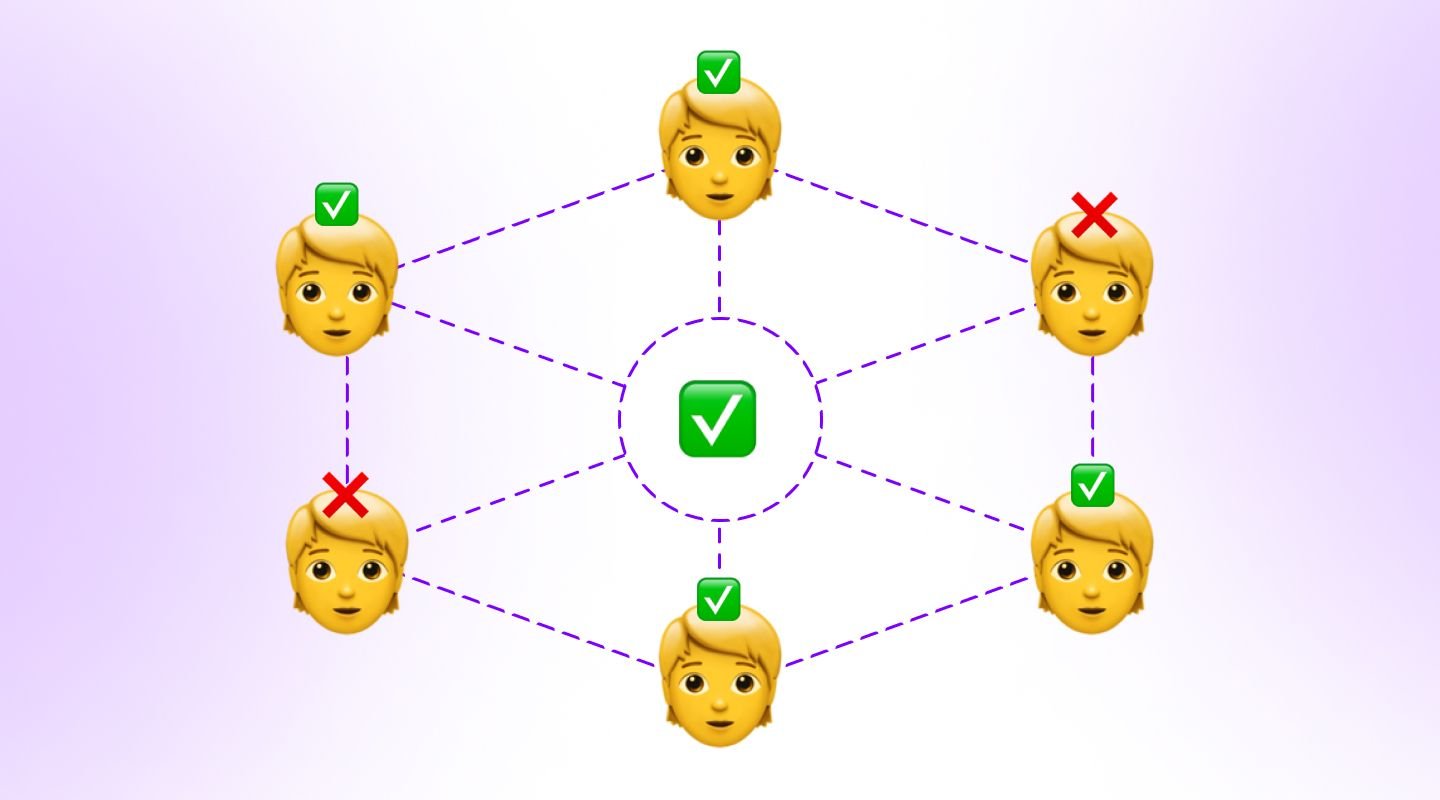
Nodes increase decentralization by distributing the blockchain data and decision-making power across a wide network of participants. This decentralization helps makes the network more resistant to censorship, tampering, and single points of failure.
Transparency and trust
Validating and recording transactions on the blockchain is the way that nodes ensure the entire network operates transparently. Blockchain transparency creates trust among participants, as they can independently verify the accuracy and legitimacy of the blockchain data.
Network reliability and redundancy
Nodes contribute to network reliability by maintaining redundant copies of the blockchain and ensuring that the network can continue operating if some nodes go offline. Redundancy helps make the network more robust and less vulnerable to disruptions, even in the face of failures or attacks.
Community participation and blockchain governance
In many blockchain networks, nodes have the ability to vote on proposals related to network upgrades, policy changes, and other important decisions. A more democratic approach to governance empowers users to have a say in the direction of the network and helps the blockchain evolve in a way that reflects the community's interests.
For instance, in the Dash network, masternodes vote on proposals for network upgrades and development projects. Decred, meanwhile, uses a hybrid consensus model where stakeholders vote on proposals through their nodes. Another example is MakerDAO, a DeFi protocol that allows users to participate in governance where nodes are operated by holders of the MKR token.
Examples of Blockchain Nodes
From Bitcoin (BTC) to Ethereum (ETH), let's explore how nodes operate on common blockchains.
Bitcoin nodes
Bitcoin nodes are fundamental to the operation and security of the Bitcoin network, which relies on a Proof-of-Work (PoW) consensus mechanism.
In a PoW system, specialized nodes known as miners compete to solve complex cryptographic puzzles, validating new blocks and adding them to the blockchain. Once a block is mined, it is propagated across the network, where other Bitcoin nodes verify it before updating their copy of the blockchain.
This decentralized network of nodes and miners functions so that the Bitcoin blockchain operates securely and remains resistant to censorship, fraud, and tampering.
Ethereum nodes
Ethereum nodes are essential to the functionality and security of the Ethereum network, particularly as it transitions from a Proof-of-Work (PoW) to a Proof-of-Stake (PoS) consensus mechanism. These nodes maintain a copy of the Ethereum blockchain, validate transactions, and execute smart contracts and decentralized applications (dApps).
With the new Ethereum 2.0 network, staking nodes stake ETH to participate in consensus. In this process, validators are chosen to propose and validate new blocks based on the amount of cryptocurrency they have staked. This "Merge" has helped enhance the network's scalability and energy efficiency (by up to 99%), while also altering the role of nodes.
Nodes in other blockchains
Different blockchain networks have unique node structures and operations, tailored to their specific consensus mechanisms and use cases. Any blockchain you can think of relies on nodes to secure the network.
For instance, Solana nodes are optimized for speed and high throughput, processing thousands of transactions per second with low transaction fees. Meanwhile, Cardano nodes support a PoS consensus mechanism, with a focus on sustainability and scalability. Binance Smart Chain nodes, on the other hand, maintain the Binance Smart Chain (BSC) blockchain, which is designed for fast and low-cost transactions.
Security and Risks of Blockchain Nodes
While nodes are critical to the security and functionality of a decentralized network, they also face various risks and challenges that can impact the stability and integrity of the system.
Node security
Nodes can be targeted by attacks such as Distributed Denial of Service (DDoS), where attackers overwhelm the node with traffic to disrupt its operation. Nodes can also be compromised by malware, phishing attacks, and other forms of cyberattacks.
To secure a node, operators should implement strong security measures, such as using firewalls, regularly updating software, employing encryption, and monitoring the node for suspicious activity. Additionally, decentralized backup strategies can help mitigate the risk of data loss.
Centralization risks
If a significant portion of nodes is controlled by a single entity or group, it could undermine the decentralization of the network, making it more vulnerable to attacks, censorship, and manipulation. Centralization can also lead to reduced trust and increased risk of collusion among node operators.
To mitigate these risks, blockchain networks should encourage the distribution of nodes across a wide range of participants and geographic locations. Incentivizing individuals and organizations to run nodes can help ensure that no single entity gains excessive control over the network.
Node failure and network impact
What happens when nodes fail?
When a node fails, it can no longer participate in the network, which can lead to delays in transaction processing and block validation. However, because blockchain networks are decentralized, the failure of a single node typically has a minimal impact on the overall network, as other nodes continue to operate and maintain the blockchain.
Remember, redundant copies of the blockchain are stored across many nodes, meaning that the network can remain operational even if some nodes go offline. In cases of widespread node failure, there could be increased network congestion or temporary slowdowns, but the blockchain will continue to function as long as a sufficient number of nodes remain active.
Blockchain Node FAQs
What does a blockchain node do?
A blockchain node validates transactions, stores a copy of the blockchain ledger, and shares verified data with other nodes. This process keeps the network decentralized, secure, and synchronized across all participants.
Can anyone run a blockchain node?
Yes, anyone can theoretically run a node, though hardware requirements vary. Full nodes need more storage and bandwidth, while light nodes can run on smaller devices like laptops or phones.
How do nodes secure the blockchain?
Nodes validate every transaction independently, ensuring no one can alter data or double-spend coins. This collective verification process keeps the blockchain secure.
How do blockchain nodes help secure the network?
Blockchain nodes protect the network by independently validating transactions and blocks, ensuring that no one can alter or falsify the data. This redundancy creates immutability, meaning that even if one node goes offline or is compromised, thousands of others maintain the blockchain’s integrity. In general, the more distributed the nodes are, the stronger and more secure the network becomes.
Are blockchain nodes the same as miners?
Not always. All miners are nodes, but not all nodes are miners. The key difference is that miners validate blocks and earn rewards, while other nodes store and verify data without mining.
How to Get Involved with Blockchain Network Nodes
You don't need to run your own blockchain node to start participating in a blockchain network ecosystem. Even small actions like sending or receiving cryptocurrency help keep nodes active.
MoonPay makes it easy to buy cryptocurrency that can be used in blockchain node consensus like Bitcoin (BTC), Ethereum (ETH), and Solana (SOL). Just enter the amount of crypto you want to purchase, and choose from payment methods like credit/debit cards, PayPal, bank transfer, and Apple Pay.
Block headers only
Low
Mobile wallets
Master Node
Provides extra services like governance or instant transactions