Can Quantum Computers Break Bitcoin? What BIP-360 Changes
Not today, but the clock has started. What quantum computers can and can't do to Bitcoin, which coins are exposed, what BIP-360 and BIP-361 propose, and what to do with your addresses.
What Are Tokenized Stocks? What You Actually Own When You Buy Apple on a Blockchain
Tokenized stocks track real shares on a blockchain, but the token is rarely the share. How the four structures differ on dividends, voting, bankruptcy, and redemption, and who can buy them in 2026.
Why Stablecoins Are Becoming the Internet's Payment Rails
Stablecoins settle in minutes, run around the clock, and cross borders for cents. What payment rails are, why stablecoins qualify, and the honest limits.
Agentic Payments & How AI Agents Actually Pay for Things
Agentic payments let an AI agent buy things without holding your money or seeing your card number. How they work, what agents can buy, and how MoonPay's PayBox does it.
For most of crypto's history, the price of admission was a ritual: write down 12 words, in order, on something that can't catch fire or get wet, and guard them for the rest of your life. Get it right and you're your own bank. Get it wrong o
On behalf of subculture, I apologize. I personally don’t think we’re doing ourselves any favors by being all mystical and snobbish on concepts and technical lingo.
However, it’s also worth highlighting this weirdness because it tells us something about the industry (its customers, personas, and user segments). That is, you can almost tell which user group someone belongs to based on the jargon they use.
Just like how an accent could indicate where someone grew up, using terms like "MRR" or "ARPU" would make you think a person has worked in SaaS (software-as-a-service). Saying things like "MECE" or "PS sessions" or "top-down comms” may be indicative of a consulting background.
MEV - miner extractable value (DeFi / investing / devs)
10k - referring to a project with 10,000 unique NFTs (NFT)
Web3 is quickly becoming a bigger industry with distinct sub-markets. If you’re just starting out here, you should take some time to explore which markets you’d be most interested in. If you’re trying to explain the industry to someone new, I think it’s also helpful to point them to sub-markets or use cases that would be more interesting for them.
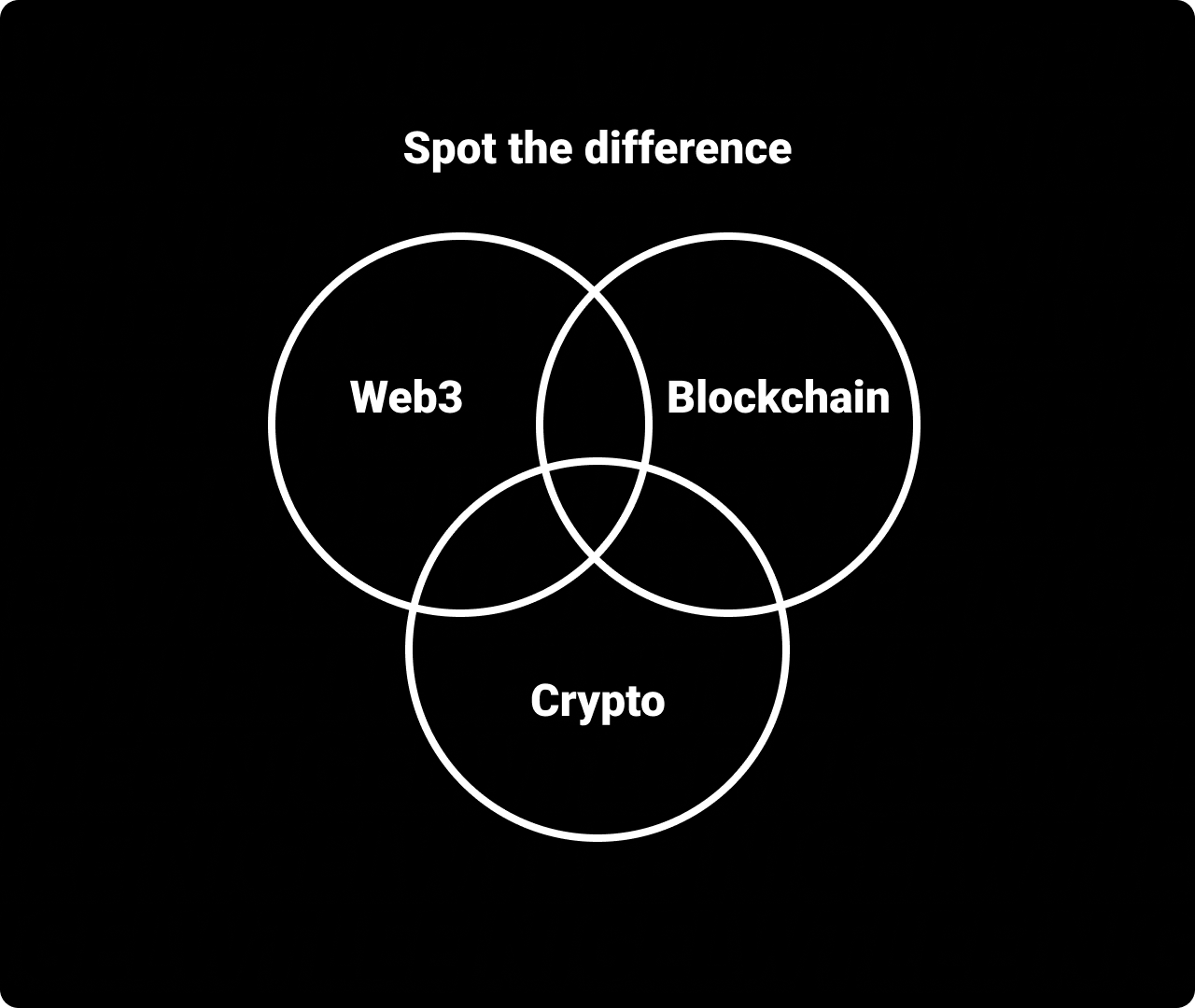
Web3 vs blockchain vs crypto
With the above established, let’s get back to the title of this post. What do you think these three major terms represent?
For me it's the following:
Web3 is a movement
The term implies a Web1 and Web2 that came before it. It’s branding for a new era of the internet. Decentralization, transparency, and self-custody are some of the concepts and core beliefs that come with the use of this term. Accordingly, the users that belong to this group will have these things top of mind as jobs-to-be-done.
Blockchain is tech
Sometimes I find myself surprised that Web3 people don’t even understand the underlying technology of the industry. This is where the "blockchain" people come in. These are likely developers or nerds that geek out over the underlying tech of the industry. Important things to them are security, ease of building, and the support network required to build cool stuff.
Crypto is a business
Finally, this group will care most about APYs (annual returns), token price, and "wen moon" (when will they get rich). They probably couldn’t care less about the innovations in technology or core tenets of Web3. If you want to cater to this group, then your tokenomics game should be pumped.
These aren’t the only user groups in this industry and more subcultures are popping up as the market matures. It’ll be interesting to see how they interact with their Web2 counterparts as Web3 grows larger.
Know the market and then dive in
So who’s your customer? A Web3 person? A blockchain person? Or maybe it's a crypto investor.
If you’re keen to dive into Web3 (or blockchain or crypto), I hope this simple mental model is a helpful first step to get an initial vibe of the market.