







The Complete Guide to Virtual Accounts with MoonPay Enterprise
Virtual accounts give every customer a named USD, EUR or GBP account that converts bank transfers into stablecoins. How MoonPay Enterprise provisions them.

By Team MoonPay
Published on Oct 28, 2026
A customer of yours wants to move $20,000 from her bank into your app and hold it as USDC. Her bank moves money by ACH and wire. Your product holds stablecoins. Something in the middle has to take dollars in, turn them into USDC, and tell your system which customer the money belongs to.
That middle layer is what virtual accounts are for. This guide covers how MoonPay Enterprise provisions them through Pay In, what they cover, who’s building on them, and which parts of the compliance work MoonPay takes on.
A MoonPay virtual account is a set of dedicated bank-transfer details issued in your customer’s name. Fiat sent to those details is screened, converted into a stablecoin, and delivered to a registered wallet. MoonPay runs the banking connections, conversion, onboarding and reconciliation for the services it provides. You get named receiving details inside your product without building the banking infrastructure yourself.
Contents
- What is a virtual account?
- How MoonPay virtual accounts work
- Currencies, rails and settlement assets
- What businesses build with virtual accounts
- Virtual accounts compared with card and wallet onramps
- Compliance, licensing and onboarding
- Where virtual accounts sit in MoonPay Enterprise
- Integration and time to launch
- Frequently asked questions
- Start with one named account
What is a virtual account?
A virtual account is a set of dedicated bank-transfer details tied to one customer. It provides the details needed to receive a transfer on the supported banking rail and carries the customer’s name. When money arrives, MoonPay can identify who it belongs to and route it into conversion.
Three distinctions matter:
- It does not hold a spendable fiat balance.
- It is not a conventional bank account with a card and banking login.
- The receiving details connect bank payments to a configured conversion and settlement flow.
MoonPay calls these Named Accounts. A payment-by-reference account relies on the sender including a reference to identify the customer. A named account gives the customer dedicated receiving details, making incoming payments easier to match.
The money passes through MoonPay’s banking infrastructure, converts into the stablecoin configured for the route, and lands in the registered wallet. Your customer sees transfer details in their name inside your app.
How MoonPay virtual accounts work
Virtual accounts live inside Pay In, one of the four products on the MoonPay Enterprise platform. The flow has four stages.
Create the account
You onboard the customer, register their destination wallet, and use the API to set up the conversion route. That route connects the incoming fiat currency with the stablecoin, blockchain and wallet that will receive the funds.
MoonPay provisions the receiving details as part of this setup. Once the route is approved, you display those details inside your own interface under your own brand.
Accounts can support individuals, businesses or your own entity’s treasury funding. The customer and the relevant payment rail need to be active before the account is ready to use.
The customer sends fiat
Your customer sends a normal bank transfer to the account details shown in your app. Where third-party funding is supported, the account can also receive payments from other people or businesses.
From the sender’s side, it looks like paying another bank account. From your product’s side, it is the start of a stablecoin deposit.
MoonPay screens and converts it
Incoming fiat goes through compliance and eligibility checks, then converts into the stablecoin configured for the route. Pay In supports settlement into USDC, EURC and PYUSD, with available combinations depending on the customer and route.
MoonPay sends the stablecoin to the registered destination wallet. The time from bank transfer to wallet delivery depends on the payment rail, bank processing and any review the payment needs.
You track and reconcile
Transaction events and status changes are available through webhooks and the REST API, with a dashboard for operations. Your system can track the deposit from review through conversion and payout.
The named account connects the incoming payment to the customer. Transaction records then give your team the information needed to reconcile it and update the customer’s view inside your app.
The on-ramp flow
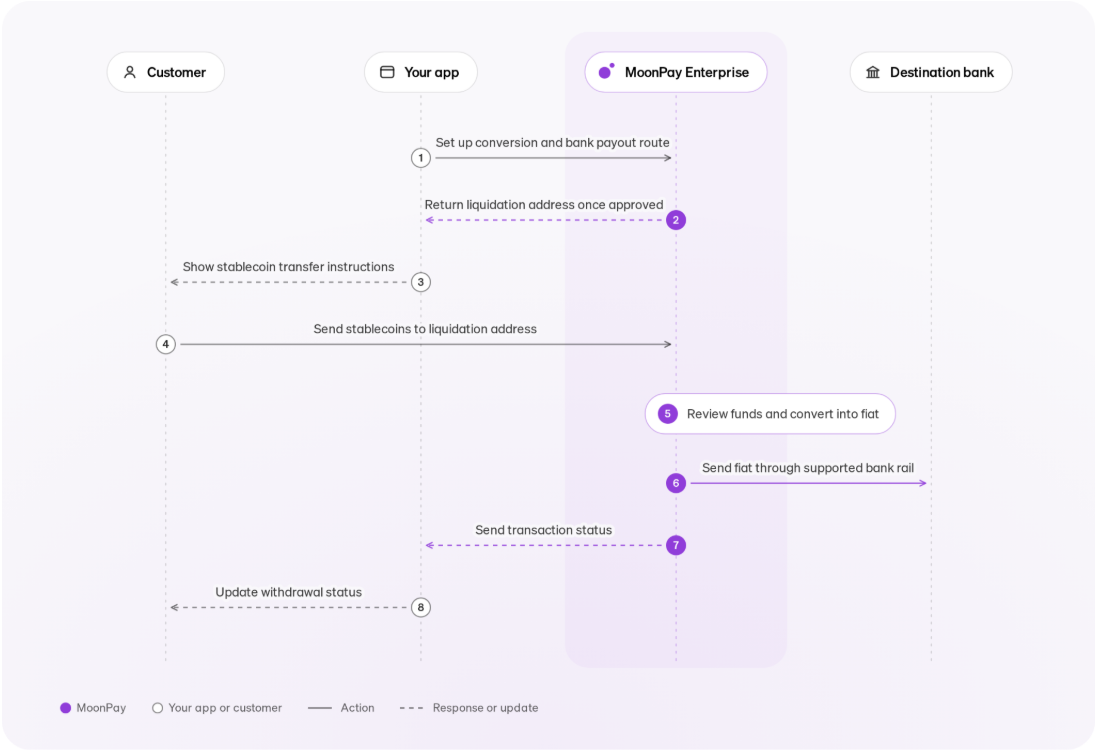
The diagram starts after customer onboarding and wallet registration.
The reverse path, stablecoins back to a bank account, is handled through Pay Out. MoonPay provides a liquidation address for the configured payout route, converts the stablecoins it receives into fiat, and sends the money to the registered bank account.
Many businesses run Pay In and Pay Out together so customers can move in both directions.
The off-ramp flow

The payout route connects the supported stablecoin and blockchain with a registered destination bank account. Wallet and bank-account setup come before the transfer.
Currencies, rails and settlement assets
Availability varies by jurisdiction, customer type, currency and rail. The MoonPay team confirms the combination for your flow during scoping, and the coverage documentation provides the current supported routes.
Fiat currencies
Virtual accounts support USD, EUR, GBP and BRL. Each currency connects to its own banking rails.
Coming soon: Colombian pesos (COP), Argentine pesos (ARS) and Mexican pesos (MXN).
Payment rails
Supported rails include:
- USD: ACH, wire, FedNow and SWIFT
- EUR: SEPA Instant and SEPA Credit
- GBP: Faster Payments and CHAPS
- BRL: PIX
Two rules affect product design. USD rails are available to business customers in the EU and UK, rather than individuals there. GBP rails support first-party payments, meaning the customer funds the account from their own bank.
Third-party funding is available on supported USD and EUR routes, but it is not universal. Some EUR markets also require first-party funding. The country coverage page is where to check a specific market.
Settlement assets and chains
Pay In supports conversion into USDC, EURC and PYUSD. The available asset and blockchain combinations depend on the route.
The wider MoonPay Enterprise platform supports multiple blockchains, including Ethereum, Solana, Base, Arbitrum, Polygon, Tron, Avalanche and Stellar. That wider coverage does not mean every asset is available on every chain or for every virtual account. Your integration uses the supported pairing configured for its conversion route.
Customer types
Virtual accounts can be issued to individuals and businesses, including your own entity for treasury funding. The onboarding path differs: KYC for individuals and KYB for businesses.
Individual spending limits are based on information such as declared income and wealth. Businesses do not have a platform-wide spending cap, though payment-rail requirements and transaction reviews still apply.
What businesses build with virtual accounts
The six core use cases for Pay In:
- Wallet funding
- Exchange deposits
- Merchant collections
- Treasury funding
- Stablecoin issuance
- Platform balances
Most of the businesses asking for virtual accounts want one of the following.
A dollar, euro or pound account for every user
Wallets and fintechs use virtual accounts to give customers transfer details in their own name. The customer can top up from their own bank or, where third-party payments are supported, receive salary and client payments. Incoming funds convert into stablecoins and arrive in their wallet.
Altitude uses MoonPay Virtual Accounts to power the virtual account infrastructure behind its global business operating account. Businesses get access to fiat payment infrastructure directly inside Altitude, connecting bank transfers with the stablecoins they use for treasury and payments. Altitude brings accounts, payments, cards and financial operations together in one platform, with MoonPay providing part of the infrastructure underneath.
Cross-border money movement
A business collecting payments in one currency and paying out in another can use virtual accounts as the collection side of a stablecoin corridor. Money comes in through a supported bank rail, converts into a stablecoin, and funds a payout at the other end through Pay Out.
The collection and payout routes work together, connecting the bank account at one end with the bank account at the other. Available currencies, countries and rails determine which routes your business can offer.
Larger and repeat funding
When a customer wants to fund an exchange account or a business needs to move treasury funds, a bank transfer into a named account provides a reusable route. The customer gets receiving details they can return to for future deposits, with incoming payments linked to their account.
For exchanges and trading platforms, that connects bank deposits to stablecoin funding. For treasury teams, it provides a way to move fiat into the stablecoins they use across their business.
Crypto payments with fiat settlement
The same infrastructure also supports money moving in the other direction: customers pay in crypto, and merchants receive fiat.
Paysafe’s Pay with Crypto brings that flow to U.S. iGaming operators and daily fantasy sports brands. MoonPay Commerce powers the crypto checkout, while MoonPay’s virtual account infrastructure supports settlement in U.S. dollars and other major fiat currencies. Customers can use their crypto, and merchants can receive the currency they run their business on. Operators can also choose stablecoin settlement.
Virtual accounts compared with card and wallet onramps
MoonPay’s consumer ramps let businesses offer payment methods such as cards, Apple Pay and bank transfers. Virtual accounts provide another way to connect customers’ money with your product.
The customer experience is the first difference. A checkout flow guides the customer through a purchase. A virtual account gives them reusable bank-transfer details. Once the account is ready, they can use those details for future funding without starting a new checkout each time.
Transaction size matters too. Cards and bank transfers have different limits and processing requirements. For exchange deposits, repeat funding and treasury flows, a named account provides a direct bank-transfer route into stablecoins.
Pricing depends on the payment method, market and commercial agreement. MoonPay prices Enterprise flows individually, so the economics for your volume come from the sales team.
Speed depends on the rail. Instant payment rails can move bank payments quickly, while ACH and international transfers follow different processing schedules. Bank arrival, conversion and wallet delivery are separate parts of the journey, so an instant bank transfer does not guarantee instant end-to-end settlement.
Returns also differ by payment method. A card purchase can face a chargeback, and a bank transfer can be returned under the rules of its rail. Your product should use MoonPay’s transaction status to track the conversion and payout rather than treating a customer’s bank confirmation as a completed stablecoin deposit.
The two approaches work together. A wallet might offer checkout-based purchases alongside named accounts for customers who prefer bank transfers or fund regularly.
Compliance, licensing and onboarding
MoonPay handles the regulated parts of the flow for the services it provides. Issuing receiving details, reviewing payments and converting money into digital assets all require infrastructure and compliance operations behind the scenes.
Licensing
MoonPay operates through regulated entities across markets including the United States, the UK, the EU and Australia. The relevant entity, permissions and service availability depend on the customer and the activity.
Your integration builds on that infrastructure for the services MoonPay performs. Your own obligations depend on your business model, what you do with funds after settlement and where your customers are. MoonPay’s licensing does not automatically cover every activity your business carries out.
The licenses page provides details of MoonPay’s regulatory registrations and authorizations.
Onboarding
MoonPay Enterprise supports two onboarding models:
- Hosted KYC and KYB, where MoonPay runs a customizable verification flow inside your product.
- Shared KYC and KYB, where you submit customer information you have already collected under an agreed data-sharing arrangement.
Hosted onboarding gives your team a ready-made flow. Shared onboarding connects your existing verification process with MoonPay’s requirements. It needs an agreement, approved verification providers and the required customer consent. Information collected before the agreement may need supplementary verification.
Existing MoonPay verification can help with onboarding, but account activation also depends on the customer’s status, accepted terms and access to the relevant rail.
Compliance operations
After onboarding, MoonPay runs the ongoing work for the flows it operates:
- Sanctions screening
- Wallet screening
- Transaction monitoring
- Due diligence and document collection
- Requests for information
- …and more
Customer status, limits and required actions are available through the API so you can show customers what they need to do inside your own product.
Security
MoonPay publishes its security controls and certifications on its security page.
Within the virtual account flow, receiving details and conversion routes are managed through the API. Incoming funds move through review, conversion and payout, with transaction records available to your operations team.
Where virtual accounts sit in MoonPay Enterprise
MoonPay Enterprise is the stablecoin infrastructure platform built on MoonPay’s acquisition of Iron. You may still see the Iron name on some pages and during identity verification.
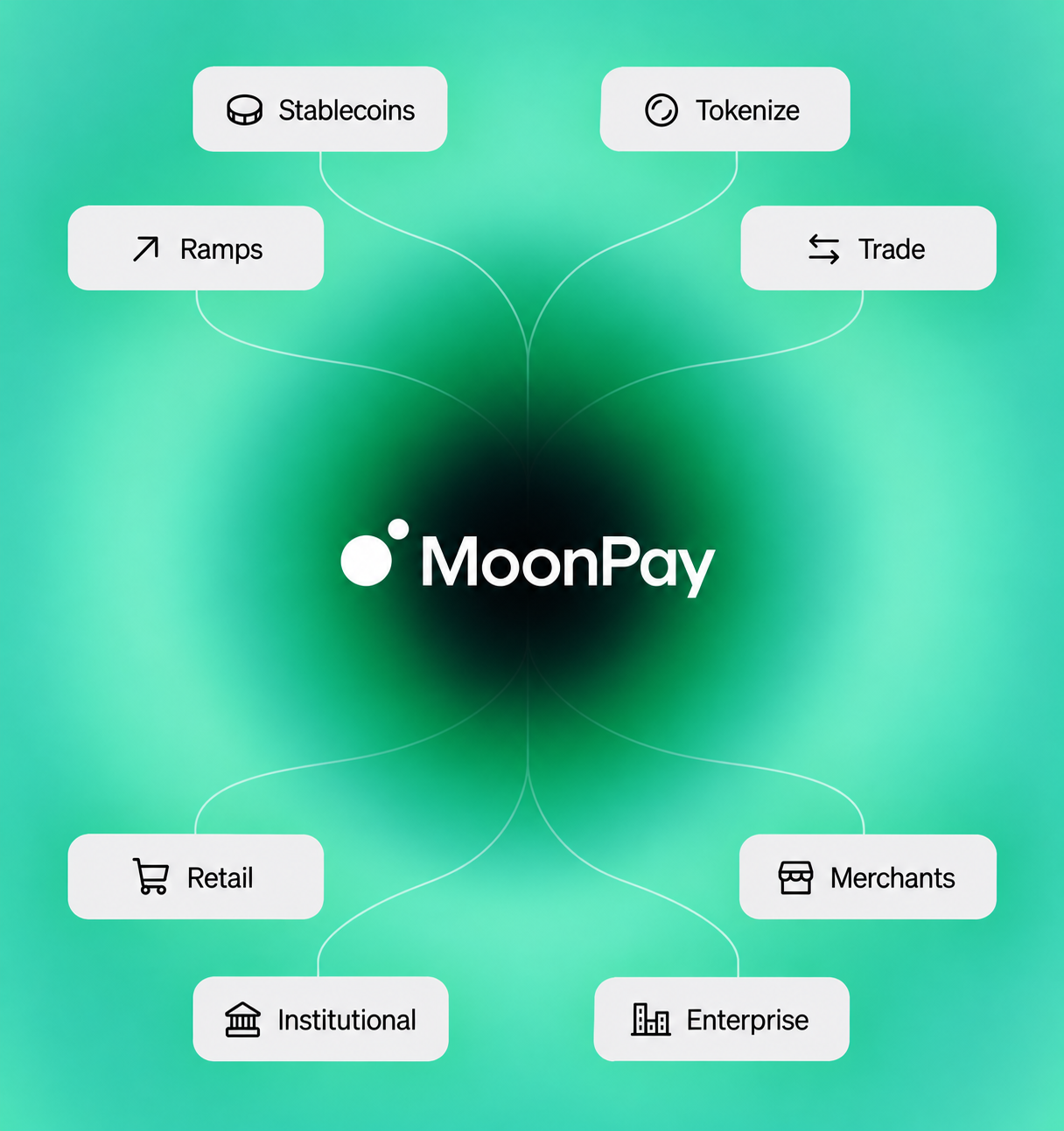
The platform has four products. Virtual accounts belong to Pay In.
Pay In is fiat collection: named accounts, bank transfers over supported rails, and conversion into stablecoins.
Trade provides institutional liquidity, stablecoin trading and FX conversion for treasury and platform needs.
Pay Out handles the reverse flow: receive stablecoins, convert them into fiat, and send funds to bank accounts for uses such as payroll, vendor payments, withdrawals and merchant settlement.
Issue supports businesses launching their own stablecoins, with infrastructure for issuance, minting, redemption and related operations.
You don’t have to adopt all four. A wallet might start with Pay In for deposits and add Pay Out for withdrawals later. A treasury platform might use Pay In, Trade and Pay Out together.
Each flow has its own setup. Pay Out, for example, requires registered destination bank accounts and a configured payout route. Adding another product means connecting that flow to your application and testing it before launch.
Integration and time to launch
Virtual accounts are provisioned through REST APIs, with webhooks for events and a dashboard for operations. Developer documentation, a sandbox and implementation support help your team build and test the flow.
The integration surface for the deposit side is focused:
- Onboard the customer and complete the required terms.
- Register the destination wallet.
- Create the conversion route and wait for approval.
- Display the receiving details in your product.
- Track transaction events and update the customer’s view.
The remaining work is product design: where the account details appear, how you explain them to a customer who has never used a virtual account, and what the customer sees while a transfer is in flight.
Your operations team also needs a way to handle requests for information, rejected transactions and deposits that need investigation. These are part of the customer experience, alongside the successful payment flow.
Time to launch depends on your onboarding model, review process and implementation. The useful starting point is a complete sandbox journey: onboard a customer, create the account, test the deposit flow and confirm that status changes appear correctly in your app.
Frequently asked questions
What is a virtual account in simple terms?
A set of bank-transfer details tied to a customer and connected to a payment flow. With MoonPay, incoming fiat is reviewed, converted into stablecoins and delivered to a registered wallet. The virtual account does not hold a spendable fiat balance.
Is a MoonPay virtual account the same as a bank account?
No. It provides receiving details for supported bank transfers, but it is not a conventional bank account with a card, banking login and a fiat balance to spend. Its role is to connect payments with conversion and settlement.
Which currencies and stablecoins are supported?
Virtual accounts support USD, EUR, GBP and BRL, with COP, ARS and MXN coming soon. Pay In supports settlement into USDC, EURC and PYUSD. Available currencies, rails, assets and blockchains depend on the customer’s location and the configured route.
Do my customers have to complete KYC?
Yes. Individuals complete KYC and businesses complete KYB. You can use hosted onboarding, share verification information under an agreed arrangement, or use a supported reliance model. The customer, required terms and relevant rail must be ready before the account can be used.
Can customers move stablecoins back into their bank account?
Yes, through Pay Out. MoonPay receives supported stablecoins at a liquidation address, converts them into fiat, and sends the funds to a registered bank account through a supported payment rail.
Do I need my own licenses to offer virtual accounts?
MoonPay provides its services through its regulated infrastructure. Whether your business needs separate licenses depends on what it does, how it handles customer funds and where it operates. Your legal team should assess your own activities.
What is Iron, and is it different from MoonPay Enterprise?
Iron is the stablecoin infrastructure company MoonPay acquired. Its technology forms part of MoonPay Enterprise. You may still see the Iron name on some pages and during identity verification.
How long does it take to go live?
The timeline depends on your onboarding model, review process and integration. MoonPay provides the APIs, sandbox and implementation support; your team connects the account details, customer journey and transaction updates inside your product.Where can I learn more about MoonPay’s Terms of Use when using these services?
Visit this page for full terms and conditions that govern MoonPay Rails, Express Checkout, MoonPay Balance, Virtual Account Services, Stablecoin Settlement Services, Iron Services, MoonPay accounts, and other products and services, along with details on third party providers and regional availability.
Get started
Virtual accounts connect the bank transfers your customers already use with the stablecoins your product runs on. MoonPay Enterprise handles the receiving details, conversion and delivery to a registered wallet, while you build the experience inside your app.
Talk to the MoonPay Enterprise team about your use case, confirm the currencies and rails you need, and test the flow in the sandbox. Add Pay Out when you’re ready to let customers move stablecoins back to a bank account.