

Launching MoonPay Enterprise: Stablecoin APIs for developers → Learn More

MoonPay
  • Individuals
  • Business
  • Language
  • Get Started
Buy
Buy cryptoUse a card, Apple Pay or Google Pay to buy crypto fast. We also accept bank transfers and wires.
Buy BitcoinBTC
Buy EthereumETH
Buy PolygonPOL
Buy SolanaSOL
Buy DogecoinDOGE
Buy CardanoADA
Buy AvalancheAVAX
Sell
Sell cryptoTurn your crypto into cash. In a flash. Get paid straight to your bank account or Visa card.
Sell BitcoinBTC
Sell EthereumETH
Sell USDCUSDC
Sell SolanaSOL
Sell CardanoADA
Sell DogecoinDOGE
Sell AvalancheAVAX
Trade
Trade cryptoTrade between tokens, even if they’re on different chains (we make bridging seamless too).
Trade EthereumETH
Trade USDCUSDC
Trade AaveAAVE
Trade ChainlinkLINK
Trade Wrapped BitcoinWBTC
Trade DaiDAI
Trade CompoundCOMP
Company
NewsroomNewsroomMediaMediaCareersCareersChangelogChangelogMoonPay DiscoverMoonPay DiscoverNew
Crypto Prices
Bitcoin PriceEthereum PriceSolana PriceDogecoin PriceCardano PriceXRP PriceBNB PriceAll Crypto Prices
Learn
What is Blockchain?What is Blockchain?What are NFTs?What are NFTs?What is Bitcoin mining?What is Bitcoin mining?What is DeFi?What is DeFi?What is crypto staking?What is crypto staking?All Learn Articles
Support
DocumentationDocumentationHelp CenterHelp CenterContact UsContact UsStatusStatus
  • Language
  • All rights reserved. MoonPay USA LLC is a registered money service business (NMLS ID: 2071245). For Law Enforcement requests please direct your official document to our compliance team here.

    English (Canada)
    • Personal
    • Buy Crypto
    • Sell Crypto
    • Trade Crypto
    • Learn about Crypto
    • Crypto Price
    • MoonAgentsNew!
    • Business
    • Ramps
    • Virtual AccountsNew!
    • MoonPay Discover
    • MoonPay Commerce
    • MoonPay InstitutionalNew!
    • Company
    • About Us
    • CareersWe're hiring
    • Newsroom
    • Media
    • Changelog
    • Support
    • API Docs
    • Help Center
    • Contact Us
    • Status
    • Security
    • Buy
    • Buy Bitcoin
    • Buy Ethereum
    • Buy Solana
    • Buy Cardano
    • Sell
    • Sell Bitcoin
    • Sell Ethereum
    • Sell XRP
    • Sell Solana
    • Trade
    • Trade Ethereum
    • Trade SOL
    • Trade Aave
    • Trade Chainlink
    • Crypto Prices
    • Bitcoin Price
    • Ethereum Price
    • Dogecoin Price
    • XRP Price
    • Cardano Price
    • Learn
    • What is Blockchain?
    • What are NFTs?
    • What is Bitcoin mining?
    • What is DeFi?
    • What is crypto staking?
    • Legal
    • Licenses
    • Privacy Policy
    • Cookie Policy
    • Terms of Use
    English (Canada)

    All rights reserved. MoonPay USA LLC is a registered money service business (NMLS ID: 2071245). For Law Enforcement requests please direct your official document to our compliance team here.

    Back to all articles

    Solana vs Ethereum: What’s the biggest difference between SOL and ETH?

    Over the last decade, many cryptocurrencies have been created in an attempt to counter the dominance of Bitcoin (BTC). Through thousands of altcoin challengers, Ethereum (ETH) and Solana (SOL) have emerged as two prominent contenders in ter

    Corey Barchat

    By Corey Barchat

    Published on Jul 25, 2024

    Last modified on Mar 21, 2025
    cryptocurrencyguidealtcoin
    Solana vs Ethereum
    1. 1.What is Ethereum?
    2. 2.What is Solana?
    3. 3.Ethereum vs Solana: Key differences
    4. 4.Smart contract ecosystem
    5. 5.Developer community, support & partnerships
    6. 6.Security, decentralization, and network stability
    7. 7.Market performance and adoption
    8. 8.Conclusion: Can Solana flip Ethereum?
    9. 9.How to buy Ethereum and Solana
    10. 10.How to sell ETH and SOL

    Over the last decade, many cryptocurrencies have been created in an attempt to counter the dominance of Bitcoin (BTC). Through thousands of altcoin challengers, Ethereum (ETH) and Solana (SOL) have emerged as two prominent contenders in terms of market capitalization and adoption.

    Ethereum, the pioneer of smart contracts and decentralized applications (dApps), has been one of the most revolutionary platforms in the blockchain space. With its robust infrastructure and widespread adoption, Ethereum remains a dominant force, continuously evolving through upgrades like Ethereum 2.0 to address performance and scalability issues.

    Solana, a high-performance blockchain platform designed for dApps, is known for its exceptional transaction speed and low fees. Solana aims to provide a scalable solution without compromising decentralization.

    Both Solana and Ethereum are essential blockchain networks leading the charge in Web3 innovation, each with unique approaches to solving key challenges like scalability, network security, and decentralization. Understanding their differences helps users and developers make informed decisions about which platform suits their needs.

    This article features a comparative analysis of these two blockchain giants, exploring their unique features, strengths, and main differences.

    What is Ethereum?

    Ethereum is a decentralized blockchain platform built for creating and executing smart contracts and decentralized applications. Launched in 2015 by Vitalik Buterin, it introduced the concept of programmable blockchain, allowing developers to build and deploy decentralized applications on its network.

    An image of Ethereum co-founder Vitalik Buterin
    Ethereum founder Vitalik Buterin — Image source

    Ethereum's native cryptocurrency, Ether (ETH), is used to power decentralized protocols and pay for transaction fees on the Ethereum network.

    What is Solana?

    Solana is a high-performance blockchain designed to provide fast, secure, and scalable decentralized applications and cryptocurrencies. Launched in 2020 by Anatoly Yakovenko, Solana uses a unique consensus mechanism called Proof of History (PoH) combined with Proof of Stake (PoS) to achieve high throughput and low latency.

    An image of Solana co-founder Anatoly Yakovenko
    Solana co-founder Anatoly Yakovenko — Image source

    Solana's native token, Solana (SOL) powers the Solana network as one of the fastest blockchain platforms available.

    Ethereum vs Solana: Key differences

    Here are some key differences that separate Solana and Ethereum:

    Feature

    Ethereum

    Solana

    Launch Year

    2015

    2020

    Consensus Mechanism

    PoS (Previously PoW)

    PoH + PoS

    Transaction Speed

    ~30 TPS

    Up to 65,000 TPS

    Transaction Fees

    Higher

    Lower

    Programming Language

    Solidity

    Rust

    Smart Contract Ecosystem

    Yes

    Yes

    Network Stability

    Strong

    Improving

    Centralization Concerns

    Lower

    Higher

    Market Capitalization

    Top 2

    Top 7

    Consensus mechanisms

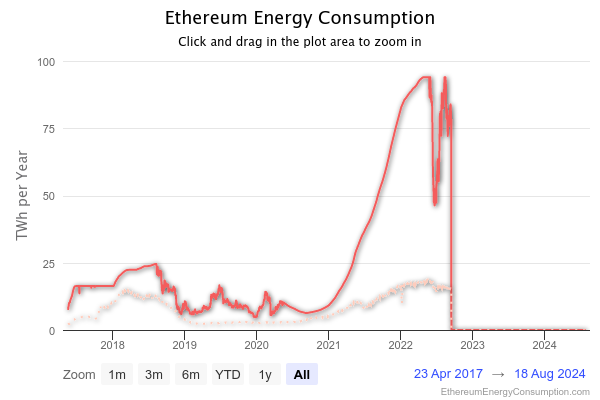
    For most of its existence, Ethereum has relied on a Proof of Work (PoW) consensus mechanism. Although this is a reliable way to validate transactions and secure the network, it often led to long transaction wait times and high gas fees. To address this, Ethereum underwent a transition to Proof of Stake (PoS) via the Ethereum Merge. This shift to Ethereum 2.0 aims to resolve scalability issues, and has already helped to significantly reduce energy consumption.

    A screenshot of Ethereum energy consumption
    The Ethereum Merge significantly reduced Ethereum's energy usage — Image source

    Solana, on the other hand, employs a Proof of History (PoH) mechanism in combination with PoS. PoH timestamps transactions, enabling the Solana blockchain to process transactions in parallel and achieve high throughput, without sacrificing network security. This unique approach allows Solana to validate transactions much faster and more efficiently than traditional PoW systems.

    Transaction speed and scalability

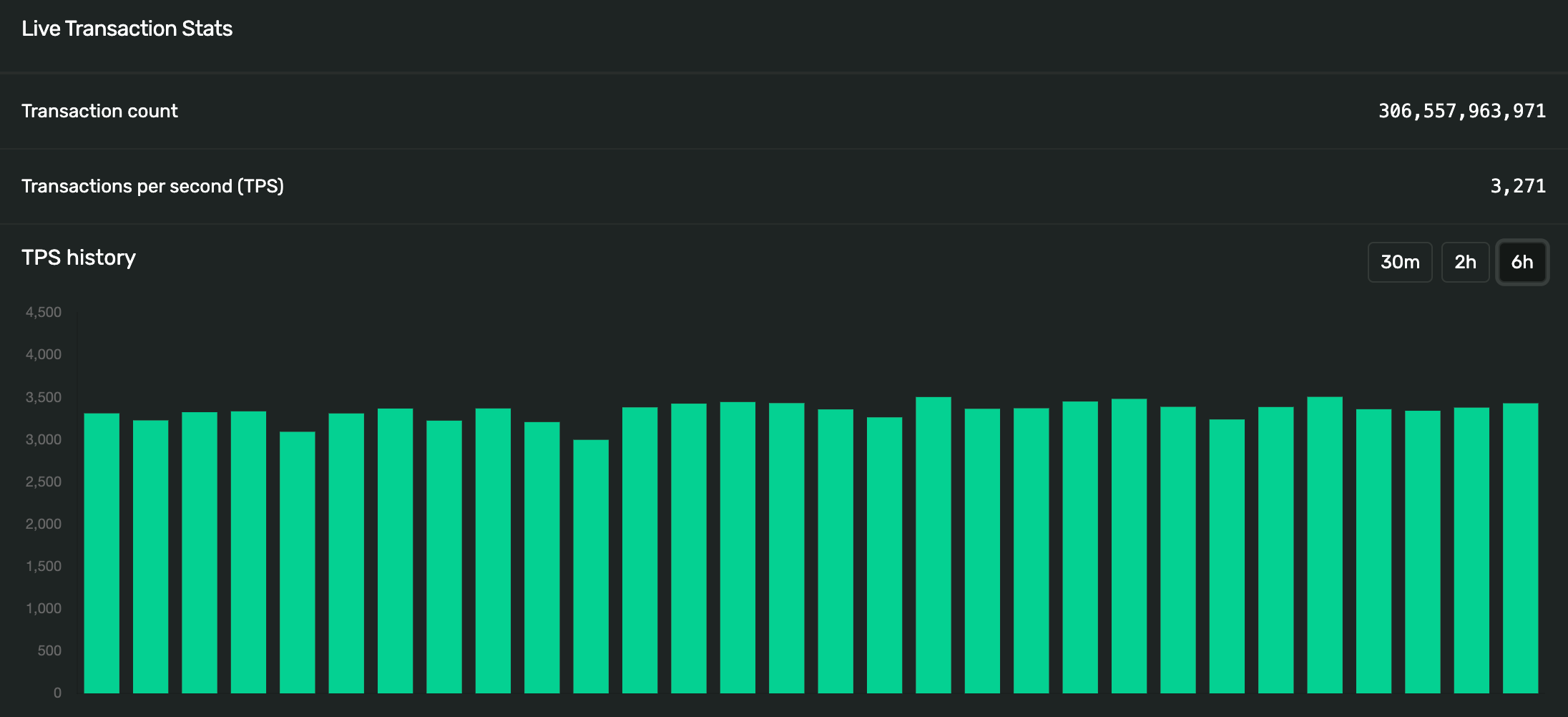
    Solana is designed to handle a high volume of transactions quickly, boasting a potential capacity of up to 65,000 transactions per second (TPS), though the daily average generally hovers around 3,300 TPS. This high speed is facilitated by its PoH consensus mechanism, which orders transactions before they are processed by the network, significantly reducing the time required for validation.

    A graph of real-time transactions per second (TPS) on Solana
    Real-time Solana transactions per second — Image source

    Post-Merge Ethereum can still only process around 30 TPS, which can lead to congestion and slower transaction times during peak usage periods. The full transition to Ethereum 2.0 is expected to help improve this, potentially increasing Ethereum's transaction speed and scalability to keep up with high-performance blockchains like Solana.

    Transaction costs and fees

    Ethereum's transaction costs, often referred to as gas fees, can vary widely and tend to be high, especially during times of network congestion. While these transaction fees are necessary as Ethereum processes and prioritizes transactions on the network, high costs can be a barrier for users and micro-transactions.

    A screenshot of Ethereum gas fees on Etherscan
    Real-time Ethereum gas fees — Image source

    Solana, in contrast, offers extremely low transaction costs, typically a fraction of a cent, making it more cost-effective for both developers and users. This low-cost structure is a significant advantage for applications that require frequent or high-volume transactions, such as DeFi platforms, NFT marketplaces, and gaming applications.

    Programming languages

    Ethereum uses Solidity, a programming language specifically designed for developing and writing smart contracts to be deployed on the Ethereum Virtual Machine (EVM). It has become the standard for smart contract development, with extensive documentation, community support, and a wide range of development tools.

    An image of the Solidity logo over code
    Solidity is the main programming language for Ethereum smart contracts — Image source

    Solana, on the other hand, primarily uses Rust, a general-purpose programming language known for its performance and safety features. While Rust may be more complex, with a steeper learning curve compared to Solidity, it offers robust performance benefits that align with Solana’s high-speed, scalable architecture.

    Smart contract ecosystem

    Both Ethereum and Solana have flourishing ecosystems of decentralized protocols and applications. Here is a comparison of the two:

    Ethereum’s smart contract dominance

    Ethereum has long been the leader in the smart contract space, having pioneered the concept when it launched in 2015. Its smart contract functionality has enabled the development of a vast ecosystem of decentralized applications (dApps), ranging from decentralized finance (DeFi) protocols to non-fungible token (NFT) marketplaces.

    The platform's dominance is further reinforced by the widespread adoption of its ERC-20 and ERC-721 token standards, which have become the de facto norms for creating fungible and non-fungible tokens, respectively.

    Solana’s smart contract capabilities

    Solana, although a newer entrant in the blockchain space, has quickly made a name for itself with its impressive smart contract functionality. Solana's high throughput and low transaction fees provide a fertile ground for developing and deploying scalable decentralized applications, NFT marketplaces, and gaming platforms.

    Its unique Proof of History (PoH) and Proof of Stake (PoS) hybrid consensus mechanism enables fast and cost-effective execution of smart contracts, attracting developers looking for performance and efficiency.

    DeFi on Ethereum

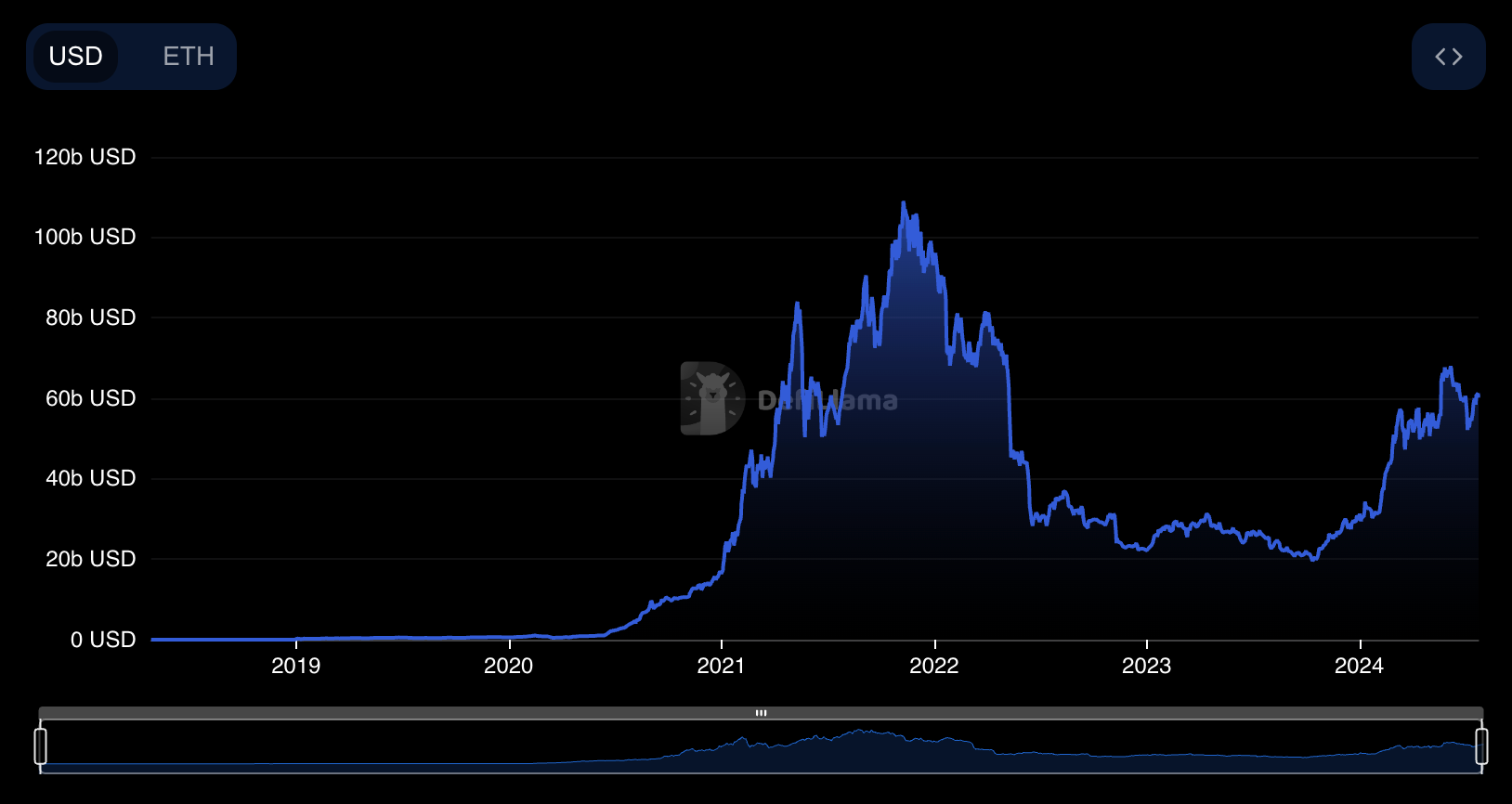
    Ethereum’s robust infrastructure and extensive developer resources have fostered a thriving ecosystem with thousands of dApps and over $60 billion in total value locked (TVL) in DeFi protocols, nearly 11x that of Solana.

    A graph of the Ethereum TVL in DeFi
    Ethereum's TVL over time — Image source

    Some of the most popular decentralized applications on Ethereum include:

    • EigenLayer
    • Aave
    • Maker
    • Uniswap
    • Compound
    • Curve

    DeFi on Solana

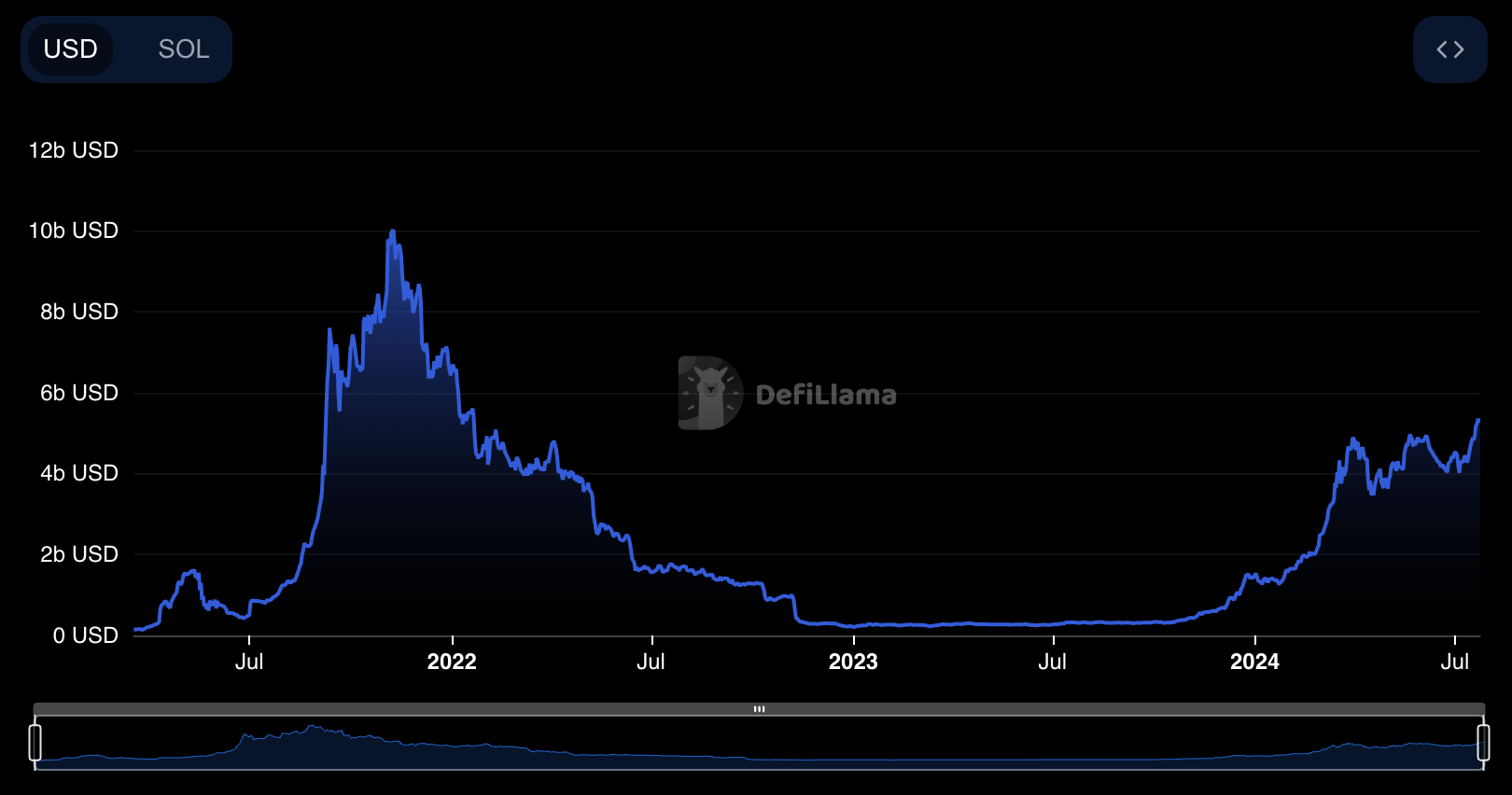
    While Solana's ecosystem is not as extensive as Ethereum’s, it is rapidly expanding with a growing number of DeFi protocols that account for over $5.3 billion in TVL.

    A graph of the Solana TVL in DeFi
    Solana's TVL over time — Image source

    Here a few common dApps that are built on Solana:

    • Raydium
    • Jupiter
    • Solend
    • Orca
    • Marinade
    • Kamino

    NFTs on Ethereum and Solana

    Ethereum is the original platform for NFTs, housing popular marketplaces like OpenSea, LooksRare, and SuperRare. It is also home to some of the most highly traded NFT collections of all time, such as CryptoPunks, Bored Ape Yacht Club, and Pudgy Penguins.

    Although it didn't have quite the same head start as Ethereum, Solana has gained significant traction in the NFT space. Solana offers a more scalable and cost-effective alternative for creators and collectors, who have flocked to Solana NFT marketplaces include Magic Eden, Tensor, and SolSea.

    While some NFT marketplaces are blockchain-specific, there are some that support both SOL and ETH NFTs like OpenSea, Magic Eden, MOOAR, and Rarible.

    Developer community, support & partnerships

    Developer tools and resources

    The Ethereum blockchain has a mature and well-established ecosystem with an extensive range of developer resources and tools. Devs can utilize comprehensive documentation, a variety of development frameworks like Truffle and Hardhat, and testing environments such as Ganache.

    Additionally, Ethereum’s robust community support is bolstered by numerous forums, tutorials, and educational resources, making it accessible for developers of all levels. The Ethereum Foundation and various other organizations actively contribute to the ecosystem, providing grants and funding for innovative projects.

    An image of the Ethereum Foundation logo
    The Ethereum Foundation helps grow the ETH ecosystem — Image source

    The Solana blockchain, meanwhile, is rapidly building its developer ecosystem, offering a growing array of tools and resources designed to support high-performance decentralized application development. The Solana Foundation provides detailed documentation, guides, and a range of developer tools like the Solana Command Line Interface (CLI).

    The Solana ecosystem also supports programming in Rust, C, and C++, catering to developers who prefer these languages for their performance and safety features. Hackathons, grants, and community initiatives further incentivize and support developers in building on Solana.

    Partnerships and collaborations

    Ethereum has established numerous high-profile partnerships and collaborations across various industries. These include partnering with major companies like Microsoft, which integrates Ethereum into its Azure cloud platform, Amazon for its AWS blockchain template, and ConsenSys, a blockchain software technology company that develops infrastructure and applications for Ethereum.

    Solana is also actively forming strategic partnerships and collaborations to expand its ecosystem and increase adoption. Notable partnerships include integration with Visa for payments and stablecoin settlement, as well as collaborations with leading DeFi projects and NFT marketplaces.

    Ecosystem growth and innovation

    The development of the Ethereum ecosystem is heavily influenced by community participation through Ethereum Improvement Proposals (EIPs). This primary mechanism for proposing changes to the Ethereum protocol is transparent and inclusive, allowing anyone to submit an EIP and contribute to the discussion and refinement of proposals. Some of the most notable EIPs include EIP-20, which standardized the ERC-20 token standard, and EIP-1559, which introduced a new fee structure to improve transaction pricing and reduce volatility.

    Solana's ecosystem, while newer, has experienced rapid growth and attracted significant interest from developers and institutions alike. Solana's focus on high throughput and scalability has spurred the development of numerous DeFi projects, NFT platforms, and other decentralized applications seeking a high performance platform. Solana also encourages community participation through its Feature Proposal Program, which allows users to vote on new proposals that are weighted via SPL token validator stake.

    Security, decentralization, and network stability

    Historical incidents and responses

    Ethereum has faced some notable security incidents throughout its brief history. The most famous of these was the DAO hack in 2016, which resulted in the theft of 3.6 million ETH (worth around $50 million at the time). This incident led to a hard fork, splitting the network into Ethereum (ETH) and Ethereum Classic (ETC).

    An image of the DAO logo
    The DAO hack in 2016 led to a hard fork — Image source

    Solana has experienced its share of security challenges, including network outages and congestion issues. For example, in September 2021, Solana’s network went offline for approximately 17 hours due to a surge in transaction volume that overwhelmed the network's capacity. The Solana team responded by collaborating with validators to restart the network and implement upgrades to prevent similar issues in the future, though these outages have still been known to occur in 2024.

    Network stability and downtime

    Ethereum has demonstrated strong network stability with minimal downtime over its nearly 10 years of operation. Its decentralized nature, supported by thousands of nodes distributed globally, helps ensure resilience against failures and attacks. Ethereum’s recent transition to Ethereum 2.0 aims to further enhance network stability by introducing danksharding to reduce the load on the main blockchain.

    Solana, while offering fast transactions with low fees, has faced network stability issues, including outages and periods of high congestion. The network’s architecture and high throughput capabilities can sometimes be a double-edged sword, occasionally leading to instability under extreme loads.

    Solana centralization concerns?

    One of the concerns surrounding Solana is its degree of centralization. Compared to Ethereum, which has a large number of nodes distributed worldwide, Solana validators are much fewer in number. This raises questions about how decentralized Solana truly is. Centralization can pose certain risks, such as potential validator collusion and censorship, increased vulnerability to coordinated attacks, and reduced network resilience.

    However, Solana is taking steps to address these concerns by encouraging more distributed validators to join the network and improving the decentralization of its validator set. Solana applications like Marinade are also pitching in to curb centralization, by creating a staking optimizer platform that encourages users to spread staked SOL amongst many different validators and not just in the hands of a few concentrated nodes.

    Market performance and adoption

    Historical market performance of ETH

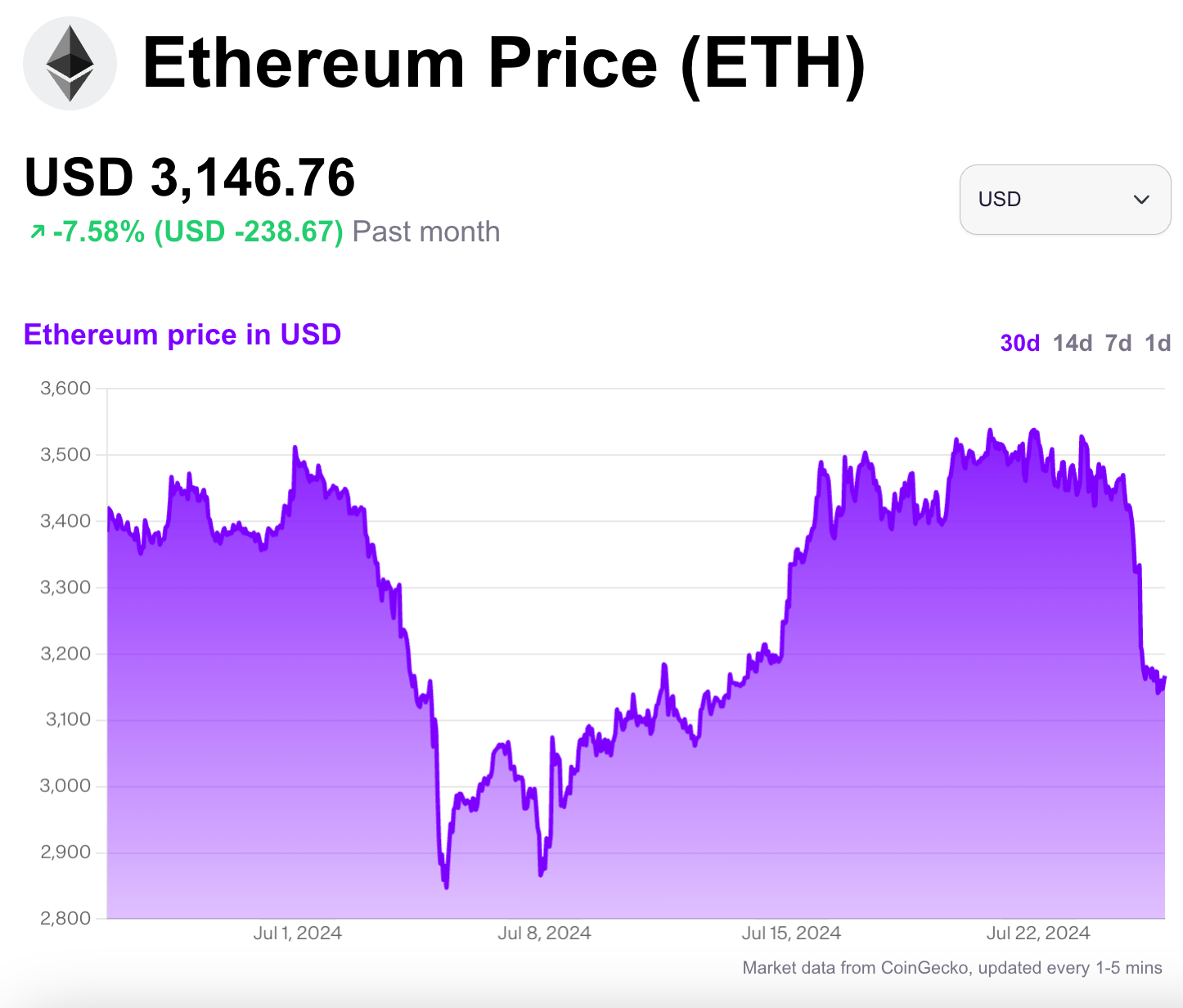
    Ethereum (ETH) has experienced significant growth over the years. Since its launch in 2015 when the Ethereum price was around $0.30 per token, ETH has since reached an all-time high above $4,000 back in 2021. This growth is partially driven by Ethereum’s pioneering role in enabling smart contracts and decentralized applications (dApps), as well as its central position in the growing fields of decentralized finance (DeFi) and non-fungible tokens (NFTs).

    A chart of the live Ethereum price
    The price of Ethereum — Image source

    Ethereum’s market capitalization, consistently ranking second only to Bitcoin, underscores its significance and widespread adoption in the crypto space.

    Historical market performance of SOL

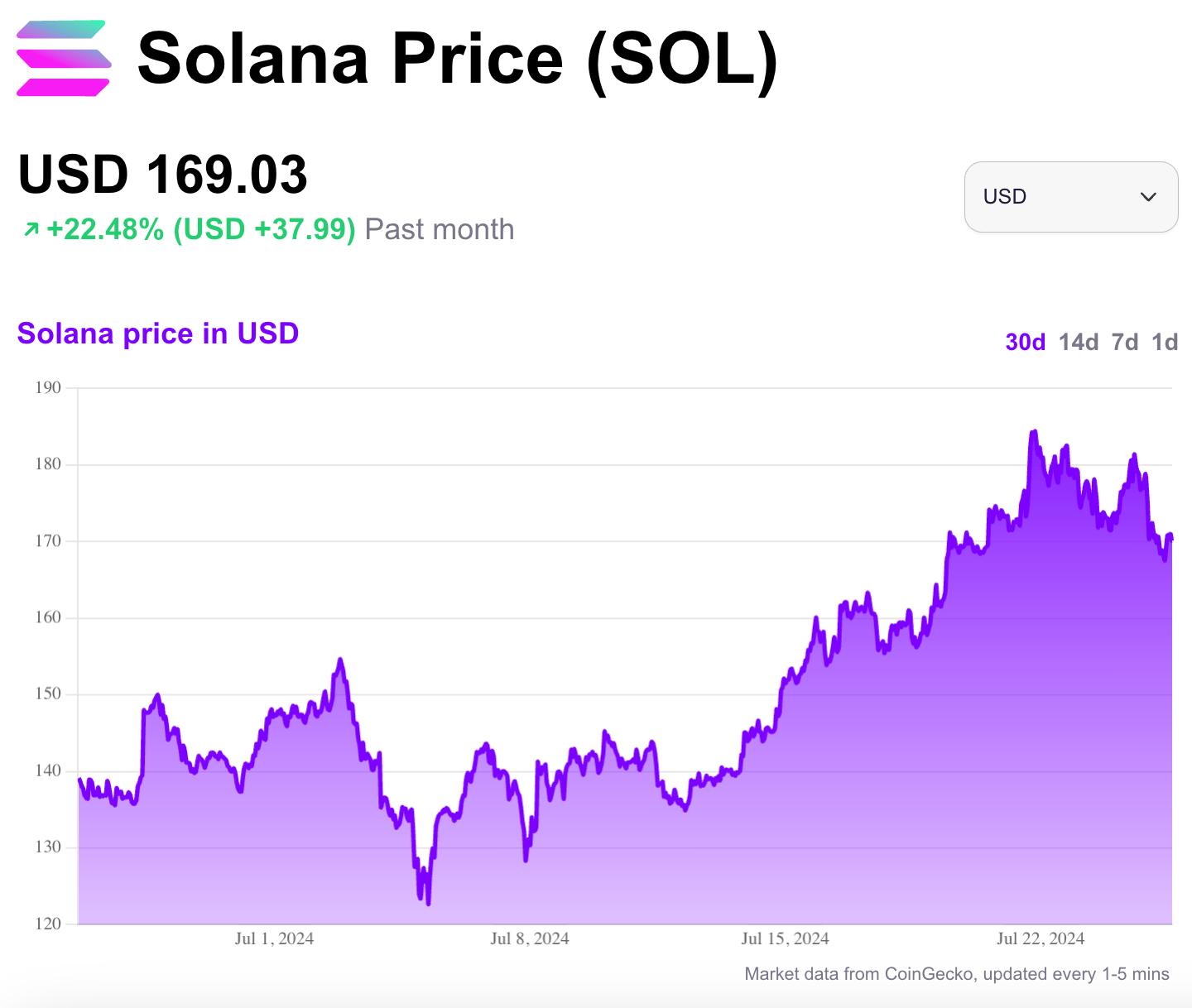
    Starting at less than a dollar in 2020, the Solana price has experienced rapid appreciation, peaking at over $200 in 2021. This rise can be attributed to Solana’s high transaction speeds, low costs, an increasing adoption within the DeFi and NFT sectors.

    A chart of the live Solana price
    The price of Solana — Image source

    Although newer than Ethereum, Solana’s ability to handle a high volume of transactions efficiently has positioned it as a strong competitor in the blockchain industry. Its market capitalization has generally fluctuated between the top 5 and 10 of all cryptocurrencies, reflecting the potential of its technology in the crypto community.

    User and institutional adoption

    Ethereum’s established presence and extensive ecosystem make it a popular choice for retail and institutional investors seeking additional exposure to blockchain technology and cryptocurrency besides just Bitcoin.

    Following the successful launch of Spot Bitcoin ETFs, Ethereum ETFs have recently gained traction, providing investors with a regulated way to gain exposure to ETH without directly holding the cryptocurrency. Several Ethereum ETFs have been launched in various jurisdictions, including the United States. This potentially reflects and increasing regulatory acceptance and demand for such investment vehicles, though some initial reports say the demand hasn't been quite as high as that of Bitcoin.

    An image of the U.S. Securities and Exchange Commission logo
    The SEC recently approved Ethereum ETFs for trading — Image source

    Solana is also attracting attention from institutional and retail investors due to its high performance and scalability. However, given its history with outages and centralization, Solana’s adoption ultimately depends on its ability to balance large-scale applications with transaction fees and speeds that are acceptable to users.

    Although approval by regulatory bodies is not guaranteed, the potential for Solana ETFs is becoming more plausible. ETFs for SOL would provide investors with a more accessible way to invest in Solana, similar to existing Bitcoin and Ethereum ETFs.

    Conclusion: Can Solana flip Ethereum?

    The question of whether Solana can surpass Ethereum is a frequent topic of debate. While Solana offers impressive speed and lower fees, Ethereum's established ecosystem, proven upgrades, and extensive developer community provide strong competition to any potential Ethereum killer. The long-term performance of both platforms will depend on how well each one addresses their respective challenges while continuing to innovate.

    Although no one can predict the future, here are some key metrics that provide a current snapshot of Solana vs Ethereum:

    Market capitalization

    • Solana: $83+ billion
    • Ethereum: $415+ billion

    Daily active users

    • Solana: 1.8 million
    • Ethereum: 416,000

    Daily transactions

    • Solana: 45 million
    • Ethereum: 1.1 million

    Monthly addresses

    • Solana: 31.7 million
    • Ethereum: 9.6 million

    How to buy Ethereum and Solana

    Now that you know what separates Solana and Ethereum, you can explore the vast ecosystems of both cryptocurrencies for yourself.

    You can buy Ethereum (ETH) and Solana (SOL) via MoonPay with a credit card, bank transfer, Apple Pay, Google Pay, and many other payment methods. Send your newly purchased crypto directly to your preferred Solana or Ethereum wallet, like Ledger, MetaMask, Phantom, Trust Wallet, Exodus, and more. Just enter the amount of ETH or SOL you wish to purchase and follow the steps to complete your order.

    Users can also top up in euros, pounds, or dollars and use MoonPay Balance to buy cryptocurrencies like ETH and SOL. Once funded, use your balance for faster, cheaper transactions and higher approval rates. When you're ready to withdraw, enjoy zero-fee transfers straight to your bank account.

    How to sell ETH and SOL

    MoonPay also makes it easy to sell Ethereum and Solana when you decide it's time to cash out your crypto.

    Simply enter the amount of SOL or ETH to sell in the MoonPay widget and enter the details where you want to receive your funds.

    You might also like

    guide+2
    embedded wallets end of seed phrases

    Embedded Wallets and The End of Seed Phrases

    For most of crypto's history, the price of admission was a ritual: write down 12 words, in order, on something that can't catch fire or get wet, and guard them for the rest of your life. Get it right and you're your own bank. Get it wrong o

    cryptocurrency+2
    Accepting Crypto Payments

    How to Accept Crypto Payments: Checkout, Settlement & Merchant Setup

    A customer just bought a $100 hoodie from your online store and paid in crypto. Quick question: where is that $100 right now?

    cryptocurrency+2
    chain abstraction explained

    Chain Abstraction Is the Next Step After Bridges and Network Switching

    Somewhere in your wallet right now there is probably money you can't easily spend. Not lost, not stolen. Just on the wrong network. USDC on Arbitrum when the app you want takes USDC on Base. ETH on mainnet when the game you're playing lives

    bitcoin+2
    crypto in prediction markets

    How Prediction Markets Work (and Where Crypto Fits In)

    A prediction market is a place where people put money on what happens next. Will the Fed cut rates in September? Will Bitcoin close the year above $150,000? Each question becomes a contract you can buy and sell, and the price of that contra

    cryptocurrency+2
    What is an MPC wallet? Benefits, Tradeoffs & Use Cases

    What is an MPC wallet? Benefits, Tradeoffs & Use Cases

    An MPC wallet is a crypto wallet that never stores your private key in one piece. The key is split into encrypted shares held in different places, and signing a transaction combines those shares without ever rebuilding the whole key. That d

    security+2
    Wallet as a Service (WaaS)

    What Builders Need to Know About Wallet as a Service (WaaS)

    You want to add a crypto wallet to your product. You start researching and hit three terms that all overlap: white-label wallets, embedded wallets, and wallet as a service. Marketing pages from infrastructure providers blur the lines. Most