







Proof of Work
Proof of Work is a method to validate blockchain transactions. It’s one example of a consensus mechanism: a system of predefined rules that, by achieving consensus, guarantees the legitimacy of blockchain transactions.

By Geoffrey Lyons
Published on Oct 18, 2024
Last modified on Feb 26, 2026
Proof of Work is a method to validate blockchain transactions. It’s one example of a consensus mechanism: a system of predefined rules that, by achieving consensus, guarantees the legitimacy of blockchain transactions.
There are many real-life examples of consensus mechanisms. Town halls, for example, rely on procedure manuals that specify rules for conducting meetings and taking votes. Academia uses peer review: a process in which papers are scrutinized by multiple experts before they’re published. These are different mechanisms (systems) for achieving consensus (agreement).
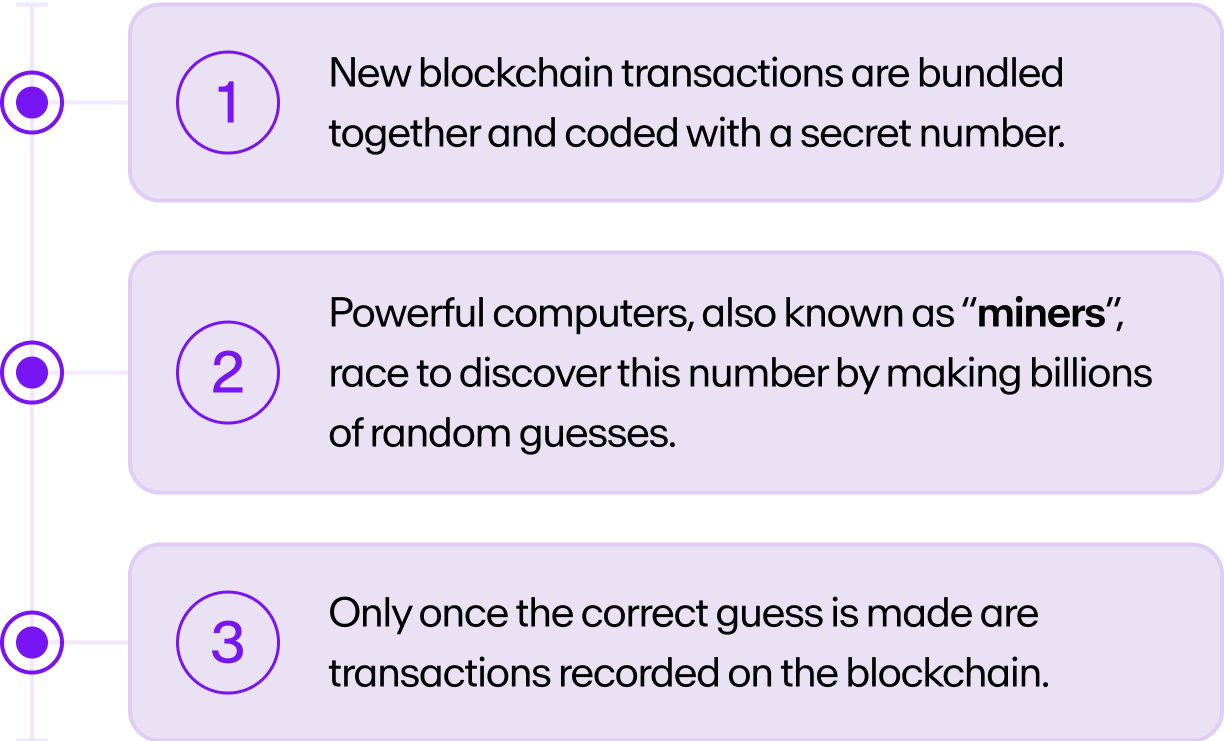
With Proof of Work, the mechanism for achieving consensus may seem peculiar: people race to solve complex math puzzles using powerful computers. When the puzzles are solved, consensus is achieved.
Sign up to our weekly MoonPay Minute newsletter
Peering under the hood
How can solving complex math puzzles work as a consensus mechanism?
It’s important to remember that most blockchains are entirely decentralized–nobody is in charge. Without a central entity running the show, there must be a system in place to prevent illegitimate activity such as double spending (when the same cryptocurrency token is spent more than once).