







Back to all articles

CEX vs DEX: A Guide to Centralized and Decentralized Exchanges
Perhaps the most basic way to engage in Web3 is to buy or exchange crypto tokens.
By Mrig P
Published on Aug 29, 2025
Last modified on Aug 29, 2025
Perhaps the most basic way to engage in Web3 is to buy or exchange crypto tokens.
By Mrig P
Published on Aug 29, 2025
Last modified on Aug 29, 2025
Perhaps the most basic way to engage in Web3 is to buy or exchange crypto tokens.
To do this, a user must go to a crypto exchange, which comes in one of two forms: a centralized exchange (CEX) or a decentralized exchange (DEX).
Although both CEXs and DEXs allow users to exchange cryptocurrencies, they differ largely in how they work. Anyone looking to trade crypto must know these differences.
In this article, we review the major differences between CEXs and DEXs so you can make an informed decision about where to make your next crypto trade.
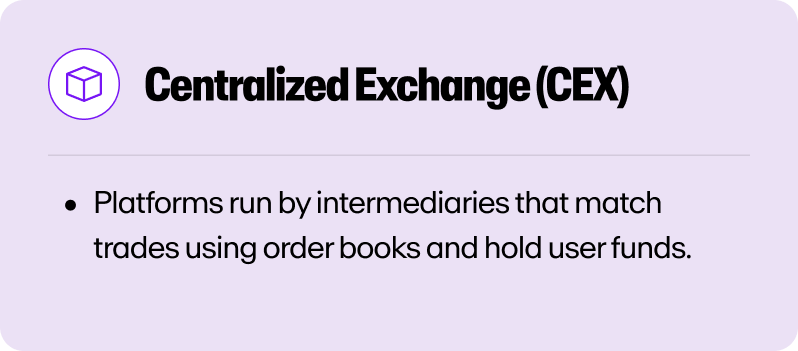
Centralized exchanges (CEXs) are cryptocurrency exchanges that monitor and facilitate crypto asset trading between users with the help of a centralized intermediary. Like traditional electronic stock exchanges, CEXs use an order book system to display and match buy and sell orders from users.
CEXs also often act as crypto on-ramps and off-ramps as many allow users to fund their accounts with fiat currency or liquidate their crypto assets back to fiat.
Centralized exchanges operate like traditional online trading platforms. When you create an account and deposit funds, the exchange holds your crypto or fiat in a custodial wallet. Trades are executed using an order book system, where buy and sell orders are matched off-chain by the exchange’s internal matching engine.
This system allows CEXs to process thousands (or even millions) of transactions per second, offering users fast execution and a familiar interface. However, it also means users must trust the exchange to safeguard their assets and private keys, comply with regulations, and remain solvent.

To start trading on centralized exchanges, you may need to first get KYC verified, which requires you to upload information such as a photo of your government ID, address proof, and signature.
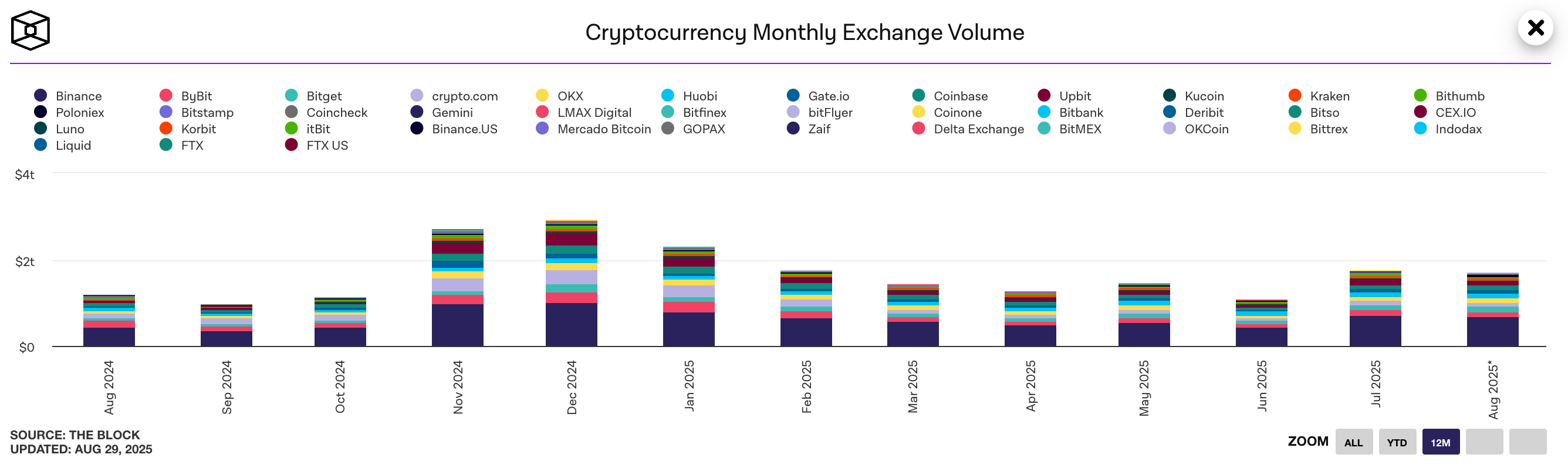
Some notable centralized exchanges include:
Decentralized exchanges are crypto exchanges where users can swap one crypto token for another in a decentralized and non-custodial manner without centralized intermediaries. DEXs are also permissionless, meaning anyone can use a DEX without revealing their private information.
All you need to log into a DEX is a non-custodial crypto wallet.
Unlike CEXs, decentralized exchanges do not require user accounts or custodial wallets. Instead, you connect your non-custodial wallet (like MetaMask or Ledger) and interact with smart contracts directly on the blockchain.
Initially, DEXs used on-chain order books, but this required every node of a blockchain to record a trade order before the order could get completed. As one might guess, this made the process unbearably slow.

The solution? Automated market maker (AMM) decentralized exchanges.
Automated Market Makers (AMMs) are a system that replaces order books with liquidity pools funded by users.
Here’s how it works:
AMMs made decentralized trading scalable and user-friendly, however, they introduce new risks like impermanent loss for liquidity providers.
To learn more about how DEXs work, read our article What is a decentralized exchange (DEX)?
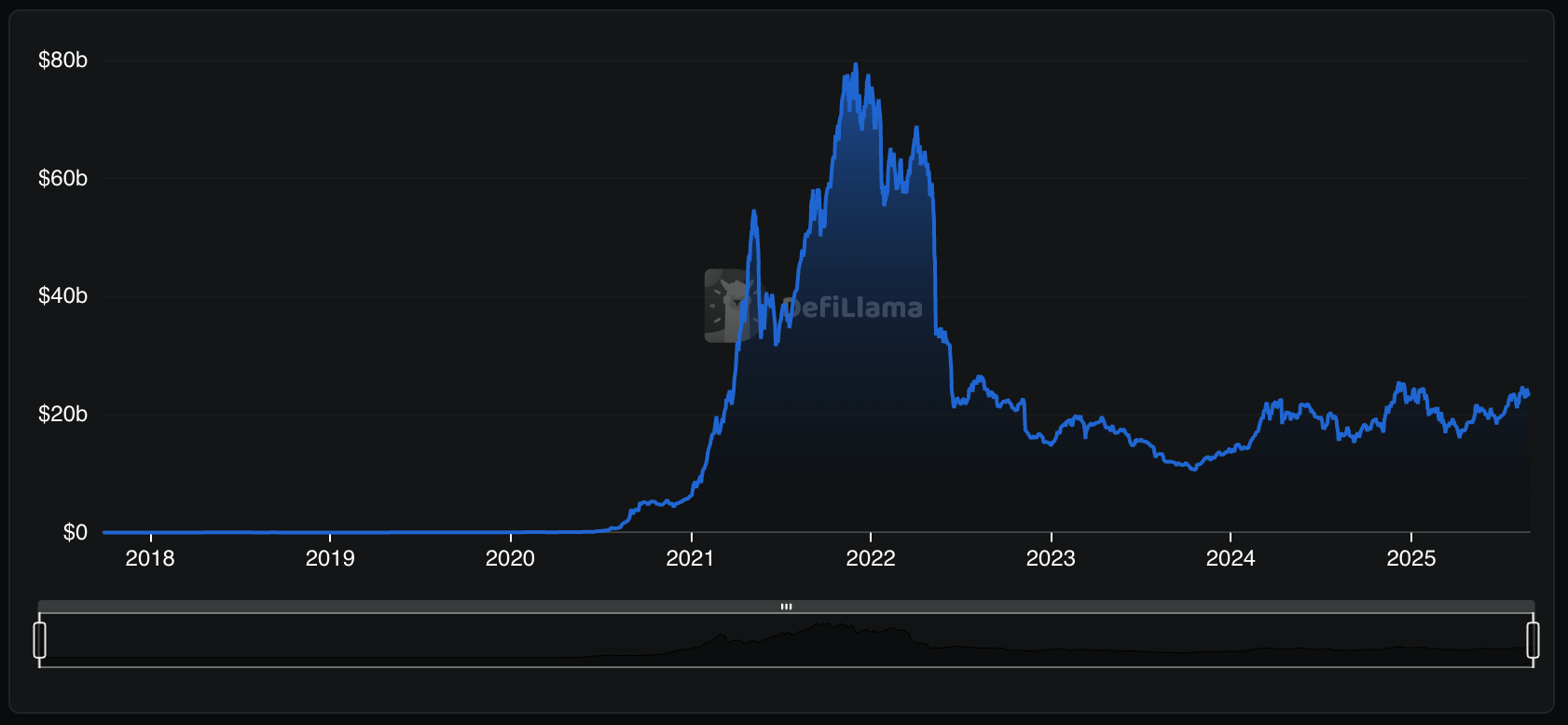
Some popular decentralized exchanges include:
Centralized exchanges remain the most popular choice for beginners and experienced traders alike, offering several advantages that make trading faster and more accessible:
Owing to their UI resemblance with Web2 platforms and their integration with traditional finance, a vast majority of crypto users prefer to trade on CEXs vs DEXs. This brings larger trade volume and higher liquidity to CEXs.
CEXs act as on-ramps and off-ramps, meaning users can easily convert fiat into crypto and vice versa.
CEXs can process transactions more quickly than their decentralized counterparts as they use off-chain matching systems designed to handle a large volume of transactions.
The user interface on a CEX is similar to traditional stock trading platforms, so they can be easier to navigate. Further, the exchange handles the transaction on the user’s behalf, which usually makes the process less complicated, especially for beginners.
With centralized exchanges, users may also get more options for trading and investment, like spot trading, options, futures, leverages, etc.
Despite their convenience, CEXs come with notable downsides that users should carefully consider before relying on them for all their trading activity.
Users must complete a mandatory identity verification process such as KYC to use a CEX. This requires users to share private information, which some may consider to be a barrier to entry.
In the case of CEXs, you do not own your private keys–the platform does. CEXs can suspend trading activities and prevent you from accessing your funds.
CEXs maintain wallets controlled by a centralized organization to store users’ funds. In the event of a wallet hack, you may lose your funds despite having enabled all security measures.
Decentralized exchanges are gaining traction thanks to features that prioritize user control, privacy, and access to emerging tokens.
With DEXs, your funds always remain in your non-custodial wallet. DEXs cannot freeze your funds or pause transactions.
A hack on a DEX doesn’t expose users’ funds. That means the overall risk in the event of a hack is lower when using a DEX.
Since DEXs don’t require users to complete a KYC process, anyone can start trading cryptocurrencies in a matter of seconds.
Since DEXs are permissionless, new projects can easily list their tokens and create liquidity pools. This offers users the chance to get in early on projects before they get listed on a CEX.
While DEXs empower users with more freedom, they also present challenges that can make trading less straightforward, especially for newcomers.
DEXs are mostly limited to conducting basic token swaps as they don’t have the necessary mechanism to analyze assets and implement different indicators, which may be important in some crypto trading.
Given that a DEX conducts transactions on-chain, miners must validate these transactions before adding them to the block. This makes them slower than CEXs like Binance, whose matching engine is capable of sustaining more than 1,400,000 orders per second.
Although DEXs are growing in popularity, one can’t deny that CEXs still dominate them in terms of the trading volume.
According to data from Dune and The Block, CEXs have consistently handled the majority of spot trading volume. For instance, back in 2021, CEXs saw over $14 trillion in trading volume while DEXs only topped $84.98 billion in the same period.
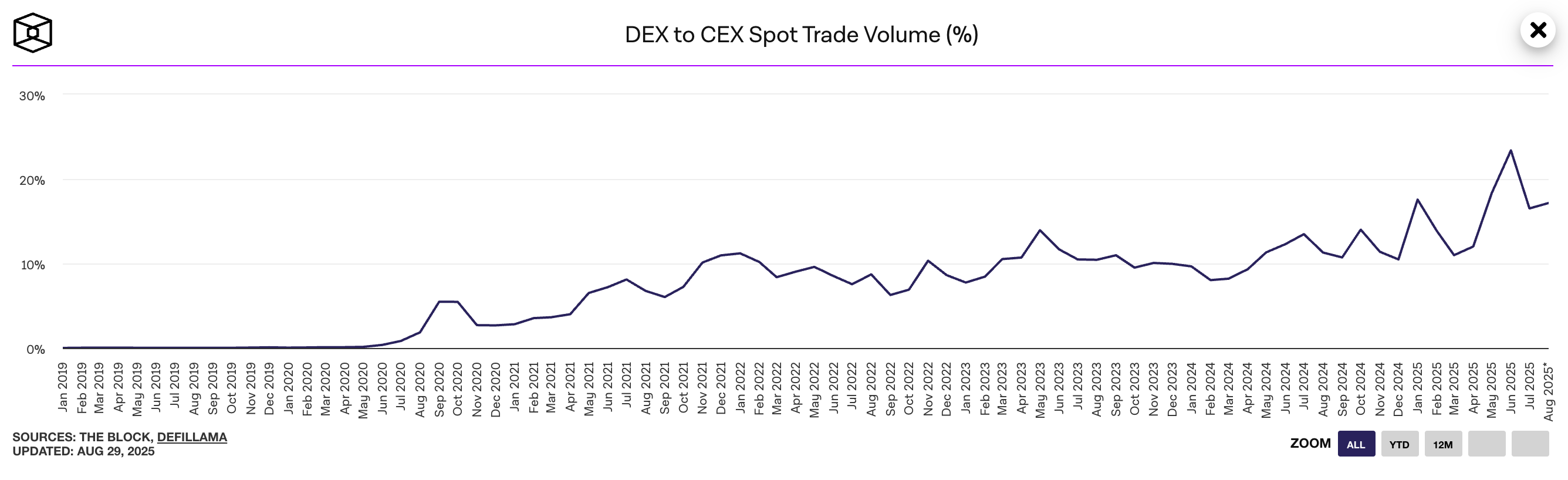
However, DEXs have steadily been gaining ground since the summer of 2020. Recently, the largest percentage of spot trade volume performed via DEXs peaked at just above 24% in June 2025, compared to just 1% nearly five years ago.
The user interface of DEXs can be hard to understand and navigate for beginners as they don’t resemble that of traditional stock trading platforms.
DEXs also require users to connect non-custodial wallets to execute trades and transfer funds, which might come off as a complex process.
Here’s a side-by-side comparison of the main differences between centralized and decentralized exchanges.
Feature | Centralized Exchange (CEX) | Decentralized Exchange (DEX) |
Custody of Funds | CEX controls user funds in custodial wallets | Users keep full control with non-custodial wallets |
Identity & KYC | Requires account setup and ID verification (KYC) | No sign-up or personal information required |
In short: CEXs prioritize convenience, liquidity, and advanced trading features, while DEXs focus on privacy, self-custody, and permissionless access. Neither is inherently “better,” so the right choice depends on whether you value ease of use and fiat access (CEX) or control and decentralization (DEX).
Both types of exchanges come with their own unique risks.
Like any decision in cryptocurrency and DeFi, the choice depends on your own risk tolerance.
No, most CEXs provide custodial wallets, making them easier for beginners but leaving control with the exchange. DEXs require a non-custodial wallet, giving you full ownership of your assets and private keys, as well as full responsibility for securing them.
While many DEXs don’t support fiat deposits like dollars or euros, there are some like DEX that have partnered directly with on-ramps like MoonPay. Rather than needing to go to a centralized exchange and transfer it to your wallet to trade on a decentralized exchange, MoonPay has simplified the process so you can do it all in one platform.
CEXs may charge users through trading fees, withdrawal fees, and sometimes deposit fees. Additionally, they may also include hidden costs like spreads.
DEXs, on the other hand, usually have lower trading fees. However, every trade generally comes with a network gas fee, which can be expensive on blockchains like Ethereum.
The cheaper choice depends on the network you use and how often you trade.
Yes, you can use a DEX and a CEX together. In fact, many crypto users actually combine both: buying crypto on a CEX, then moving assets to a DEX for greater DeFi opportunities.
Now that you understand the difference between CEXs and DEXs, it’s time to start trading crypto yourself.
To get started, you can simply buy cryptocurrency via MoonPay using PayPal, credit/debit card, Apple Pay, and many more payment methods.
You can also kick off your crypto journey by topping up your wallet in euros, pounds, or dollars and use your MoonPay Balance for buying Bitcoin (BTC), Ethereum (ETH), and other tokens. Use your balance to enjoy lower transaction fees, quicker processing times, and better approval rates. Plus, withdraw to your bank account with zero fees when you're ready to cash out.
MoonPay also makes it easy to sell crypto when you decide it's time to cash out. Simply enter the amount of the token you'd like to sell and enter the details where you want to receive your funds.
Faster (off-chain order matching) |
Network dependent (on-chain validation by miners/validators) |
Liquidity Levels | High liquidity and large trading volumes | Variable liquidity, steadily growing |
Trading Features | Wide range: spot, margin, futures, options | Mostly token swaps, certain dedicated DEXs have advanced features like futures and options |
Security & Risk | Risk of exchange hacks, fund freezes, or shutdowns | Smart contract vulnerabilities, slippage, rug pulls |