

Launching MoonPay Enterprise: Stablecoin APIs for developers → Learn More

MoonPay
  • Individuals
  • Business
  • Language
  • Get Started
Buy
Buy cryptoUse a card, Apple Pay or Google Pay to buy crypto fast. We also accept bank transfers and wires.
Buy BitcoinBTC
Buy EthereumETH
Buy PolygonPOL
Buy SolanaSOL
Buy DogecoinDOGE
Buy CardanoADA
Buy AvalancheAVAX
Sell
Sell cryptoTurn your crypto into cash. In a flash. Get paid straight to your bank account or Visa card.
Sell BitcoinBTC
Sell EthereumETH
Sell USDCUSDC
Sell SolanaSOL
Sell CardanoADA
Sell DogecoinDOGE
Sell AvalancheAVAX
Trade
Trade cryptoTrade between tokens, even if they’re on different chains (we make bridging seamless too).
Trade EthereumETH
Trade USDCUSDC
Trade AaveAAVE
Trade ChainlinkLINK
Trade Wrapped BitcoinWBTC
Trade DaiDAI
Trade CompoundCOMP
Company
NewsroomNewsroomMediaMediaCareersCareersChangelogChangelogMoonPay DiscoverMoonPay DiscoverNew
Crypto Prices
Bitcoin PriceEthereum PriceSolana PriceDogecoin PriceCardano PriceXRP PriceBNB PriceAll Crypto Prices
Learn
What is Blockchain?What is Blockchain?What are NFTs?What are NFTs?What is Bitcoin mining?What is Bitcoin mining?What is DeFi?What is DeFi?What is crypto staking?What is crypto staking?All Learn Articles
Support
DocumentationDocumentationHelp CenterHelp CenterContact UsContact UsStatusStatus
  • Language
  • All rights reserved. MoonPay USA LLC is a registered money service business (NMLS ID: 2071245). For Law Enforcement requests please direct your official document to our compliance team here.

    English (Canada)
    • Personal
    • Buy Crypto
    • Sell Crypto
    • Trade Crypto
    • Learn about Crypto
    • Crypto Price
    • MoonAgentsNew!
    • Business
    • Ramps
    • Virtual AccountsNew!
    • MoonPay Discover
    • MoonPay Commerce
    • MoonPay InstitutionalNew!
    • Company
    • About Us
    • CareersWe're hiring
    • Newsroom
    • Media
    • Changelog
    • Support
    • API Docs
    • Help Center
    • Contact Us
    • Status
    • Security
    • Buy
    • Buy Bitcoin
    • Buy Ethereum
    • Buy Solana
    • Buy Cardano
    • Sell
    • Sell Bitcoin
    • Sell Ethereum
    • Sell XRP
    • Sell Solana
    • Trade
    • Trade Ethereum
    • Trade SOL
    • Trade Aave
    • Trade Chainlink
    • Crypto Prices
    • Bitcoin Price
    • Ethereum Price
    • Dogecoin Price
    • XRP Price
    • Cardano Price
    • Learn
    • What is Blockchain?
    • What are NFTs?
    • What is Bitcoin mining?
    • What is DeFi?
    • What is crypto staking?
    • Legal
    • Licenses
    • Privacy Policy
    • Cookie Policy
    • Terms of Use
    English (Canada)

    All rights reserved. MoonPay USA LLC is a registered money service business (NMLS ID: 2071245). For Law Enforcement requests please direct your official document to our compliance team here.

    Back to all articles

    Bitcoin Pizza Day: Commemorating the $1B Pizza Order

    Today, you can virtually anything with cryptocurrency. Participating merchants will offer their goods and services in exchange for tokens like Bitcoin. With its market cap in the trillions, Bitcoin (BTC) is becoming a more viable alternativ

    Corey Barchat

    By Corey Barchat

    Published on Apr 28, 2025

    Last modified on May 22, 2025
    cryptocurrencybitcoin
    Bitcoin Pizza Day
    1. 1.Bitcoin Before Pizza Day
    2. 2.Laszlo Hanyecz and the 10,000 BTC Pizza
    3. 3.The Bitcoin Pizza Agreement: How the Deal Went Down
    4. 4.What did Jeremy Sturdivant do with the 10,000 bitcoins?
    5. 5.Fun Facts About Bitcoin Pizza Day
    6. 6.Why Bitcoin Pizza Day is Important
    7. 7.How Bitcoin Pizza Day Is Celebrated
    8. 8.Other Historic Firsts in Bitcoin’s History
    9. 9.Buy Bitcoin (and pizza) today

    Today, you can virtually anything with cryptocurrency. Participating merchants will offer their goods and services in exchange for tokens like Bitcoin. With its market cap in the trillions, Bitcoin (BTC) is becoming a more viable alternative to fiat currency, and is even seen as more desirable than fiat in certain countries.

    But paying with crypto wasn't always so convenient or accessible.

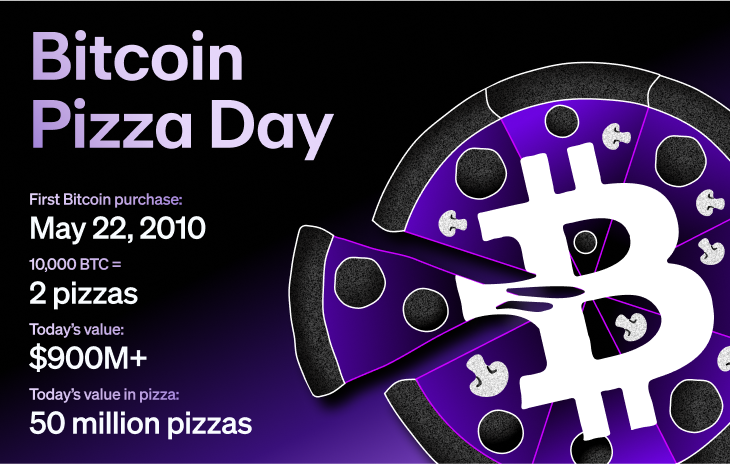
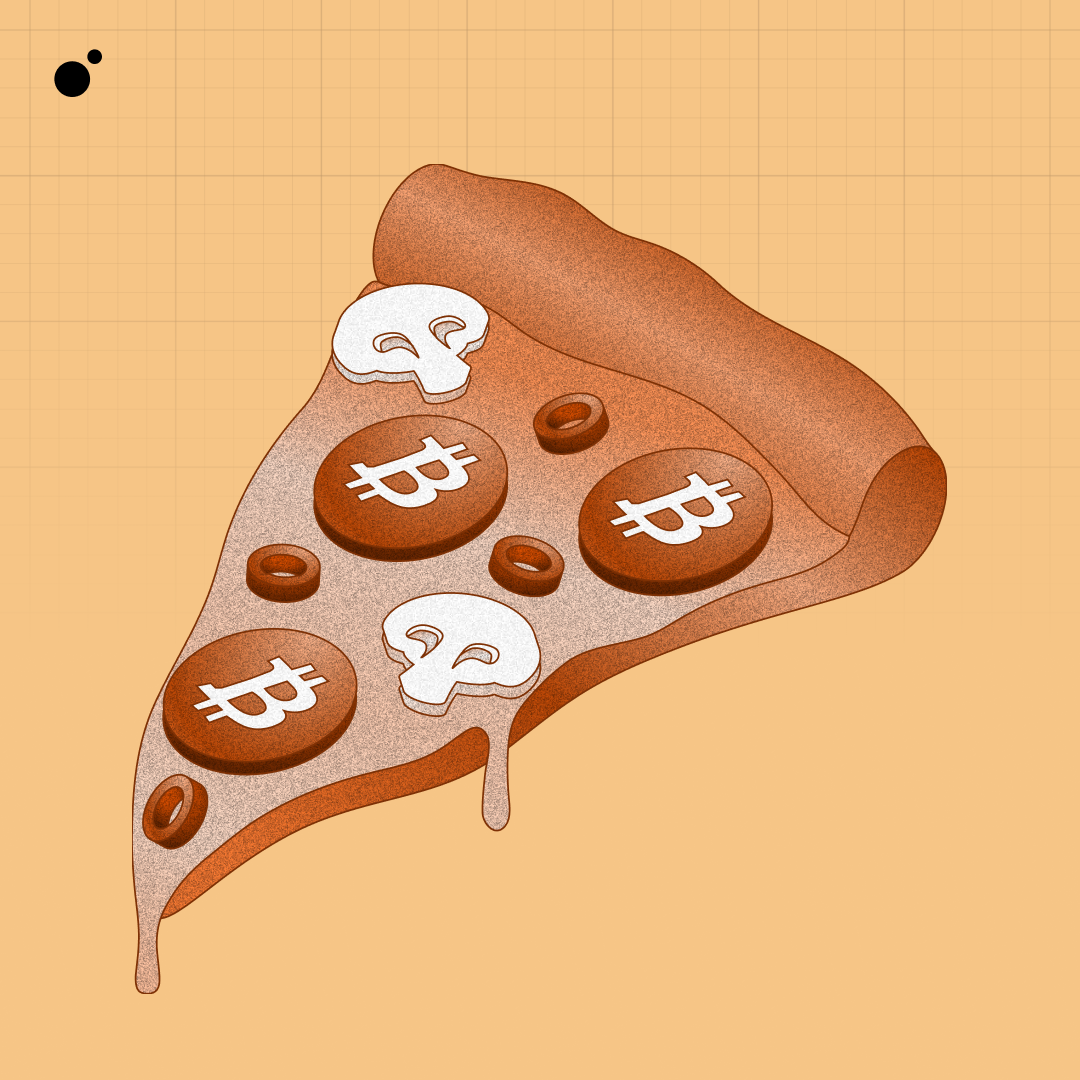
    Back in 2010, software developer Laszlo Hanyecz paid 10,000 BTC for two pizzas in the first known real-world transaction using Bitcoin

    Though seemingly innocuous—and quite expensive in today's terms—this simple act represented a fundamental shift in how Bitcoin was perceived. Prior to the transaction, Bitcoin had no established monetary value and had never been publicly used to purchase tangible goods or services.

    Facts about Bitcoin Pizza Day

    And now, every year on May 22, the global crypto community commemorates this pivotal milestone in Bitcoin’s history: Bitcoin Pizza Day.

    But how did Bitcoin Pizza day happen, and what is the significance of this historic event in the timeline of blockchain technology?

    Bitcoin Before Pizza Day

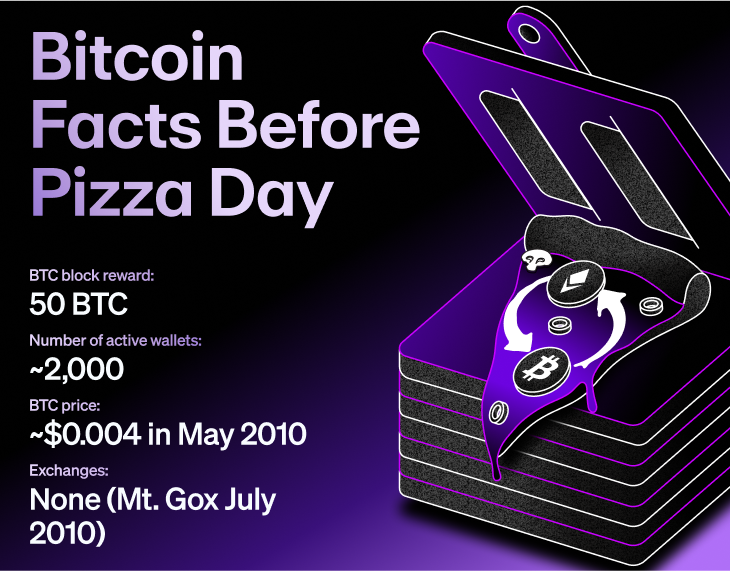
    To fully understand the importance of this moment, we have to rewind to what Bitcoin was like before Pizza Day.

    On January 3, 2009, the first BTC block was mined by Satoshi Nakamoto. The network was small, its users were mostly niche cryptography geeks, and there was little value yet attached to a “bitcoin.”

    In those days, BTC was mined on home computers using CPUs without GPU cards or fancy mining equipment. Transactions were limited to test sends between developers, and people gave away thousands of bitcoins just for fun or for testing code.

    No one could really know if the concept of decentralized, peer-to-peer money would actually work. The only things keeping Bitcoin alive were curiosity and idealism among a small group of believers.

    An infographic of facts about Bitcoin before the Pizza Transaction

    Forums like Bitcointalk.org became the epicenter of Bitcoin conversation (as we'll see below), and even that hub had its share of doubters who weren’t sure the project would catch on. There weren't any crypto exchanges up and running, just informal trading and in-person swaps.

    Bitcoin existed more as a theoretical alternative to fiat than a usable currency. That’s what makes Pizza Day such a big deal. It was the first time someone said, “I will give you Bitcoin if you give me food,” and it actually worked.

    Laszlo Hanyecz and the 10,000 BTC Pizza

    Enter Laszlo Hanyecz, a programmer based in Jacksonville, Florida. Hanyecz had been contributing to Bitcoin’s early development, and was even on Satoshi's original dev team. He was also one of the first to experiment with GPU mining, which helped him accumulate thousands of BTC when they possessed little to no value.

    In his book Digital Gold, author Nathaniel Popper shares that Hanyecz was winning up to blocks of 50 bitcoins per day and multiple blocks per hour using his experimental methods. Legend has it that Hanyecz even explained his breakthrough to Satoshi Nakamoto via email.

    To this, Satoshi replied back expressing his hesitation that such mining techniques could eventually cause an unfair playing field, with too many coins concentrated in the hands of a few lucky miners—an issue that is still prevalent in Bitcoin mining to this day.

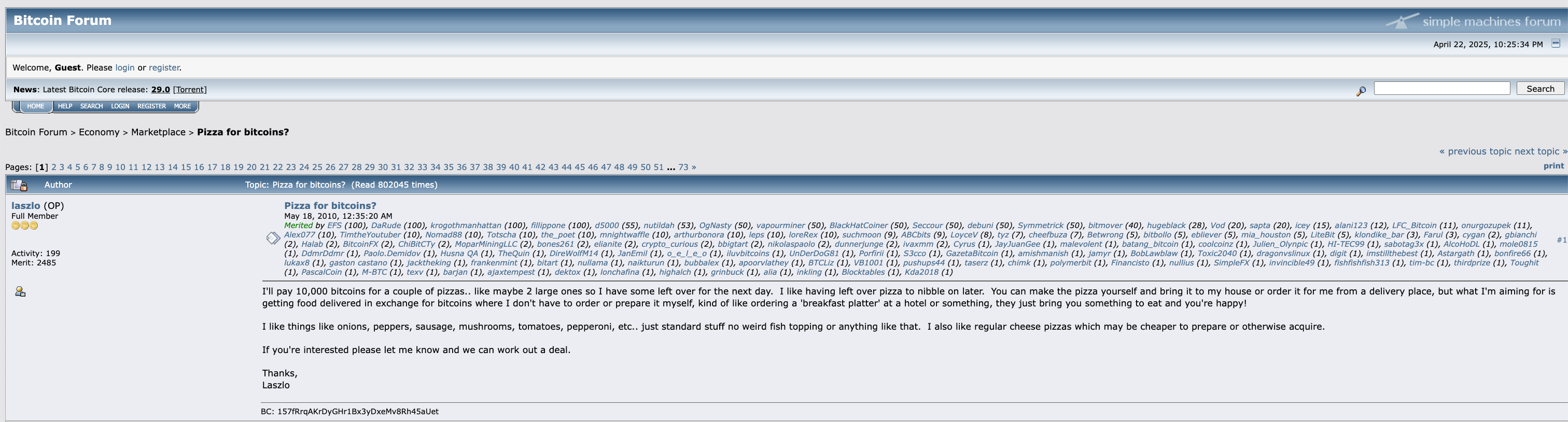
    On May 18, 2010, Laszlo made a post on Bitcointalk offering 10,000 BTC for two large pizzas. He wasn’t even looking for the best offer, but rather just someone to accept BTC in return for something real.

    “I’ll pay 10,000 bitcoins for a couple of pizzas like maybe two large ones so I have some left over for the next day. I like having left over pizza to nibble on later,” he wrote.

    At the time, those 10,000 BTC were worth roughly $41 based on early exchange rates. But this was really just a fuzzy estimate, as there was no real BTC price discovery yet (as shown by the bartering being done on the forum itself). Today, those same coins would have been worth hundreds of millions of dollars—exceeding even $1 billion in 2025—making it the most expensive pizza order in history.

    A screenshot from Bitcointalk.org showing the request for two pizzas
    The original offer posted by Laszlo Hanyecz — Image source

    But Laszlo wasn’t concerned about mere price or value. He cared about proving utility. And that’s exactly what he did.

    The Bitcoin Pizza Agreement: How the Deal Went Down

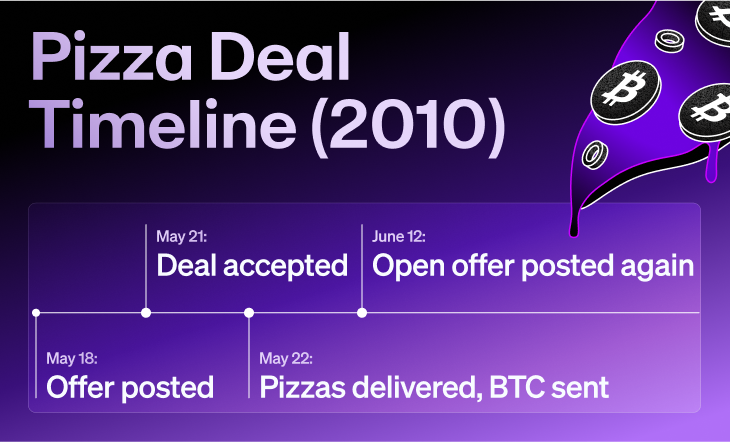
    The offer sat on the forum for a few days, with many users unsure whether someone would actually go through with it. Some thought it was a joke, others said it was too early for such trading, and a few even warned Laszlo not to “waste” his BTC on pizza.

    An infographic showing a timeline of the Bitcoin Pizza Day deal

    After a few days without receiving a bite on his offer, Hanyecz posted again, wondering if his listed price of 10,000 BTC was too low. One user based outside the US did express interest in the deal, though they didn't have the means to complete the pizza order from their home location.

    But then, on May 22, a user named Jeremy Sturdivant (handle: “Jercos”) replied on a different forum and agreed to make the trade. He was only 19 years old at the time and saw it as a fun experiment. He ordered two Papa John’s pizzas for Laszlo—one cheese and one supreme, without the "weird fish" toppings per Laszlo's instructions—and had the food delivered to his home.

    In return, Laszlo transferred 10,000 BTC to Jeremy’s wallet. The transaction happened completely online. No banks, no credit cards, no PayPal. Just two people using the internet and trusting a protocol that was barely over a year old.

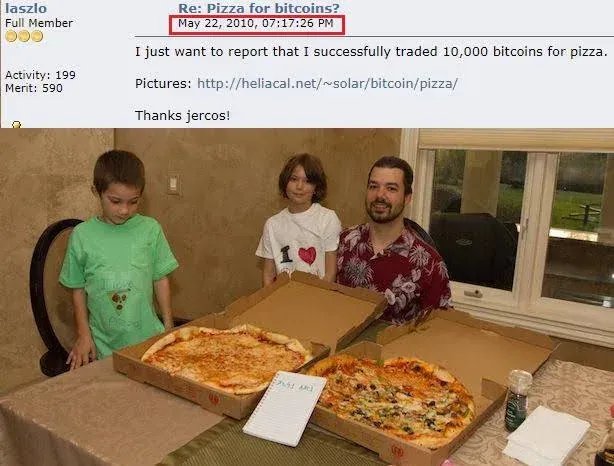
    An image of Laszlo Hanyecz and his children enjoying their pizza delivery.
    The first Bitcoin Pizza Day — Image source

    Laszlo later posted photos of his children and himself enjoying the pizzas, documenting the first time Bitcoin was used to purchase of real-world goods. Through this, he also etched himself and the date of May 22 into blockchain lore forever.

    What did Jeremy Sturdivant do with the 10,000 bitcoins?

    You might think Jeremy became a crypto whale millionaire off that pizza trade. But that’s not what happened. Like some early Bitcoiners, he saw BTC as a cool project, rather than a long-term investment.

    An image of Jeremy Sturdivant
    Jeremy Sturdivant aka Jercos — Image source

    Jeremy spent most of the 10,000 BTC over the next few months. He later said he didn't regret it because, at the time, there was no reason to believe Bitcoin would become what it is today. "I would never have thought that the same number of bitcoin would have a purchasing power on the order of real estate," Sturdivant said.

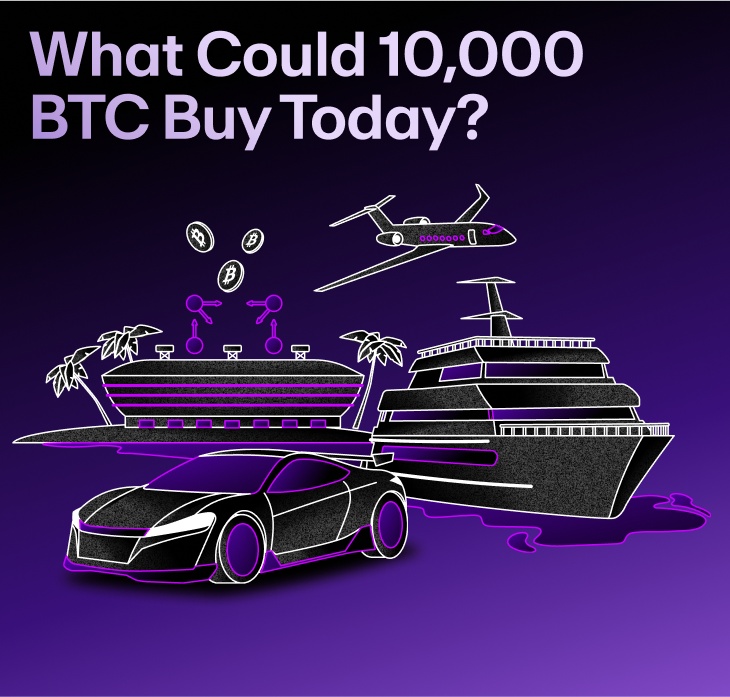
    If he had decided to HODL, Sturdivant says that he would've used the money on a road trip with his girlfriend. But with the buying power of 10,000 bitcoins, he could've purchased an entire fleet of luxury sports cars, rather than spending it on a single road trip.

    An infographic showing what 10,000 BTC could buy today

    And while he didn’t hold onto the BTC, Jeremy still became a minor legend in the crypto world for his role in validating Bitcoin’s value. Without someone willing to accept BTC in exchange for something tangible, the idea of Bitcoin-as-money may have taken much longer to take root. Says Hanyecz of the exchange, “I’d like to think that what I did helped. But I think if it wasn’t me, somebody else would have come along.”

    Fun Facts About Bitcoin Pizza Day

    • 📜 The original transaction is recorded on the blockchain forever, in Block Height 57,043.
    • 💸 Laszlo kept buying pizzas with Bitcoin and spent over 100,000 BTC on similar purchases that summer.
    • 😱 His total expenses would've cost over $10 billion at Bitcoin's height in 2025.
    • 🎉 May 22 is now a global celebration in the cryptocurrency space, commemorated by users and companies alike, with memes, merch, and tributes.
    • 😅 Laszlo has said he doesn’t regret it, since he helped spark Bitcoin’s utility.
    • 🤝 Jeremy doesn't regret spending his 10,000 BTC pizza winnings either.
    • 🍕 The Bitcoin Pizza Index measures how much these pizzas would be worth today (over $1 billion at its ATH in 2025).
    • 🤑 You could buy over 50 million pizzas today with 10,000 bitcoins.
    • 💰 Those two pizzas today would be worth just 0.00044 BTC.
    • 📈 Bitcoin Price Checkpoint: Each Pizza Day is a yearly reflection point for Bitcoin’s value.

    Check out the table below to see BTC's price over the last 15 years on May 22, and how much those two pizzas would've cost him.

    Day

    Year

    BTC Price (USD)

    Price paid for Laszlo's two pizzas

    May 22

    2010

    ~$0.0041

    $41

    May 22

    2011

    $6.12

    $61,200

    May 22

    2012

    $5.10

    $51,000

    May 22

    2013

    $123.89

    $1,238,900

    May 22

    2014

    $524.58

    $5,245,800

    May 22

    2015

    $240.97

    $2,409,700

    May 22

    2016

    $439.32

    $4,393,200

    May 22

    2017

    $2,173.40

    $21,734,000

    May 22

    2018

    $8,041.78

    $80,417,800

    May 22

    2019

    $7,680.07

    $76,800,700

    May 22

    2020

    $9,182.58

    $91,825,800

    May 22

    2021

    $37,536.63

    $375,366,300

    May 22

    2022

    $30,323.72

    $303,237,200

    May 22

    2023

    $26,851.28

    $268,512,800

    May 22

    2024

    $69,122.34

    $691,223,400

    May 22

    2025

    $111,970.17

    $1,119,701,700

    Why Bitcoin Pizza Day is Important

    Bitcoin Pizza Day is more than just a meme. It represents the moment when Bitcoin transitioned from a theoretical system into a usable form of digital money. That simple pizza transaction proved a fundamental point: Bitcoin could be exchanged for real goods, peer-to-peer, without intermediaries.

    Key Lessons from BTC Pizza Day

    • Early adoption comes with risk: Many early adopters couldn't know for sure if Bitcoin would last, but their participation made the system viable.
    • Evolving perception of value: What was once seen as geek currency is now traded by Wall Street and held by billionaires, companies, and entire nations.
    • Utility drives adoption: Bitcoin needed to be used, not just mined and traded, to reach its full potential for everyday relevance.

    How Bitcoin Pizza Day Is Celebrated

    Today, Bitcoin Pizza Day is commemorated with events, memes, and, of course, pizza. Crypto companies often join the fun with special promos: discounted or free pizza for using their platform, limited-edition NFTs, free crypto, and pizza-themed dApps (decentralized applications) and games.

    Companies have hosted gatherings in cities around the world like Rome, Naples, Rio de Janeiro, and Miami for crypto-natives and newbies alike to share slices and stories. There are also hubs like Pizza.Day that provide resources to help commemorate the day at home, online, or create/find an in-person event near you.

    A screenshot from Pizza.Day showing ways to celebrate Bitcoin Pizza Day around the world.
    You can find Bitcoin Pizza Day events on Pizza.Day — Image source

    In an industry often focused on price charts, Pizza Day is about culture, community, and remembering why Bitcoin started in the first place.

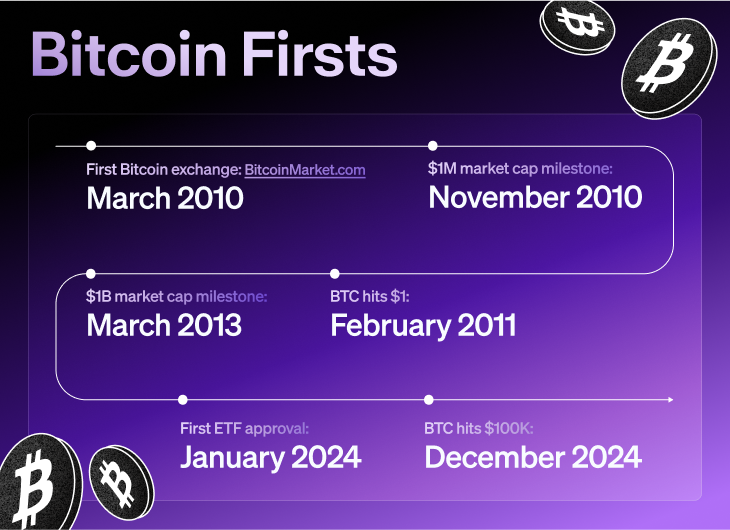
    Other Historic Firsts in Bitcoin’s History

    Bitcoin Pizza Day isn’t the only “first” that helped BTC evolve. Some other notable milestones include:

    • First Bitcoin exchange: BitcoinMarket.com, March 2010
    • $1M market cap milestone: November 2010
    • BTC hits $1: February 2011
    • $1B market cap milestone: March 2013
    • First ETF approval: January 2024
    • BTC hits $100K: December 2024
    An infographic showing a timeline of firsts in the history of Bitcoin

    Buy Bitcoin (and pizza) today

    Want to pay for your own pizza using cryptocurrency like Bitcoin? With MoonPay, you can. And for a lot less than 10 thousand tokens.

    MoonPay allows you to buy BTC instantly and send it to any wallet in minutes. Just enter your wallet address and choose from supported payment methods like credit/debit cards, Apple Pay, Google Pay, PayPal, and more.

    You might also like

    guide+2
    embedded wallets end of seed phrases

    Embedded Wallets and The End of Seed Phrases

    For most of crypto's history, the price of admission was a ritual: write down 12 words, in order, on something that can't catch fire or get wet, and guard them for the rest of your life. Get it right and you're your own bank. Get it wrong o

    cryptocurrency+2
    Accepting Crypto Payments

    How to Accept Crypto Payments: Checkout, Settlement & Merchant Setup

    A customer just bought a $100 hoodie from your online store and paid in crypto. Quick question: where is that $100 right now?

    cryptocurrency+2
    chain abstraction explained

    Chain Abstraction Is the Next Step After Bridges and Network Switching

    Somewhere in your wallet right now there is probably money you can't easily spend. Not lost, not stolen. Just on the wrong network. USDC on Arbitrum when the app you want takes USDC on Base. ETH on mainnet when the game you're playing lives

    bitcoin+2
    crypto in prediction markets

    How Prediction Markets Work (and Where Crypto Fits In)

    A prediction market is a place where people put money on what happens next. Will the Fed cut rates in September? Will Bitcoin close the year above $150,000? Each question becomes a contract you can buy and sell, and the price of that contra

    cryptocurrency+2
    What is an MPC wallet? Benefits, Tradeoffs & Use Cases

    What is an MPC wallet? Benefits, Tradeoffs & Use Cases

    An MPC wallet is a crypto wallet that never stores your private key in one piece. The key is split into encrypted shares held in different places, and signing a transaction combines those shares without ever rebuilding the whole key. That d

    cryptocurrency+2
    what is a smart wallet?

    What is a smart wallet? Self-custody made simple

    Anyone who has used a regular crypto wallet knows the shape of the problem. You write down twelve words on a piece of paper. You hide the paper somewhere clever, then forget where. You pay gas in a token you don't have, on a network you did