

Launching MoonPay Enterprise: Stablecoin APIs for developers → Learn More

MoonPay
  • Individuals
  • Business
  • Taal
  • Begin
Buy
Buy cryptoUse a card, Apple Pay or Google Pay to buy crypto fast. We also accept bank transfers and wires.
Buy BitcoinBTC
Buy EthereumETH
Buy PolygonPOL
Buy SolanaSOL
Buy DogecoinDOGE
Buy CardanoADA
Buy AvalancheAVAX
Sell
Sell cryptoTurn your crypto into cash. In a flash. Get paid straight to your bank account or Visa card.
Sell BitcoinBTC
Sell EthereumETH
Sell USDCUSDC
Sell SolanaSOL
Sell CardanoADA
Sell DogecoinDOGE
Sell AvalancheAVAX
Trade
Trade cryptoTrade between tokens, even if they’re on different chains (we make bridging seamless too).
Trade EthereumETH
Trade USDCUSDC
Trade AaveAAVE
Trade ChainlinkLINK
Trade Wrapped BitcoinWBTC
Trade DaiDAI
Trade CompoundCOMP
Company
NewsroomNewsroomMediaMediaCareersCareersChangelogChangelogRisk WarningRisk WarningMoonPay DiscoverMoonPay DiscoverNew
Crypto Prices
Bitcoin PriceEthereum PriceSolana PriceDogecoin PriceCardano PriceXRP PriceBNB PriceAll Crypto Prices
Learn
What is Blockchain?What is Blockchain?What are NFTs?What are NFTs?What is Bitcoin mining?What is Bitcoin mining?What is DeFi?What is DeFi?What is crypto staking?What is crypto staking?All Learn Articles
Support
DocumentationDocumentationHelp CenterHelp CenterContact UsContact UsStatusStatus
  • Taal
  • All rights reserved. MoonPay Europe B.V. is an AFM-licensed crypto-asset service provider under the EU MiCA Regulation (Reference Number: 41000002).

    Dutch
    • Personal
    • Buy Crypto
    • Sell Crypto
    • Trade Crypto
    • Learn about Crypto
    • Crypto Price
    • MoonAgentsNew!
    • Business
    • Ramps
    • Virtual AccountsNew!
    • MoonPay Discover
    • MoonPay Commerce
    • MoonPay InstitutionalNew!
    • Company
    • About Us
    • CareersWe're hiring
    • Newsroom
    • Media
    • Changelog
    • Support
    • API Docs
    • Help Center
    • Contact Us
    • Status
    • Security
    • Buy
    • Buy Bitcoin
    • Buy Ethereum
    • Buy Solana
    • Buy Cardano
    • Sell
    • Sell Bitcoin
    • Sell Ethereum
    • Sell XRP
    • Sell Solana
    • Trade
    • Trade Ethereum
    • Trade SOL
    • Trade Aave
    • Trade Chainlink
    • Crypto Prices
    • Bitcoin Price
    • Ethereum Price
    • Dogecoin Price
    • XRP Price
    • Cardano Price
    • Learn
    • What is Blockchain?
    • What are NFTs?
    • What is Bitcoin mining?
    • What is DeFi?
    • What is crypto staking?
    • Legal
    • Legal Page
    • Pricing
    • Licenses
    • Privacy Policy
    • Cookie Policy
    • Terms of Use
    • Risk Warning
    • Complaints
    Dutch

    All rights reserved. MoonPay Europe B.V. is an AFM-licensed crypto-asset service provider under the EU MiCA Regulation (Reference Number: 41000002).

    Back to all articles

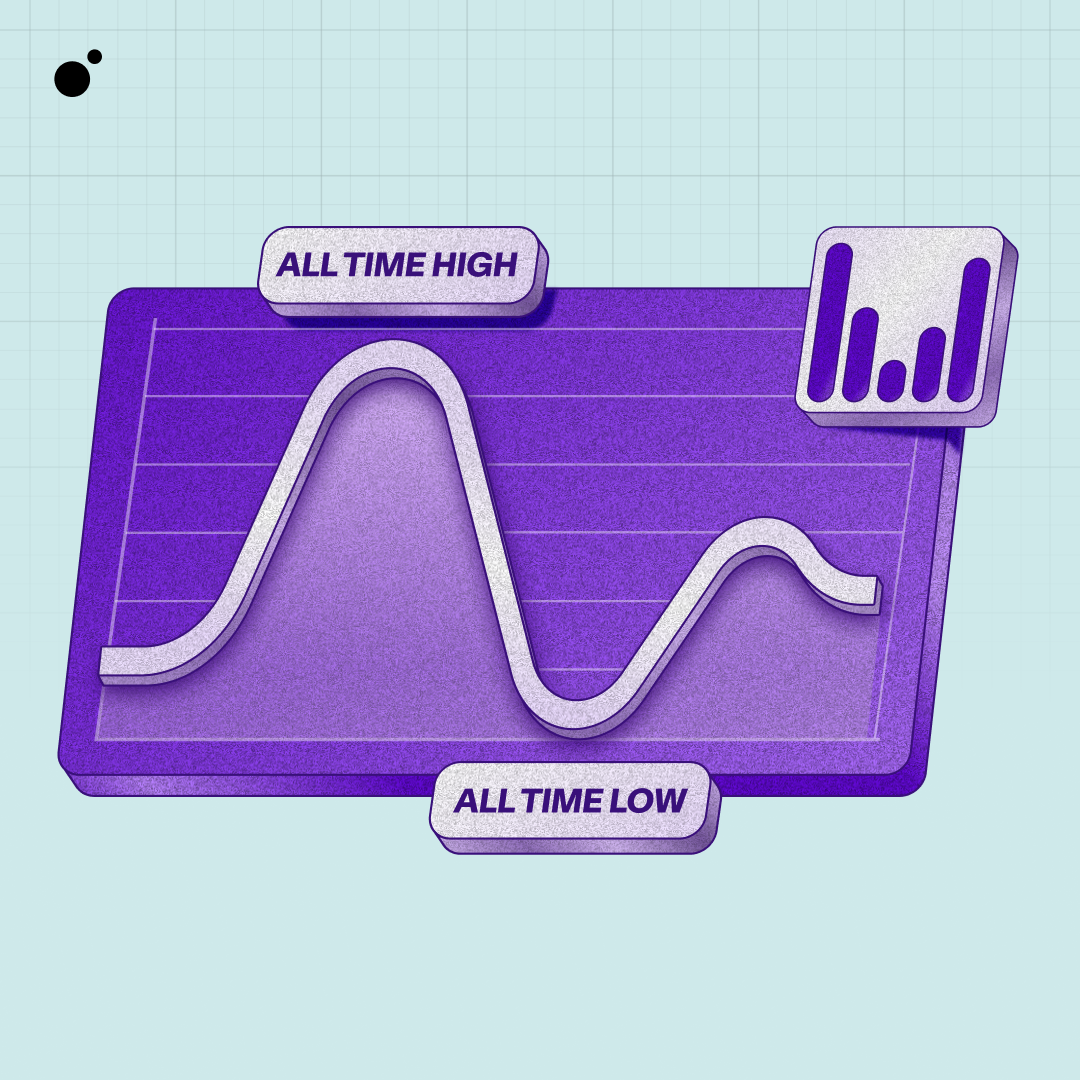
    What Is ATH in Crypto? All-Time High & All-Time Low Explained

    If you spend any time in crypto communities, you’ll see three letters pop up constantly: ATH. Sometimes they’re posted with rocket emojis during a price surge; other times they appear in wistful comparisons to better days. But what does ATH

    Team MoonPay

    By Team MoonPay

    Published on Mar 10, 2026

    Last modified on Mar 11, 2026
    cryptocurrencyguidebasicsbitcoinaltcoinethereum
    1. 1.What is ATH (all-time high) in crypto?
    2. 2.What is ATL (all-time low) in crypto?
    3. 3.ATH vs. ATL: Key differences at a glance
    4. 4.Why ATH and ATL matter for crypto traders and investors
    5. 5.Notable cryptocurrency all-time highs
    6. 6.ATH and ATL in stocks and traditional trading
    7. 7.The psychology of ATH and ATL: Common traps to avoid
    8. 8.How to track ATH and ATL data
    9. 9.Practical tips for using ATH and ATL wisely
    10. 10.Frequently asked questions

    If you spend any time in crypto communities, you’ll see three letters pop up constantly: ATH. Sometimes they’re posted with rocket emojis during a price surge; other times they appear in wistful comparisons to better days. But what does ATH actually mean, and why does it matter for your decisions as a crypto participant?

    ATH stands for all-time high, the highest price a cryptocurrency has ever reached. Its counterpart, ATL (all-time low), marks the lowest price. Together, these two data points frame the full range of an asset’s price history and serve as reference points that traders, investors, and analysts use every single day.

    This guide breaks down everything you need to know about ATH and ATL: what they mean, how they’re calculated, why they matter for crypto and traditional markets alike, and how to use them without falling into common psychological traps.

    What is ATH (all-time high) in crypto?

    An all-time high (ATH) is the highest price a cryptocurrency has ever traded at since it first became available on a market. When someone says “Bitcoin just hit a new ATH,” they mean the price of BTC has surpassed every previous peak in its entire history.

    ATH isn’t limited to price alone. The term can also apply to other metrics: a token’s market capitalization can reach an ATH, its trading volume can hit an ATH, or the total crypto market cap can reach an all-time high. However, when used without further context, ATH almost always refers to price.

    The concept isn’t unique to crypto either. In stock markets, you’ll hear about the S&P 500 reaching an all-time high, or a company’s share price hitting ATH. The meaning is identical: the highest recorded value to date. In trading broadly, ATH represents a price level where no historical resistance exists. In other words, the asset has entered uncharted territory.

    How ATH is determined

    An asset’s ATH is simply the highest price recorded across any exchange where it has traded. There are a few nuances worth understanding:

    • Exchange variation: Different exchanges can show slightly different ATH prices because each platform has its own order books and liquidity. Data aggregators like CoinMarketCap and CoinGecko typically report a composite or averaged ATH across major exchanges.
    • Timeframe: ATH encompasses the asset’s entire trading history, from its very first trade to the present moment. There’s no expiration, meaning an ATH set five years ago remains the ATH until it’s surpassed.
    • Intraday vs. close: In crypto’s 24/7 markets, ATH usually refers to the highest price reached at any point (intraday), not a daily close price. A token might briefly spike to an ATH during a volatile hour and then pull back.

    What happens when a cryptocurrency reaches ATH

    When an asset breaks past its previous ATH, it enters what traders call “price discovery.” Because there’s no prior price history above the ATH, there are no established resistance levels to guide where the price might stall or reverse. This makes price action above ATH inherently unpredictable and often volatile.

    A new ATH typically triggers a cascade of market activity. Media coverage increases, social media buzz intensifies, and new participants may enter the market driven by FOMO (fear of missing out). At the same time, some existing holders may see the ATH as an opportunity to lock in profits, creating selling pressure that can lead to a pullback.

    What is ATL (all-time low) in crypto?

    An all-time low (ATL) is the lowest price a cryptocurrency has ever reached since it began trading. If ATH represents the ceiling of an asset’s price history, ATL represents the floor.

    For most well-established cryptocurrencies, ATLs were set early in their life cycle. Bitcoin’s ATL, for example, dates back to its earliest trades when it was worth fractions of a cent. For newer or struggling tokens, an ATL can be a more recent and painful marker, sometimes signaling a loss of confidence in the project.

    Unlike ATH, which is often celebrated, reaching a new ATL tends to signal distress. It means the asset’s price has fallen below every previous point in its history, which can trigger panic selling, negative media coverage, and a further downward spiral. However, ATLs can also represent opportunity for those who believe in the asset’s long-term fundamentals.

    Common causes of new all-time lows

    • Broader market downturns (bear markets), where the entire crypto ecosystem declines and even strong projects see significant price drops.
    • Project-specific failures, such as security breaches, regulatory actions, team departures, or failed product launches.
    • Loss of community confidence, often triggered by broken roadmap promises or controversy.
    • Macroeconomic pressures, including rising interest rates, inflation, or geopolitical instability that pushes investors toward lower-risk assets.

    ATH vs. ATL: Key differences at a glance

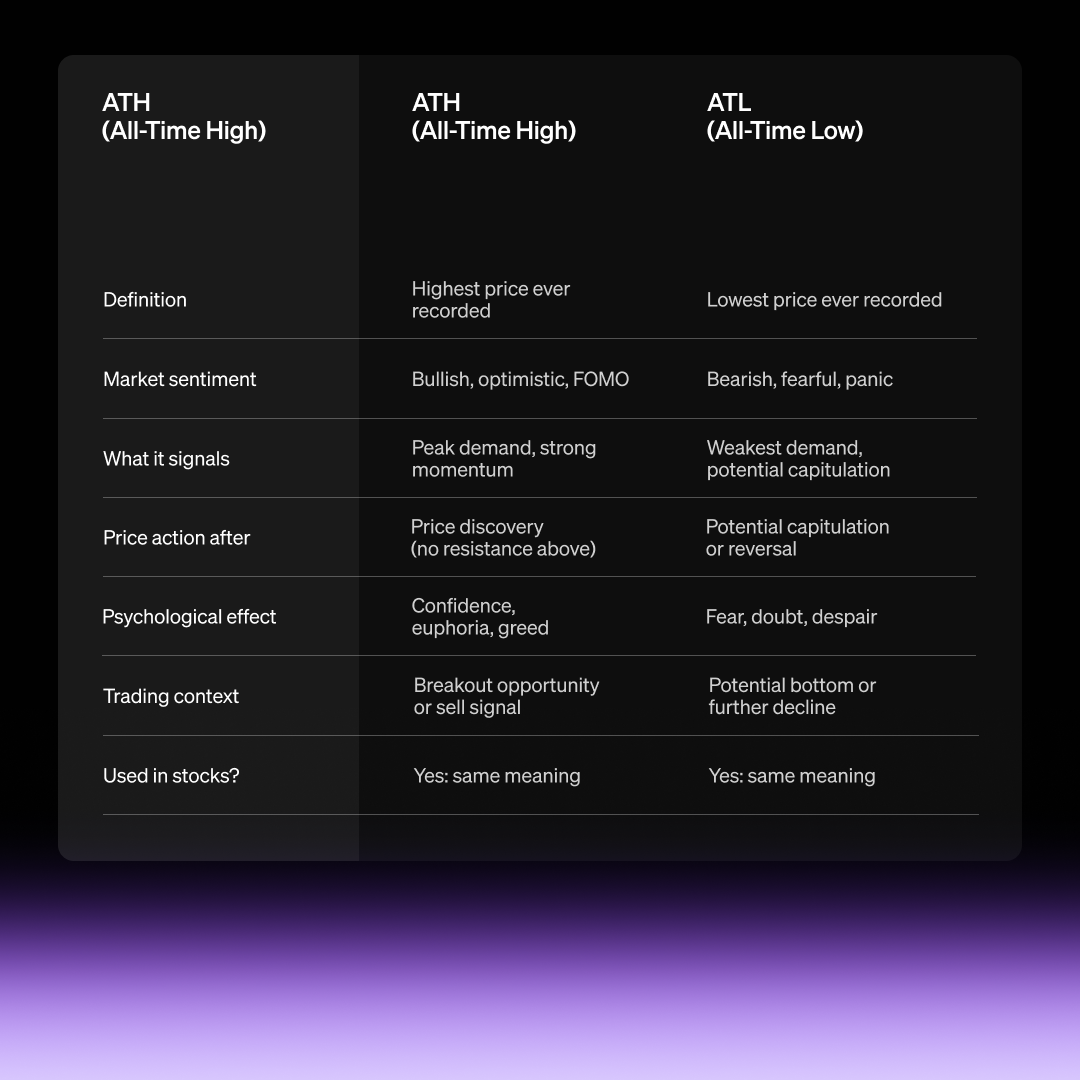
    Understanding how ATH and ATL compare helps you interpret crypto market data more effectively. Here’s how they stack up:

    ATHvs.ATL.png
    ATH vs ATL comparison infographic

    Why ATH and ATL matter for crypto traders and investors

    ATHs and ATLs serve practical functions in how market participants analyze and act on price data.

    Benchmarking performance

    Investors use ATH as a benchmark to evaluate how far a cryptocurrency has fallen from its peak. If Ethereum’s ATH was around $4,800 and it’s currently trading at $2,400, it’s roughly 50% below ATH. This “distance from ATH” metric helps assess whether an asset is trading at a perceived discount or whether the ATH was an unrealistic spike.

    Resistance and support levels

    Previous ATHs often act as psychological resistance levels. When a token approaches its former ATH, some holders who bought near the peak may sell to break even, creating selling pressure at that price point. Similarly, ATLs can act as support levels. If a price has bounced off a certain low before, traders may expect it to hold again.

    Gauging market sentiment

    The relationship between an asset’s current price and its ATH or ATL can reveal market sentiment. An asset approaching ATH suggests growing confidence and bullish momentum. An asset trending toward ATL often reflects deteriorating sentiment or external pressures. When Bitcoin reaches new ATHs, it frequently triggers positive sentiment across the entire crypto market. Often, alongside shifts in Bitcoin dominance that influence how capital rotates into altcoins.

    Informing entry and exit decisions

    Some investors use ATH and ATL data to time their entries and exits. Buying well below ATH might represent a value opportunity if the asset’s fundamentals remain strong. Selling near ATH might lock in gains before a potential correction. However, no single metric should drive investment decisions.

    A disciplined approach like dollar-cost averaging (DCA) can help smooth out the emotional highs and lows of trying to buy at ATL and sell at ATH. By investing a fixed amount at regular intervals, you reduce the impact of any single price point on your overall position.

    Notable cryptocurrency all-time highs

    To put ATH into concrete terms, here’s a look at the all-time high milestones for some of the largest cryptocurrencies. Prices are approximate and based on CoinGecko ATH data available at the time of writing:

    Notable crypto all-time highs.jpg

    These figures illustrate an important point: ATHs are set in specific market conditions. The ATH itself doesn’t tell you whether the asset will ever reach that level again. Bitcoin has repeatedly broken past its previous ATHs over multiple market cycles, while many altcoins from the 2017 era never recovered their peaks. For live pricing and recent ATH data, see MoonPay’s Bitcoin price page, Ethereum price page, and Solana price page.

    ATH and ATL in stocks and traditional trading

    While this article focuses on crypto, ATH and ATL are universal financial terms that apply equally to stocks, commodities, indices, and other traded assets. In the stock market, you’ll regularly hear that the S&P 500 or Dow Jones has hit a new all-time high, typically reflecting broad economic confidence.

    The mechanics are identical: ATH is the highest recorded price, ATL is the lowest. The psychological effects are the same too (euphoria at ATH, despair at ATL). However, there are some key differences in how ATH behaves across asset classes:

    • Stock markets have circuit breakers and trading hours; crypto trades 24/7, making ATH breaks potentially more volatile.
    • Stock ATHs for indices like the S&P 500 are relatively common during long bull markets. Crypto ATHs tend to be more cyclical, often clustering around Bitcoin halving events.
    • Individual stocks can hit ATH based on earnings reports or company news. Crypto ATHs are more frequently tied to broader market cycles, narrative shifts, and liquidity flows.

    The psychology of ATH and ATL: Common traps to avoid

    ATH and ATL are data points, but they’re wrapped in powerful emotions. Understanding the psychological pitfalls can make you a more level-headed participant.

    FOMO at ATH

    When an asset breaks ATH, social media lights up. Headlines scream about new records. It’s natural to feel like you’re missing out if you’re not already invested. But buying exclusively at ATH is one of the most common and costly mistakes. The price may continue climbing, but it could also correct sharply as early holders take profits. Don’t let excitement override a rational assessment of value.

    Anchoring to a past ATH

    If you bought a token near its ATH and the price has since dropped significantly, it’s tempting to hold indefinitely waiting for it to “come back.” This is anchoring bias and fixating on a past price as the “true” value. The reality is that some assets never return to their ATH. Evaluating the project’s current fundamentals matters more than what the price once was.

    Panic selling at ATL

    When prices plunge to new lows, fear takes over. Selling at ATL locks in losses at the worst possible moment. If you still believe in the asset’s long-term potential, an ATL might actually be a buying opportunity, though only if your conviction is based on research and not hope.

    Whale influence

    Large holders (“whales”) can significantly influence price action around ATH and ATL levels. A single large sell order near ATH can trigger cascading liquidations, while a large buy at ATL can spark a rapid reversal. Understanding that these price extremes are particularly susceptible to whale activity helps you interpret sudden moves with a more skeptical eye.

    How to track ATH and ATL data

    Keeping an eye on ATH and ATL data is straightforward with the right tools:

    • MoonPay Price Pages: MoonPay’s Bitcoin price page, Ethereum price page, and Solana price page show live prices, historical charts, market cap, and supply data. This is everything you need to contextualize how close an asset is to its ATH or ATL.
    • CoinMarketCap and CoinGecko: Both aggregate data from hundreds of exchanges and display ATH/ATL prices with the dates they were reached, plus the percentage change from ATH.
    • Exchange platforms: Most major crypto exchanges display ATH data on individual asset pages, often alongside trading volume and market depth charts.
    • Portfolio trackers: Apps like CoinStats and Delta let you track your holdings relative to each asset’s ATH, showing your “distance from peak” in real time.

    Practical tips for using ATH and ATL wisely

    1. Don’t treat ATH as a target. Just because Bitcoin once reached a certain price doesn’t mean every other token will follow the same trajectory. Each asset has unique fundamentals and market dynamics.
    2. Combine with other analysis. ATH and ATL are most useful alongside other indicators: trading volume, market cap trends, developer activity, and on-chain metrics. No single data point tells the whole story.
    3. Consider time context. An ATH set during a speculative mania (like the ICO craze of 2017) carries different implications than an ATH set during a period of sustained institutional adoption.
    4. Use ATH/ATL as conversation starters, not conclusions. “This token is 80% below ATH” should prompt further questions: why did it fall? Have fundamentals changed?
    5. Protect yourself with a plan. Decide in advance at what percentage below ATH you’d consider buying, or at what level you’d take profits. Writing down your strategy helps prevent emotional decision-making.

    Frequently asked questions

    What does ATH stand for in crypto?

    ATH stands for all-time high. In crypto, it refers to the highest price a cryptocurrency has ever reached across its full trading history. The term is used the same way in stocks and other financial markets.

    What does ATL mean in crypto?

    ATL stands for all-time low, meaning the lowest price a cryptocurrency has ever been traded at. For established coins like Bitcoin, the ATL is usually from its earliest trading days. For newer tokens, an ATL could be more recent.

    What is Bitcoin’s all-time high?

    Bitcoin’s ATH has changed many times throughout its history. On Oct 06, 2025, Bitcoin reached an all-time high of about $126,080. Check MoonPay’s Bitcoin price page for the most current ATH data.

    Should I buy a cryptocurrency at its ATH?

    Buying at ATH isn’t inherently good or bad since context matters. In a sustained uptrend, an ATH could represent early entry into a longer rally. But ATH purchases also carry the risk of buying at the peak of a speculative cycle. Consider the asset’s fundamentals, broader market conditions, and your personal risk tolerance before making any decision. A strategy like dollar-cost averaging can help reduce the risk of timing your entry poorly.

    What is ATH in stocks and trading?

    In stocks and traditional trading, ATH means exactly the same thing: the highest price a stock, index, or commodity has ever reached. Major indices like the S&P 500 frequently set new ATHs during long bull markets. The psychological dynamics like euphoria, FOMO, and profit-taking mirror what happens in crypto.

    What’s the difference between ATH and ATL?

    ATH (all-time high) is the highest price ever; ATL (all-time low) is the lowest price ever. They represent the extreme ends of an asset’s price history. ATH is associated with bullish sentiment and peak demand, while ATL is associated with bearish sentiment and low confidence.

    Can a cryptocurrency set a new ATL after reaching ATH?

    Yes, an asset can set a new ATL at any point if it trades below its previous lowest recorded price. For coins whose earliest prices were near zero, a new ATL is less likely, but it’s still possible (especially for newer tokens or assets that experience extreme drawdowns). Many altcoins have seen prices fall so sharply after a peak that they approach prior lows (or make new lows), particularly in prolonged bear markets or when measured against BTC instead of USD.

    You might also like

    guide+2
    embedded wallets end of seed phrases

    Embedded Wallets and The End of Seed Phrases

    For most of crypto's history, the price of admission was a ritual: write down 12 words, in order, on something that can't catch fire or get wet, and guard them for the rest of your life. Get it right and you're your own bank. Get it wrong o

    cryptocurrency+2
    Accepting Crypto Payments

    How to Accept Crypto Payments: Checkout, Settlement & Merchant Setup

    A customer just bought a $100 hoodie from your online store and paid in crypto. Quick question: where is that $100 right now?

    cryptocurrency+2
    chain abstraction explained

    Chain Abstraction Is the Next Step After Bridges and Network Switching

    Somewhere in your wallet right now there is probably money you can't easily spend. Not lost, not stolen. Just on the wrong network. USDC on Arbitrum when the app you want takes USDC on Base. ETH on mainnet when the game you're playing lives

    bitcoin+2
    crypto in prediction markets

    How Prediction Markets Work (and Where Crypto Fits In)

    A prediction market is a place where people put money on what happens next. Will the Fed cut rates in September? Will Bitcoin close the year above $150,000? Each question becomes a contract you can buy and sell, and the price of that contra

    cryptocurrency+2
    What is an MPC wallet? Benefits, Tradeoffs & Use Cases

    What is an MPC wallet? Benefits, Tradeoffs & Use Cases

    An MPC wallet is a crypto wallet that never stores your private key in one piece. The key is split into encrypted shares held in different places, and signing a transaction combines those shares without ever rebuilding the whole key. That d

    security+2
    Wallet as a Service (WaaS)

    What Builders Need to Know About Wallet as a Service (WaaS)

    You want to add a crypto wallet to your product. You start researching and hit three terms that all overlap: white-label wallets, embedded wallets, and wallet as a service. Marketing pages from infrastructure providers blur the lines. Most