







Crypto Payroll vs Stablecoin Payroll & How Global Payouts Work in 2026
Global payroll is having its Netflix moment: the shift from mailing DVDs to streaming. The "DVDs" here are correspondent banking rails, with 3 to 7 day wire transfers, 1.5% to 5% all-in cost stacks, $50 to $90 wire fees, FX spreads, and cut

By Team MoonPay
Published on May 4, 2026
Last modified on May 4, 2026
Global payroll is having its Netflix moment: the shift from mailing DVDs to streaming. The "DVDs" here are correspondent banking rails, with 3 to 7 day wire transfers, 1.5% to 5% all-in cost stacks, $50 to $90 wire fees, FX spreads, and cut-off windows that ignore time zones. The "streaming" is blockchain settlement: near-instant, borderless, denominated in whatever currency your worker prefers.
That shift has a name. It's called crypto payroll. But the term is muddled, because there are really two things being bundled under it:
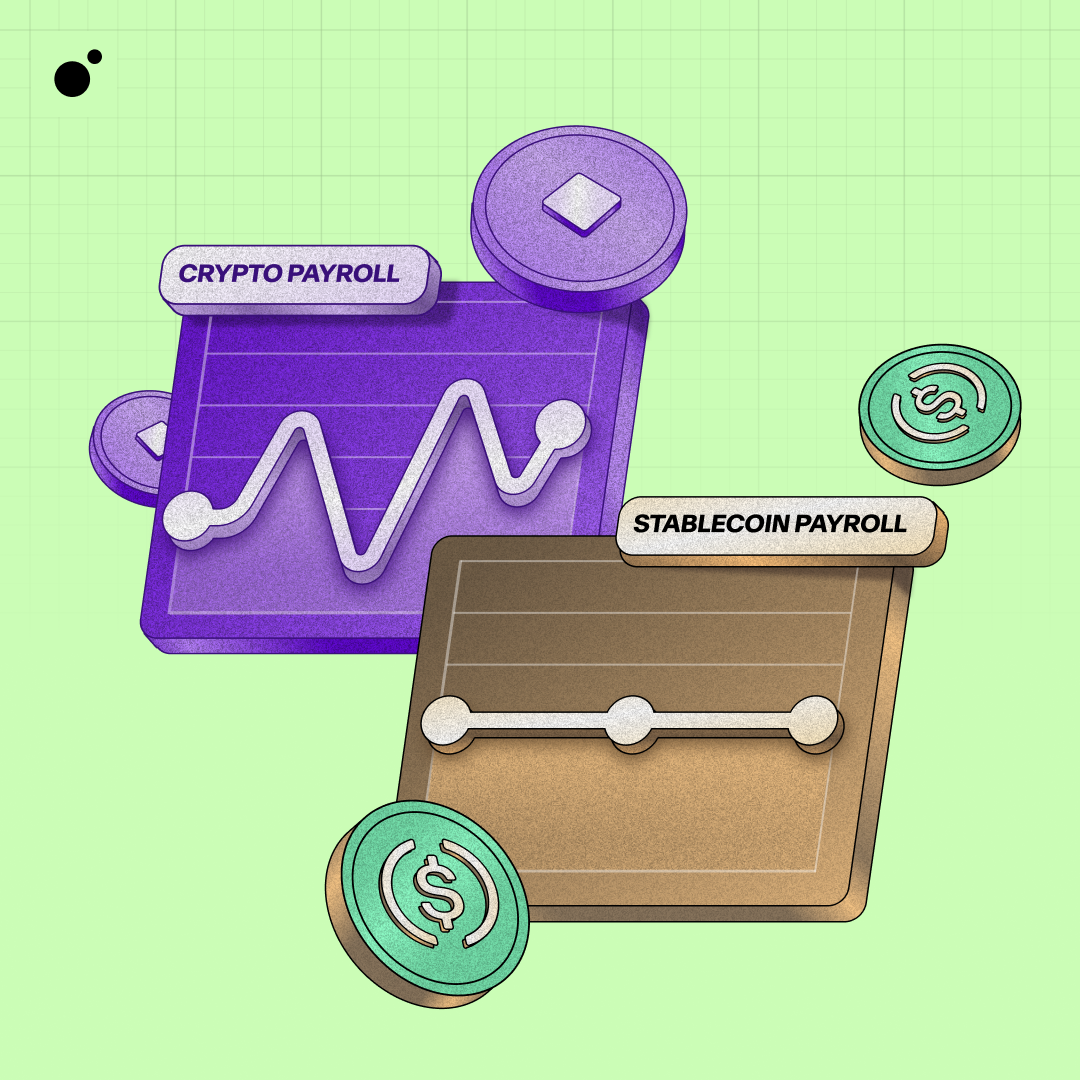
- Crypto payroll, paying workers in volatile digital assets like Bitcoin or Ether, where the fiat value of the paycheck depends on market price at conversion time.
- Stablecoin payroll, paying workers in fiat-pegged tokens like USDC or USDT, where the paycheck is denominated in USD (or EUR, etc.) but settles on a blockchain.
The distinction matters, because in 2026 the second one is eating the first. Industry reporting suggests stablecoins now account for the overwhelming majority of on-chain payroll volume, while volatile-asset payroll has receded into a niche preference for crypto-native workers. And high-profile launches, including Deel's partnership with MoonPay to route stablecoin salaries to non-custodial wallets for workers in the UK and EU (with US rollout planned in a second phase), signal that the infrastructure has moved from experimental to production-grade.
This guide breaks down how crypto payroll and stablecoin payroll actually differ, how global payouts work mechanically on each rail, what the regulatory picture looks like after the GENIUS Act and MiCA, and how to decide which model fits your business.
TL;DR
- Crypto payroll is the umbrella category: paying workers in any digital asset.
- Stablecoin payroll is the subset of crypto payroll that uses fiat-pegged tokens (USDC, USDT, DAI, PYUSD, EURC) as the payment medium. It preserves salary stability while still using blockchain rails.
- Volatile-asset payroll (paying in BTC or ETH) still exists, but is almost always employee-elected rather than employer-mandated, and usually happens after fiat calculation.
- Settlement cost and speed: stablecoin transfers on Layer-2 networks typically clear in seconds for fractions of a cent, versus 1.5% to 5% and multi-day timelines for traditional wires.
- Compliance anchor: in most jurisdictions, gross-to-net wage calculation must still happen in legal tender. Blockchain comes in at the payout step, not the calculation step.
- Regulatory backdrop: the US GENIUS Act (signed July 2025) established a federal framework for payment stablecoins; the EU's MiCA regime has been in force since 2024. Both meaningfully de-risk stablecoin payroll for employers.
Definitions: cutting through the terminology soup
What is crypto payroll?
Crypto payroll is the practice of disbursing worker compensation via blockchain-based digital assets instead of, or in addition to, traditional bank rails. It's a payment-channel choice, not a compensation structure: wages are still quoted in fiat, reported to tax authorities in fiat, and calculated in fiat. The crypto part is how the value moves from the employer's treasury to the worker's wallet.
Under the "crypto payroll" umbrella, three asset types dominate:
- Stablecoins (USDC, USDT, DAI, PYUSD, EURC)
- Major cryptocurrencies (BTC, ETH)
- Network tokens used by specific L1/L2 chains for settlement fees (not typically paid to workers)
What is stablecoin payroll?
Stablecoin payroll is crypto payroll that specifically uses fiat-pegged digital tokens as the payout currency. Every $1 of USDC is designed to be redeemable for $1 of USD. The token's issuer (Circle, in USDC's case) holds reserves, typically short-duration US Treasuries and cash, that back each token in circulation and publishes regular attestations of those reserves.
From a worker's perspective, receiving 5,000 USDC is economically equivalent to receiving $5,000, minus whatever fees apply when they off-ramp to their local fiat currency or spend directly on-chain.
What's the actual difference?
The difference comes down to who carries volatility risk.
Factor | Volatile crypto (BTC/ETH) | Stablecoin (USDC/USDT) |
Paycheck denomination | Quantity of tokens | USD amount, delivered as tokens |
Value between pay date and spending | Fluctuates with market | Stable |
Who bears price risk | Worker (or employer, by contract) | Issuer / reserve backing |
Accounting simplicity | Low — mark-to-market | High — 1:1 to fiat |
Primary use in 2026 | Employee-elected upside | Default payroll rail |
Tax reporting complexity | High | Moderate |
This is why the industry has consolidated around stablecoins: they deliver the speed and cost benefits of blockchain rails without introducing volatility into someone's rent payment.
How global payouts actually work: the mechanics
The big reason blockchain payroll exists at all is that traditional cross-border wages are expensive and slow. To see why stablecoin rails win on cost and speed, you have to look at what happens inside each pipeline.
Traditional correspondent banking (SWIFT wire)
When a US company pays a contractor in, say, Argentina via SWIFT:
- The originating bank debits the employer's account.
- Payment is routed through one or more correspondent banks (intermediaries with reciprocal accounts in multiple currencies).
- Each correspondent takes a cut: lifting fees ($15 to $30 each), FX spread on the USD-to-ARS conversion (often 1% to 3%), and settlement float.
- Receiving bank credits from the contractor's account in local currency after local compliance checks.
- Total time: 2 to 7 business days. Total cost: typically 3% to 7% all-in, with the World Bank's Remittance Prices Worldwide dataset reporting an industry-wide average of ~6.49% for consumer remittances in Q1 2025.
On a $5,000 contractor payment, that's $150 to $350 in friction every month.
Volatile crypto rails (BTC/ETH)
When an employer pays a worker in BTC:
- Employer converts USD to BTC via an OTC desk or exchange (spread and fees, ~0.5% to 1%).
- BTC is transferred on-chain from employer wallet to worker wallet (network fee: variable; historically $1 to $30 per transaction on Bitcoin L1, cents on the Lightning Network).
- Worker holds BTC, exposed to price movement between now and when they spend or convert.
- Worker off-ramps to local fiat when needed (exchange fees and FX spread, ~0.5% to 2%).
The volatility problem: between steps 2 and 4, the value of that "paycheck" can move 5%, 10%, or more. That's unacceptable for rent, groceries, or tuition. This is precisely why volatile-asset payroll never scaled.
Stablecoin rails (USDC/USDT on L2)
When an employer pays a worker in USDC on a Layer-2 network like Polygon, Base, or Arbitrum:
- Employer funds payroll in USDC (either from on-chain treasury or by converting USD to USDC at 1:1 minus a small issuer fee).
- Payroll platform sends USDC on-chain from employer wallet to worker wallet (network fee: typically fractions of a cent on L2s; a few dollars on Ethereum mainnet).
- Worker receives USDC within seconds, denominated in USD.
- Worker then either holds USDC in a self-custody wallet, spends directly via a crypto debit card, or off-ramps to local fiat through a licensed on-ramp and off-ramp provider (typically 0.1% to 1%).
Total time: seconds to minutes. Total cost (employer side): often under 0.1% of payroll value when using L2 networks. Worker-side off-ramp varies by corridor, but is typically lower than correspondent banking.
Side-by-side cost math for a $5,000 international payment
Rail | Employer cost | Worker cost | Settlement |
SWIFT wire | $25–$50 + 1–3% FX | $5–$25 local fee | 2–7 days |
Bitcoin (L1) | ~$15 + 0.5–1% spread | 0.5–2% + FX | Minutes (volatile) |
USDC on Polygon | <$0.01 + ~0% issuer | 0.1–1% off-ramp | Seconds (stable) |
USDC on Ethereum L1 | $2–$15 network | 0.1–1% off-ramp | 1–3 minutes (stable) |
For a company paying 100 contractors $5,000 per month each internationally, the annual difference between SWIFT and stablecoin rails is often $200,000 or more in direct fees alone, before accounting for FX markups and float.
Why stablecoins became the default in 2025 to 2026
Three things converged to make stablecoin payroll the dominant model.
First, issuer maturity and attestations. Circle took USDC issuer Circle Internet Group public via an NYSE IPO in June 2025 (ticker CRCL) and operates under a regulatory regime that includes monthly reserve attestations by Big Four auditors. Tether has significantly improved its transparency reporting. For CFOs, "the stablecoin might depeg" stopped being a credible Tier-1 risk for the major issuers.
Second, regulatory clarity in the US and EU. The GENIUS Act, signed into US law in July 2025, created a federal framework for payment stablecoins with issuer licensing, reserve requirements, and redemption rights. In the EU, MiCA has been in force for crypto-asset service providers since mid-2024. Employers who previously needed to navigate fragmented state-level money transmitter rules now have a clearer federal playbook.
Third, Layer-2 settlement costs collapsed. Polygon, Base, Arbitrum, and Optimism brought per-transaction costs down to fractions of a cent with sub-3-second finality. This made high-volume payroll, where a company might run 10,000 individual payouts in a single cycle, economically viable in ways Ethereum L1 was not.
The downstream signal: major global employment platforms are building stablecoin payout rails directly into their products. Deel, which processes $22 billion in payroll annually across 150+ countries, partnered with MoonPay to provide enterprise-grade stablecoin infrastructure for salary payouts, starting with UK and EU workers in March 2026 and expanding to the US in a second phase. Rise has processed over $1 billion in payroll volume with stablecoins representing the majority of worker-side withdrawals. Bitwage, BVNK, Request Finance, and others occupy similar territory.
The five operational models
In practice, "crypto payroll" encompasses five operational models, not one. Understanding which one you're actually deploying is the difference between a clean compliance posture and a regulatory headache.
Model 1: pure volatile-asset payroll
The employer pays workers directly in BTC or ETH. Wages are often still quoted in fiat, but the payout is denominated in tokens at a locked conversion rate. Rare in 2026, and mostly limited to crypto-native companies whose employees actively prefer asset exposure.
Model 2: pure stablecoin payroll
The employer funds payroll in a stablecoin (typically USDC or USDT, though the leading stablecoins used for payouts now include a broader set) and pays workers in the same asset. Gross-to-net calculation happens in fiat, but the entire payout rail is on-chain. Common for globally distributed contractor bases and Web3-native teams.
Model 3: hybrid fiat + crypto (the Deel/Rise model)
Payroll is calculated and processed entirely in fiat, with all statutory obligations met in legal tender. Then, the worker can elect to convert some or all of their net pay into a stablecoin or other digital asset post-calculation, through a regulated provider. This is the model most large payroll platforms use for US employees because it keeps wage-and-hour law completely untouched.
Model 4: on-chain salary streaming
Smart contracts release salary continuously, by the second, rather than in pay periods. Services like Sablier and Superfluid operate here. Workers can withdraw accrued wages at any moment. Niche but growing for DAOs and crypto-native organizations.
Model 5: EOR with stablecoin rails
A global Employer of Record handles the statutory compliance locally (country-specific contracts, tax withholding, benefits), then settles net pay to the worker's wallet in stablecoins. Combines the compliance umbrella of traditional EOR with the speed of crypto rails. Fastest-growing model for distributed teams entering new countries without local entities.
The regulatory landscape
The single biggest change between "crypto payroll in 2023" and "crypto payroll in 2026" is that regulators stopped being silent.
United States
- GENIUS Act (July 2025): federal framework for payment stablecoins. Issuers must be licensed, hold 1:1 reserves in high-quality liquid assets (cash and short-duration Treasuries), publish regular disclosures, and honor redemption on demand. Non-compliant stablecoins cannot be offered to US persons.
- IRS classification: crypto is property, not currency. Any crypto paid as wages must be valued at fair market value at the time of transfer and reported as wages in fiat on W-2s or 1099s. Subsequent disposition is a taxable event.
- State-level wage laws: most states require wages to be paid in US legal tender. This is why the hybrid model — fiat wage paid, then optionally converted post-net — has become the predominant structure for US employees.
- Contractors: have more flexibility. A 1099 contractor can generally accept crypto directly, with the fair market value at receipt reported as ordinary income.
European Union
- MiCA (Markets in Crypto-Assets Regulation): fully in force since late 2024 for crypto-asset service providers. Creates a single licensing regime across the EU for stablecoin issuers (e-money tokens and asset-referenced tokens), custody providers, and exchanges.
- Payroll implications: stablecoin payroll is broadly permissible for contractors. Employee wages generally must follow national labor law, which in most member states requires payment in legal tender or a bank account; stablecoins as post-net conversion remain the safest structure.
Country-by-country snapshot
Jurisdiction | Contractor in crypto | Employee wage direct | Notes |
United States | Generally permissible | Restricted by state law | Hybrid model dominant |
United Kingdom | Permissible | Generally restricted | FCA AML rules apply |
EU (MiCA) | Permissible under MiCA | Generally restricted | Varies by member state |
UAE | Permissible in free zones | Permissible in VARA zones | Leading crypto payroll hub |
Singapore | Permissible under MAS | Restricted by Employment Act | Strong institutional adoption |
Argentina / Brazil / Mexico | Widely used | Grey zone | High inflation drives demand |
Nigeria | Permissible | Grey zone | Largest African crypto payroll market |
Japan | Restricted | Prohibited | Strict currency requirements |
China | Prohibited | Prohibited | Both models banned |
India | Permissible | Grey zone | 30% crypto tax on gains |
The takeaway: for contractor payments, most jurisdictions are either permissive or silent. For employee wages, you almost always need to process through fiat first and offer crypto as a post-net conversion option.
Decision framework: which model fits your business?
Start here: what are you paying?
Paying contractors internationally
- Small team (<20), mostly US/EU: SWIFT is fine; the overhead of setting up crypto payroll isn't worth the savings. Revisit when international spend crosses ~$50K per month.
- Distributed team (20–200), mixed regions including emerging markets: stablecoin payroll via a platform (Request Finance, Rise, Bitwage, or similar) typically saves 2% to 4% of payroll plus cuts settlement time from days to minutes. Strong fit.
- Crypto-native company (DAO, Web3 foundation, protocol team): on-chain streaming or native stablecoin payroll with multisig treasury. Consider Sablier, Superfluid, or a dedicated payroll platform.
Paying employees (W-2 or local equivalents)
- US or EU employees: run standard fiat payroll. Offer stablecoin payout as a post-net conversion option through a regulated partner (Deel + MoonPay, Coinbase, Rise, Bitwage). Do not try to pay wages directly in crypto.
- Employees in high-inflation economies via EOR: use an EOR with stablecoin rails. The EOR handles local compliance; net pay lands in the worker's wallet in USDC.
Paying yourself or a handful of co-founders
Legal advice first, then usually: salary via standard payroll, distributions via any rail you prefer. Don't get creative with wage payments for founders-as-employees.
Key questions to pressure-test your choice
- Do we need our wage statements to show payment in legal tender? If yes, use Model 3 (hybrid) or Model 5 (EOR).
- Do workers actually want this? Survey before committing. Stablecoin demand is high among distributed tech teams; near-zero among, say, US-based hourly staff.
- What's our treasury comfortable with? Holding stablecoins on a corporate balance sheet has accounting and tax implications; consult your auditor on fair-value measurement under current guidance.
- Who's our worst-case jurisdiction? If you have a single worker in a restrictive country, it's often easier to keep everyone on a compatible rail than to run two systems.
The CFO / treasury playbook
Crypto payroll creates a few operational questions that HR-led implementations often miss. If finance isn't at the table, these bite later.
Reserve policy. Decide whether you hold stablecoins permanently on-balance-sheet (a "stablecoin treasury") or convert in and out around each pay cycle. Holding creates an FX-like exposure to depeg events (rare but non-zero); just-in-time conversion avoids this but adds operational steps.
Chain selection. Not all L2s are equal. Polygon, Base, Arbitrum, and Optimism are the dominant choices for payroll because they combine low fees with sufficient liquidity for off-ramps. Using an obscure chain may save a few cents per transaction but introduces off-ramp friction for workers.
Multisig and custody. Payroll wallets should be multisig (Gnosis Safe, Fireblocks, or similar) with clear approval policies. Single-signer hot wallets are the single largest source of payroll fraud in crypto-native companies.
Accounting integration. Your crypto payroll provider should export transactions in a format your accounting system (QuickBooks, NetSuite, Xero) can ingest. Fair-market-value capture at the moment of payment is non-negotiable for tax purposes.
Reconciliation. Every on-chain transaction has a deterministic hash. This actually makes reconciliation easier than traditional ACH or wire, if your systems are set up for it. Auditors increasingly accept on-chain proofs as primary evidence.
Counterparty concentration. If you settle all payroll in USDC, you're implicitly long Circle and its reserve portfolio. Some treasuries deliberately split between USDC and USDT (or add PYUSD) to reduce single-issuer risk, the same way you wouldn't keep all corporate cash at one bank.
Common pitfalls
Treating "pay in crypto" as a wage decision. In most jurisdictions, wages must be paid in legal tender. Crypto payroll is a post-wage conversion, not a wage substitution. Getting this wrong is the most common compliance failure.
Forgetting fair-market-value capture. The IRS (and most equivalent tax authorities) requires the FMV of crypto wages at the moment of payment. If your tooling doesn't capture this automatically, you're creating a manual reconciliation nightmare.
Mixing employee and contractor flows. Contractors have broad flexibility; employees almost always don't. Running both on the same rail without differentiated workflows leads to mistakes.
Wallet custody confusion. Who holds the keys? If workers use self-custody wallets and lose their seed phrase, the employer typically has no recourse and the funds are gone. Onboarding education here is not optional.
Volatility exposure for employees who don't want it. Defaulting workers into BTC or ETH without explicit opt-in creates real harm. Stablecoin default with optional conversion is the safer posture.
Ignoring local sanctions and AML screening. On-chain transfers are traceable, which means sanctioned wallet addresses are visible. Payroll platforms should screen against OFAC's SDN list and equivalent sanctions lists in every relevant jurisdiction.
How to actually start: a practical rollout
If you've decided stablecoin payroll is the right move, here's a pragmatic sequence:
- Survey your workers. Find out who actually wants this. You'll likely discover the demand is concentrated in 20% to 40% of your distributed team, not 100%.
- Verify legality in every jurisdiction where you pay. Produce a written matrix: employees vs. contractors, permitted or not, any local restrictions, required disclosures.
- Pick a platform, not a script. The DIY wallet-to-wallet approach creates audit and compliance gaps. Use a platform that handles KYC, AML screening, FMV capture, reporting, and off-ramps. Major options: Rise, Deel, Bitwage, Request Finance, Franklin, BVNK.
- Start with contractors in one or two corridors. The highest-impact corridors are typically US-to-LatAm, US-to-SEA, and EU-to-Africa. Run a 90-day pilot with volunteer contractors before expanding.
- Write a policy. One page. Who's eligible, what rails, what assets, what conversion timing, what happens if the stablecoin depegs, what happens if a worker loses wallet access. Get legal to review it.
- Integrate with accounting from day one. Don't try to reconcile three months later. On-chain makes this easier than fiat, but only if you set it up properly.
- Measure and expand. Track: percent of workers electing crypto, average settlement time, total fees saved vs. SWIFT baseline, support ticket volume. If the numbers are what you expected, roll out to more corridors.
The tooling landscape (neutral snapshot)
No single platform dominates, but here's a rough map of who does what.
Rise runs end-to-end hybrid fiat and crypto payroll with a strong Circle integration for native USDC, focused on mid-market global teams.
Deel is the global EOR and payroll incumbent; stablecoin payouts were added through a partnership with MoonPay and a separate Coinbase integration. Focus: enterprise and scale.
Bitwage is one of the earliest crypto payroll services, with broad asset support. Focus: SMB and contractor-heavy teams.
Request Finance offers invoicing and payroll for crypto-native companies and DAOs. Focus: Web3 organizations.
BVNK is a stablecoin infrastructure platform used behind the scenes by enterprises for stablecoin settlement. Focus: B2B infrastructure.
Franklin delivers payroll for Web3 teams with a strong stablecoin-first posture.
Remote, Rippling, and Gusto are traditional payroll incumbents; most have added some degree of stablecoin payout via partnerships but aren't crypto-first.
Choose based on your worker mix (contractors vs. employees), geographic footprint, and whether you need a full EOR or just a payout rail.
FAQs
Is stablecoin payroll legal in the US?
Paying contractors in stablecoins is generally permissible. Paying employee wages directly in stablecoins runs into state wage-payment laws in most states, which is why the hybrid model (fiat wages + optional post-net stablecoin conversion) is the standard for US employees.
How is crypto payroll taxed?
In the US, the IRS classifies crypto as property. Wages paid in crypto are taxed as ordinary income at fair market value at the time of receipt, reported on W-2 or 1099 in USD. Subsequent sale or conversion is a separate capital gains event. Most other OECD jurisdictions follow similar frameworks; specifics vary.
What's the difference between USDC and USDT for payroll?
Both are USD-pegged and widely used. USDC (Circle) operates under a clearer US regulatory framework with monthly reserve attestations by Big Four auditors and is generally preferred for enterprise compliance. USDT (Tether) has higher global liquidity and broader exchange support, particularly in emerging markets. Many payroll platforms support both and let the worker choose.
Can a worker lose their paycheck if they mess up their wallet?
Yes. If using self-custody, a lost seed phrase means lost funds. Platforms with custodial or hybrid wallet models reduce this risk. Worker education at onboarding is critical.
What happens if a stablecoin depegs?
Major regulated stablecoins (USDC, USDT, PYUSD) have robust reserve backing and redemption mechanisms. A brief depeg occurred with USDC during the March 2023 Silicon Valley Bank incident and was resolved within days. For payroll, the mitigation is: don't hold stablecoins longer than you need to, and diversify across issuers if you run a sizable stablecoin treasury.
Do I need separate crypto payroll for contractors vs. employees?
Usually yes. Contractors have far more flexibility in most jurisdictions, while employee wages are constrained by local labor law. Most platforms handle both, but with different workflows. Don't try to unify them at the process level.
How fast is stablecoin payroll really?
On L2 networks (Polygon, Base, Arbitrum, Optimism), settlement is typically 1 to 5 seconds. On Ethereum L1, 1 to 3 minutes. Worker off-ramp to local fiat varies: instant in many corridors, up to a business day in others with strict banking integration.
Is this just for crypto companies?
No, and increasingly not. The companies driving crypto payroll adoption in 2025 to 2026 are remote-first SaaS companies, agencies, fintechs, and traditional enterprises with distributed contractor bases. Crypto-native firms were early adopters; they're no longer the only buyers.
Bottom line
"Crypto payroll vs stablecoin payroll" is a bit of a false dichotomy. Stablecoin payroll is the mature form of crypto payroll — the version that kept the infrastructure benefits (speed, cost, borderlessness) and dropped the thing employers and workers didn't want (volatility).
For internationally distributed teams in 2026, the cost and speed advantages of blockchain rails are too significant to ignore. The decision is how to implement: which model (pure stablecoin, hybrid, EOR-routed), which platform, which jurisdictions first, and how to structure the policy so that compliance, treasury, and worker experience all hold up at scale.
Get those four decisions right and global payouts stop being a monthly tax on your business. Get them wrong and you'll spend a year unwinding the mess. The good news is that in 2026, the right answer is more legible than it has ever been.