
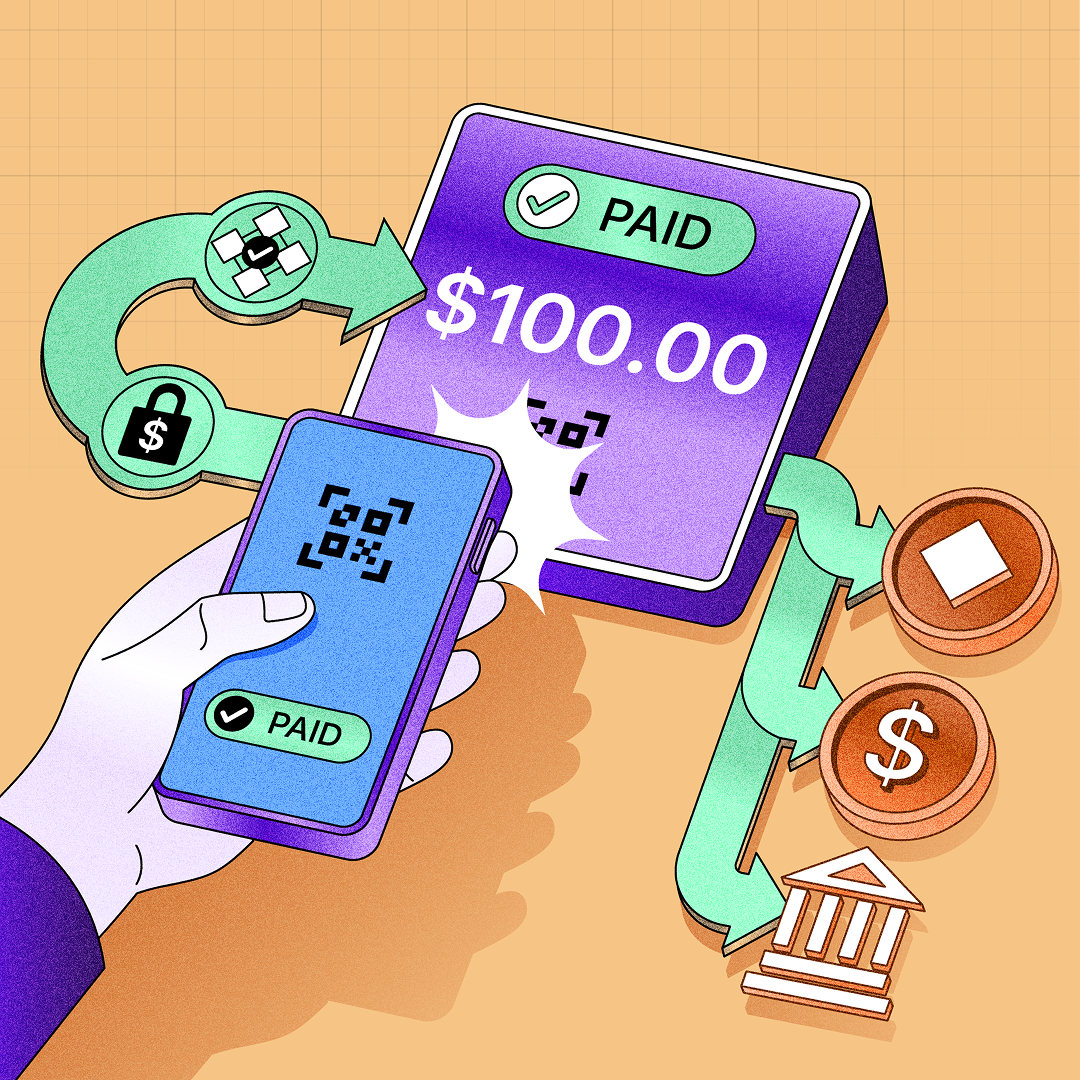
A customer just bought a $100 hoodie from your online store and paid in crypto. Quick question: where is that $100 right now?
If you can answer that at every step, from the click to the money landing in your bank account, you understand how to accept crypto payments better than plenty of merchants already doing it. Most guides hand you a numbered list and wish you luck. This one follows the money instead: what happens at checkout, what settlement really means, what you set up beforehand, and what to do on the rare day a payment goes sideways. Along the way we'll run the same sale through an online store, a market stall, a subscription, and a cross-border invoice, because accepting crypto looks different depending on where you sell.
In short: To accept crypto payments, you open an account with a crypto payment platform such as MoonPay Commerce, verify your business, choose which coins to accept and what you want to be paid in (crypto, stablecoins, or your local currency), then add a checkout, pay link, or plugin wherever you sell. On modern platforms the whole setup is a same-day job, and most of it takes minutes.
What accepting crypto payments means
Accepting crypto means letting customers pay you from a crypto wallet, with value moving over a blockchain instead of a card network. The customer sends digital money. You decide what you end up holding: the crypto itself, stablecoins, or regular money in the bank. That choice matters more than any other part of the setup, and we'll get to it.
It helps to know who pays this way, because it isn't one audience. The first group is crypto-native customers, people who already keep crypto in digital wallets and choose to use their existing assets for purchases. . The second is bigger and less obvious: customers whose cards don't travel well. A buyer in Buenos Aires or Lagos who wants your $100 product may have an international card that declines half the time and a local currency that moves against them weekly, but a stablecoin transfer from their wallet arrives the same way yours would. The third group is brand new and doesn't have hands: AI agents with funded wallets are starting to pay for services, subscriptions, and API access on their own, which is why agentic payments run on crypto rails almost by default.
Across all three groups, the money that behaves like payments rather than trading moves overwhelmingly in stablecoins, tokens like USDC and USDT built to hold a steady dollar value. So the practical version of accepting crypto in 2026 is this: accept stablecoins, add Bitcoin and Ethereum for the customers who ask by name, and let a platform handle the machinery. The rest of this guide shows what that machinery does.
Before the first sale: the 20-minute setup
Everything a payment needs is decided before the first customer clicks. Four decisions, none of which requires an engineer.
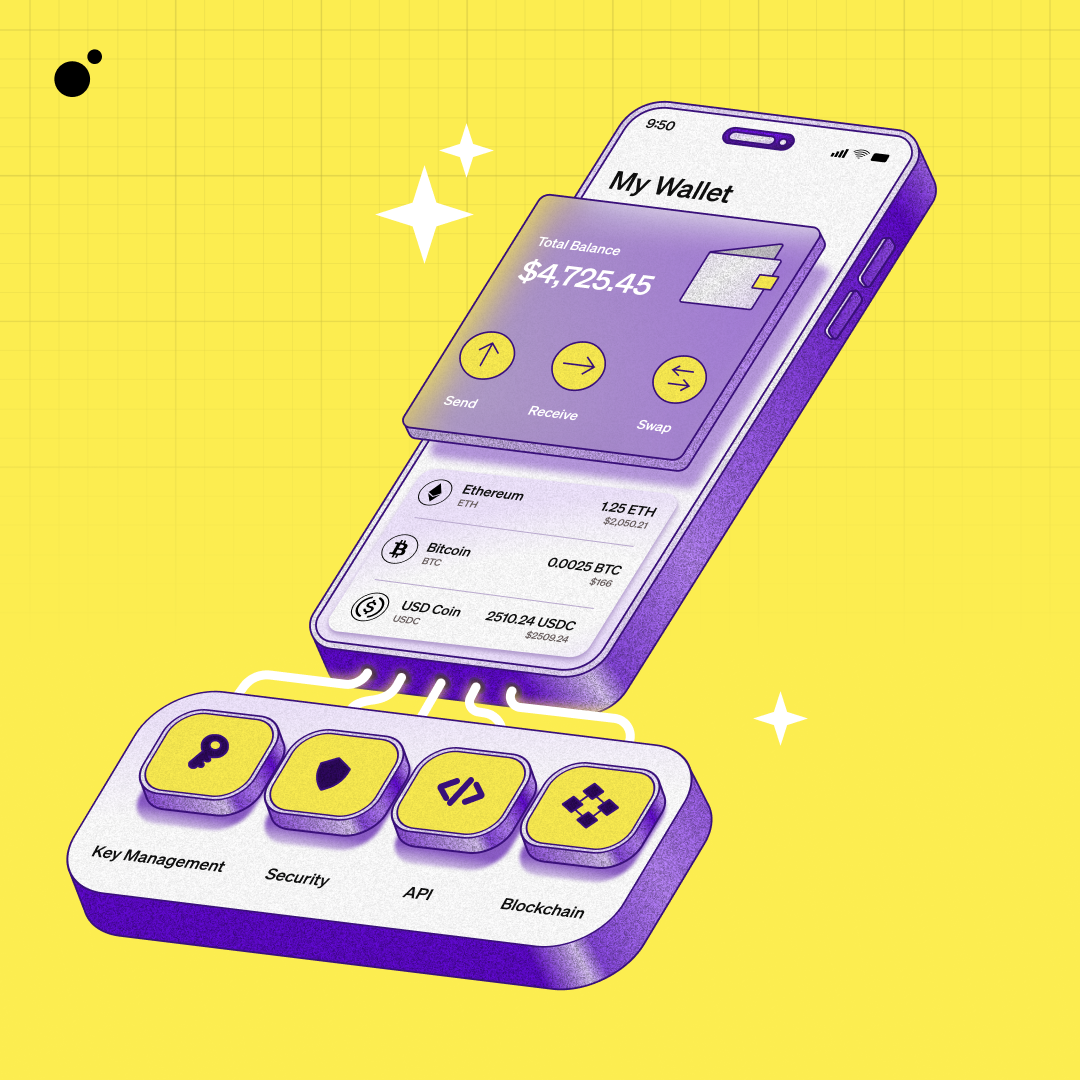
First, the provider. Most businesses use a crypto payment gateway, also called a crypto payment processor: a service that generates a unique payment address for each order, watches the blockchain, confirms the money arrived, converts it if you want, and pays you out. A card processor, in other words, rebuilt for blockchains. Other paths exist. You can take payments straight into a wallet you control, which means matching payments to orders yourself and carrying the compliance load alone, or run your own open-source payment server if you have the technical appetite. Builders deciding how keys should be held at scale usually end up comparing MPC wallets and wallet-as-a-service models, the tier MoonPay Institutional is built for. Everyone else starts with a platform. This guide uses MoonPay Commerce, MoonPay’s crypto payments infrastructure, as its running example, but the mechanics below apply anywhere.
Second, the paperwork. Payment platforms are regulated companies, so expect business verification before money moves: registration documents, ownership details, and a bank account if you want payouts in regular currency. It's the same anti-money-laundering routine any payment company runs, and it protects you as much as anyone, since it's the reason the platform can screen the payments coming in. Have your registration number and director details ready and, on a self-serve platform, verification takes anywhere from minutes to a few days.
Third, the coins. Start with stablecoins, because that's where payment volume lives, and read up on the difference between USDT and USDC before picking defaults, since regulation treats them differently in some regions. Add Bitcoin and Ethereum for recognition. Ten coins at launch impresses nobody and complicates your books. One more thing to notice now, because it matters later: the same stablecoin exists on several networks (USDC lives on Ethereum, Solana, Base, and more), and your platform will quote and accept specific ones.
Fourth, the surface. Where does the payment physically happen? This is where accepting crypto stops being one product and becomes six, and each has a natural owner:
- A hosted checkout for an online store. The customer clicks pay with crypto and lands on a payment page your platform maintains. This is our hoodie store's pick.
- A pay link for selling anywhere. The link is its own checkout, shareable by text, email, or bio. A ceramicist at a weekend market tapes the QR version to her stall and takes USDC between card customers, with nothing to install and no terminal to rent.
- A plugin for e-commerce platforms. MoonPay Commerce powers and maintains the Solana Pay integration for Shopify, so a Shopify store adds crypto at checkout without writing code.
- Subscriptions for anything recurring. A newsletter bills monthly and gates its Discord behind an active subscription; a SaaS does the same with seats.
- Deposits for platforms. Trading apps and gaming products let users top up balances in crypto, which is a payment flow of its own.
- An API for developers. SDKs and webhooks let you build the whole flow into your product and keep your own interface.
Pick the surface that matches where you sell today. The rest can wait, and adding a second one later is a settings change, not a project. On a self-serve platform, all four decisions fit inside a lunch break. The interesting part is what happens when someone pays.
Follow the $100
Back to the hoodie. Here is the whole journey, from click to ledger. It assumes a stablecoin on a modern network, which is the typical case; Bitcoin's base layer runs slower, and we'll flag where.
The price locks
Your customer picks pay with crypto and chooses a coin, say USDC. The checkout quotes the exact amount owed at the live exchange rate and holds that price for a short window, typically 10 to 15 minutes, so nobody is exposed to a rate change mid-payment. It also generates a one-time address or QR code that belongs to this order alone, which is how the platform knows this specific $100 is for this specific hoodie. Nothing gets matched by hand later.
This is also the moment crypto quietly solves a problem cards never did. The customer in Buenos Aires whose international card keeps declining sees the same USDC price as everyone else, and her payment will travel exactly the same way. There is no such thing as a cross-border crypto transaction. There are just transactions.
The wallet does the work
The customer scans the code with their wallet app, checks the amount, and approves. That is the entire form. No 16-digit card number, no expiry date, no billing address typed with thumbs. Wallets have come a long way; smart wallets confirm this step with a face scan.
And when the customer holds no crypto at all? Checkouts like MoonPay Commerce include Pay with Card: the customer pays the way they always do, and you still receive crypto on your side, with onramp rails like MoonPay's doing the conversion in between. Your reachable market is every customer, not just the ones with wallets. It's the detail that turns crypto acceptance from a niche gesture into a payment method.
The network confirms
Here is the part card processing splits into three separate events. A card payment is authorized in seconds, cleared that night, and settled days later, and each stage can disagree with the last. On a blockchain, one confirmation does all three jobs at once: the network checks the funds exist, records the transfer, and makes it final in the same motion. Confirmations are the network's version of double-checking. Each new block stacked on top of the one holding your payment makes reversing it harder, and your platform waits for enough of them to call the payment final.
On fast networks, a stablecoin payment confirms in seconds. Bitcoin's base layer is the slow lane at 10 to 60 minutes. Either way, once the required confirmations land, your platform pings your store through a webhook, the order flips to paid, and the hoodie is safe to ship. There is no pending authorization that might evaporate next week.
The settlement fork
Now the money is yours, and the one real strategic decision in crypto acceptance arrives: what do you want to be holding? Three roads.
Keep the crypto, and it sits in a wallet as the asset the customer sent. If its price moves before you sell, that change belongs to you, in both directions. Some crypto-native businesses want exactly this, because their expenses live in the same coins as their revenue.
Settle in stablecoins, and the value parks in digital dollars the moment the payment confirms. Nothing to watch, and you convert to bank money on your own schedule. On MoonPay Commerce this is the default: payments settle instantly in stablecoins to your wallet, in seconds rather than statements. It's also why the same rails now carry payroll for global teams, because money that settles instantly in one direction settles instantly in the other.
Auto-convert to fiat, and the platform sells at the rate locked at checkout and sends USD, EUR, or GBP to your bank on its payout schedule, often the same day. You pay a conversion spread for the convenience, and your books never touch a crypto asset at all.
The fork matters most where the old rails are worst. A design freelancer invoicing a client in Singapore knows the routine: the wire takes days, costs a flat fee at both ends, and loses a spread in the FX conversion nobody itemizes. A USDC invoice settles in minutes at any hour on any day, and the fork above decides what lands in her books. For contrast, a domestic card sale typically reaches your account in one to three business days. On the fastest crypto road, the $100 is spendable value before the customer has closed the tab.
Month end
Whichever road you took, your books record $100 of revenue at the moment of payment, valued in your local currency. Convert instantly and the sale looks like any other line item. Hold, and the gap between the price then and the price when you sell becomes its own line. Your accountant will have questions. We've collected them below.
When the $100 goes sideways
Most crypto payments are boring, which is the point. But five things occasionally happen, and the difference between a good and a bad first month is knowing them in advance.
The underpayment
$98.40 arrives against a $100 invoice, because the customer paid from an exchange account that shaved a withdrawal fee on the way out. Platforms flag partial payments automatically, and your options are to request the remainder or refund what came in. Nothing ships until the invoice closes. Decide the policy once, in settings, and the software enforces it while you sleep.
The overpayment
The reverse, and easier: refund the difference, keep the sale, and enjoy the rare support ticket that ends with everyone pleased.
The expired quote
The customer found the right wallet, then the right account, then got a phone call, and approved the payment 22 minutes after the 15-minute price window closed. The exchange rate has moved since. Platforms either honor a small tolerance or hold the payment for review so you can decide. The money isn't lost either way. It's waiting for a human.
The wrong network
The same stablecoin exists on several blockchains, and USDC sent over the wrong one lands at a wallet address on a network your order isn't watching. This is the mistake customers fear most, and the reason a good checkout displays the network in large friendly letters and only shows addresses for networks it accepts, which removes most of the risk before it exists. Recovery is sometimes possible, but slow. Prevention is the whole game here, and it's a checkout design problem, not a customer intelligence problem.
The refund request
Crypto has no chargebacks. Once confirmed, a payment can't be pulled back by a bank, which closes off an entire category of fraud along with the fees and paperwork that came with it. It also means refunds become your policy rather than a card network's obligation, so write the policy down before launch.
The two honest versions: return the same coin amount the customer paid, or return the fiat value at the time of purchase. They diverge whenever prices move. Suppose an order was paid in a coin that has risen 10% since: a same-coin refund returns the original amount, now worth about $110, while a fiat-value refund returns $100 worth of the coin. Neither is wrong, but publish which one you do at checkout, and note that for stablecoin payments the two numbers are nearly identical, which is one more argument for stablecoins. And know the trade you've made: disputes that used to land at the card network now land in your support inbox. Most merchants consider that a good deal. It is still a trade.
The receipt: what the $100 costs
Run the same hoodie through both rails, using typical published rates.
Card | Crypto via a payment platform | |
Processing fee | 2.9% + $0.30 (typical online rate) | 0.5% to 1% |
You keep | $96.80 | around $99 |
Money available | 1 to 3 business days | seconds to same day |
Reversible | chargeback window stays open for months | final once confirmed |
Three costs the table doesn't show. If you auto-convert to fiat, a conversion spread sits on top of the processing fee. The blockchain itself charges a network fee, usually cents on modern networks and more on Bitcoin's base layer, and checkouts differ on who pays it. And the largest cost is invisible: fewer of your customers hold crypto than hold cards, so this is an added rail that wins you new buyers rather than a replacement for the old one.
The comparison tilts further the moment your customers stop being domestic. Cross-border card payments stack international fees on top of base rates, decline more often, and pay out slower, while a crypto payment from abroad is mechanically identical to one from across the street: same fee, same speed, same finality. If your customers are global, this is where the rail earns its place. Exact rates vary by provider and volume, so read the fee schedule the way you'd read any processor's.
Five questions your accountant will ask
No FAQ at the end of this one. These five questions do the same job, and unlike an FAQ, someone will genuinely ask them.
What was it worth when you got paid?
The value of the crypto in your local currency at the moment of payment is your revenue, and it's also your cost basis for whatever you received. Your platform's transaction export should show this per payment, alongside the coin, the amount, and the order it belongs to. If it doesn't, find a platform whose export does, because rebuilding this by hand at year end is nobody's favorite January.
Did you convert or hold?
Instant conversion keeps the books boring, which in accounting is a compliment. Holding means the difference between the value at receipt and the value when you sell shows up as a gain or a loss, with its own reporting. Neither answer is wrong. The point is deciding on purpose rather than discovering your treasury policy by accident, and stablecoin settlement barely moves this needle at all, which is a large part of its appeal.
How did you refund that order in March?
Same-coin refunds and fiat-value refunds book differently, because one returns an asset and the other returns a value. Whichever policy you chose in the section above, apply it consistently and note it in your records, so March's refund and October's refund tell the same story.
Where are the records?
Every payment needs a transaction hash, a timestamp, the amount, its value at receipt, and the order it belongs to. The blockchain keeps its half of the record forever, publicly, which auditors have been known to appreciate. Keep your half somewhere your accounting software can reach.
Who's checking this?
Tax treatment of crypto payments differs by country and keeps changing, and this article is education, not tax advice. The honest fifth answer is a bookkeeper or accountant who has seen a crypto ledger before. They exist now, in normal accounting firms, at normal rates. Find one before your first filing, not after.
Start accepting crypto payments with MoonPay
The fastest way to test everything in this article is to run a real payment through it.
MoonPay Commerce gives merchants, creators, and developers a crypto checkout that works across web, apps, and Shopify: hosted checkouts, pay links you can share anywhere, subscriptions, and deposits, with the Solana Pay integration for Shopify built and maintained by MoonPay. Payments settle instantly in stablecoins, or auto-convert to USD, EUR, or GBP and pay out to your bank. Pay with Card means customers without any crypto can still buy from you while you receive crypto all the same.
More than 6,000 merchants and partners run on it, including the Solana Foundation, Ledger, Jupiter, Fortune Media, and Dorsia, and the toolkit goes past the basics: split payments across multiple wallets, gate a Discord or Telegram behind a subscription, run timed sales, track affiliates. Developers get APIs, SDKs, and webhooks for fully custom flows, and MoonPay's wider business platform covers the ramps and stablecoin infrastructure around it. Setup is self-serve and takes minutes, which makes the 20-minute estimate earlier in this article generous.
Accepting crypto doesn't change what you sell. It changes how far your checkout reaches and how fast the money lands.

.png?w=3840&q=90)