
President Donald Trump has nominated Michael “Mike” Selig to serve as Chair of the Commodity Futures Trading Commission (CFTC), the agency responsible for overseeing markets in derivatives (financial contracts “derived” from the price of an underlying asset) and an expanding segment of digital asset trading.
He succeeds Caroline Pham, who has served as Acting Chair since early 2025.
Position on crypto
Selig has argued for clearer, more consistent rules for crypto markets. At the SEC’s Crypto Task Force, he called for replacing “regulation by enforcement” with defined pathways for registration and compliance. He supports policies that encourage innovation while maintaining market integrity and has said that oversight should “meet the industry where it operates.”
His nomination aligns with the administration’s goal of making the United States a global leader in crypto markets.
Career snapshot
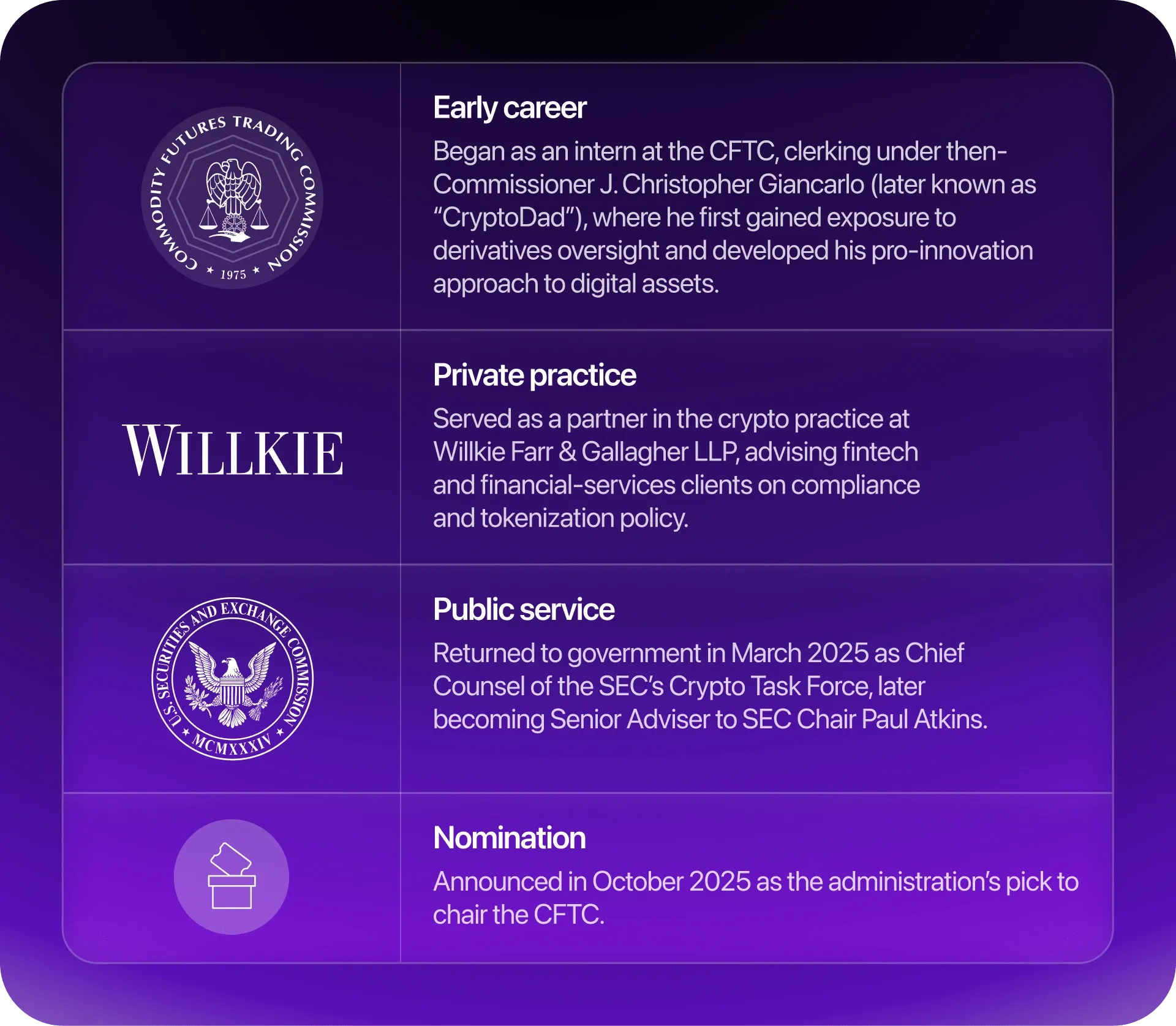
Selig currently serves as Chief Counsel of the SEC’s Crypto Task Force and Senior Adviser to SEC Chair Paul Atkins. In these positions, he has helped shape a more structured framework for crypto regulation, focusing on guidance and engagement with industry stakeholders.
“I pledge to work tirelessly to facilitate Well-Functioning Commodity Markets, promote Freedom, Competition and Innovation, and help the President make the United States the Crypto Capital of the World.” — Mike Selig on X
How does the CFTC regulate crypto?
Derivatives, financial contracts based on the price of an underlying asset, have existed for centuries, from early grain futures to today’s sophisticated financial instruments. The CFTC oversees the markets where these products trade. Its remit now includes crypto derivatives, such as futures and options tied to digital assets, making it a key player in connecting crypto markets to the broader financial system.
The road ahead
If confirmed, Selig is expected to align CFTC oversight with broader U.S. frameworks and support supervised crypto-derivatives pilots and sandboxes.
His nomination signals a pro-innovation shift that could shape future policy on market structure, trading platforms, and asset classification.