

Every crypto wallet is controlled by a private key, or a secret number that authorizes transactions. Whoever holds the key controls the assets.
Multi-party computation, or MPC, is an upgrade to how crypto wallets handle security, distributing key control instead of concentrating it in one place.
How MPC works
Instead of a single key sitting on one device, MPC splits the key into separate pieces and distributes them across multiple parties or devices. No single piece is enough to move funds on its own. When a transaction needs to be approved, each party contributes their piece to a shared computation. The result is a valid signature, but the full key is never assembled anywhere in that process.
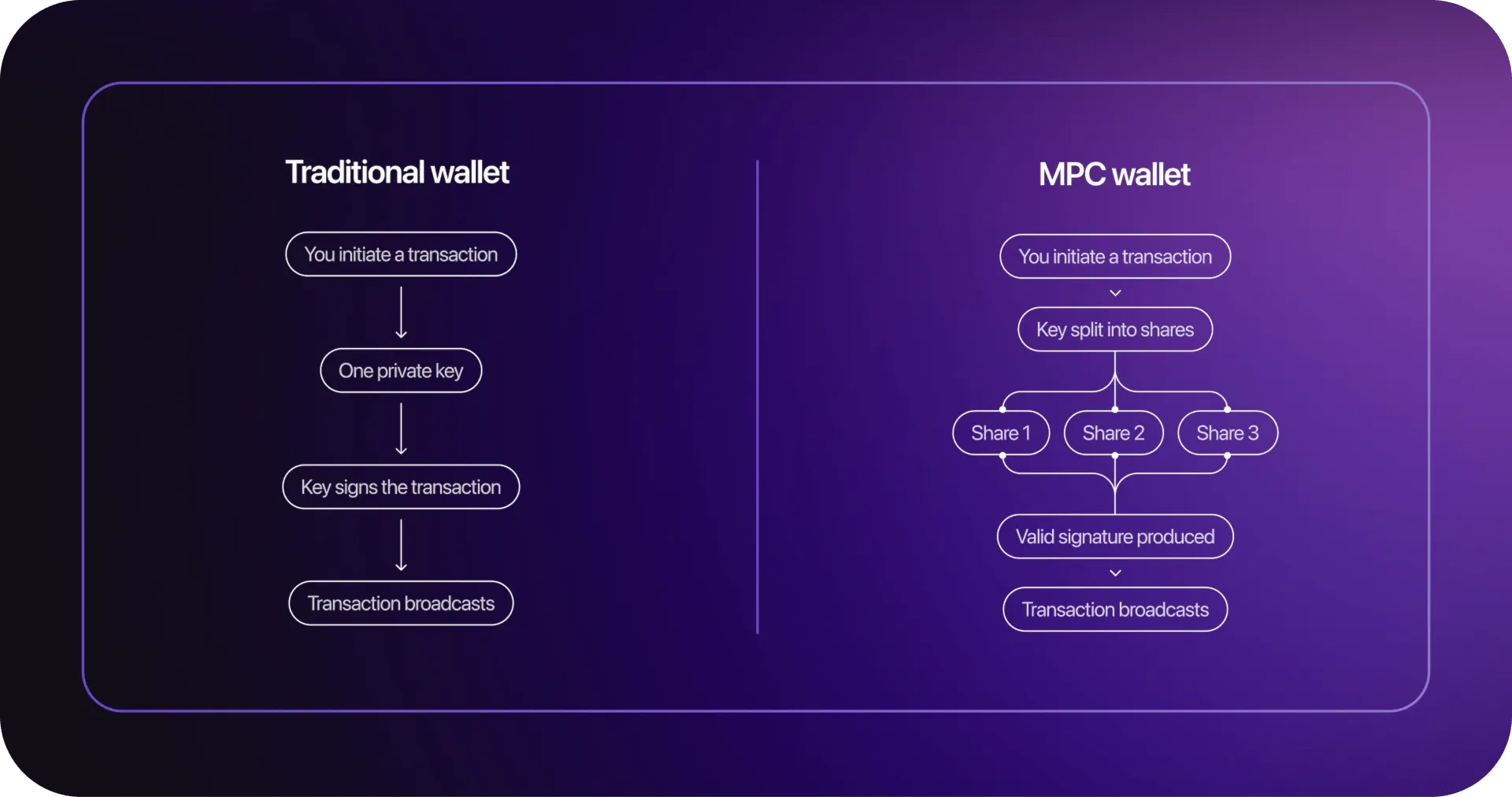
To the blockchain, it looks like a normal transaction.
Why MPC matters
By distributing access to a crypto wallet, MPC ensures there is not a single gateway for security when completing a transaction.
It also changes how recovery works. Some newer wallets built on MPC have eliminated seed phrases entirely. Instead of using a backup code that has to be written down and kept safe, the security is distributed automatically across a user's devices and a secure service.
The bigger picture
MPC has quietly become the infrastructure layer behind much of how digital assets move at scale. For institutions, it removes the operational risk that once made large-scale digital asset management impractical. For the broader ecosystem, it enables a model where security doesn't depend on any single party, making crypto infrastructure more resilient as more financial products move on-chain.