

A crypto exchange is an online marketplace where users can buy, sell, and trade cryptocurrencies. There are two types of exchange: a centralized exchange (CEX) is managed by a central coordinating entity, whereas a decentralized exchange (DEX) is not.
In this way a CEX is like an auction house, where users participate in auctions under the supervision of the auctioneer, and a DEX is like a local farmer’s market, where all the equipment is provided to facilitate trades (booths, tables, etc.) but nobody’s in charge.
Further reading: CEX vs DEX: What are the differences between crypto exchanges?
CEXs vs DEXs
CEXs are by far the more popular option and offer users a much simpler trading experience, but they’re not without drawbacks.
Sign up to our weekly MoonPay Minute newsletter
The most common complaint is that users don’t technically own their private keys (the password used to gain access to a crypto wallet)—the platform does. Hence the popular slogan “not your keys, not your coins”, which is used in the crypto community to discourage people from using CEXs.
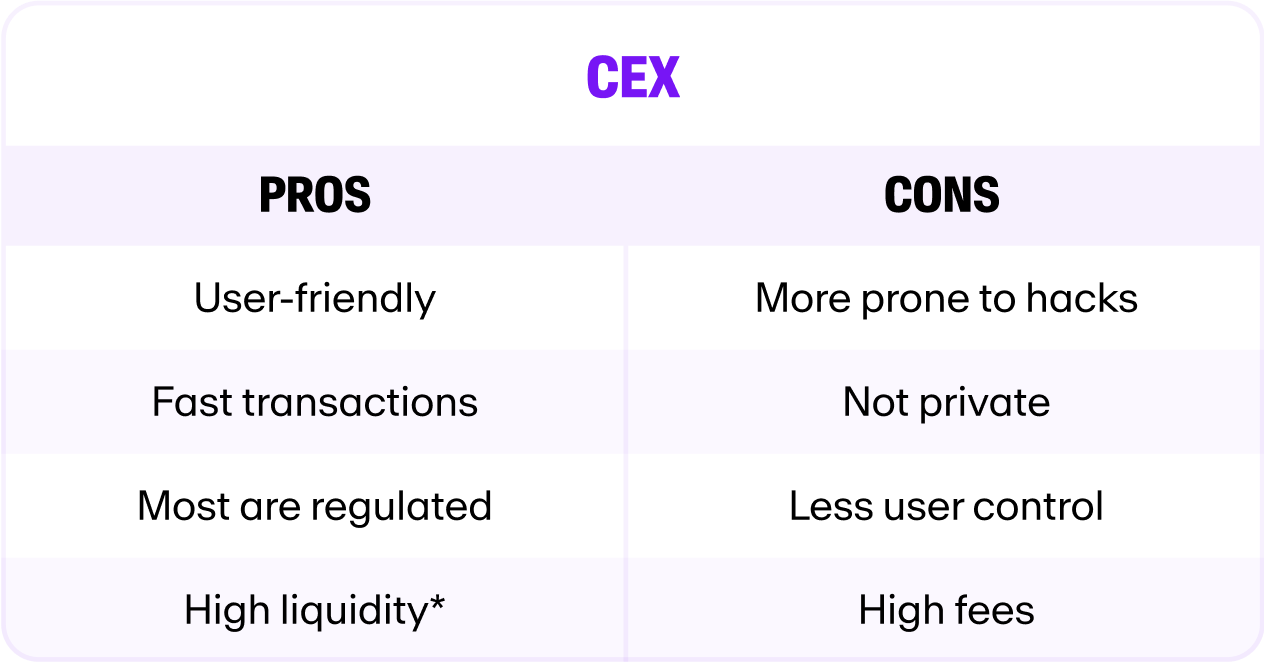
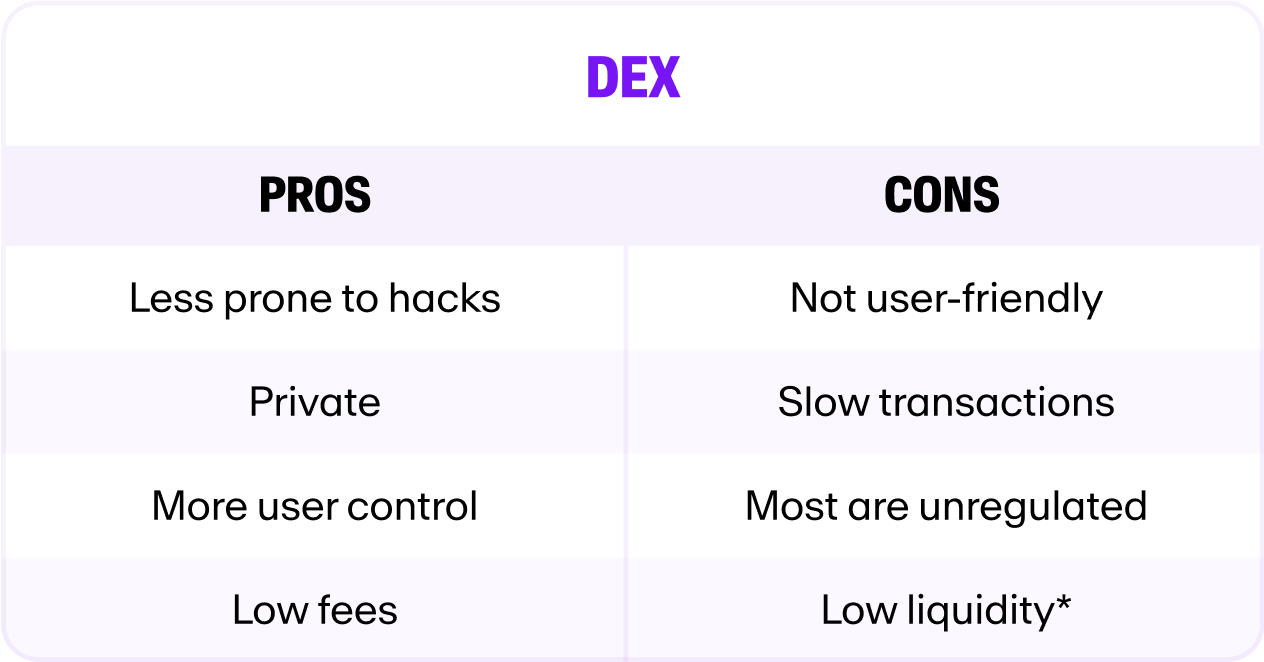
*Liquidity: the ready availability of tradable assets.
How do DEXs work?
With no central entity facilitating transactions, how do DEXs actually work?
Whereas a CEX relies on “market makers” to ensure orderly trading (these can be professional traders or businesses who help facilitate buy and sell orders), a DEX relies on something called an Automated Market Maker (AMM): a system of smart contracts (self-executing blockchain programs) that are programmed to enable liquidity and discover prices.
That means that on DEXs, users never need an intermediary–smart contracts manage everything end-to-end.
Further reading: What is an Automated Market Maker (AMM)
Subscribe to our newsletter!
Did you like this article? Sign up to our weekly MoonPay Minute newsletter to get similar content delivered directly to your inbox.