

What is DePIN? Real-world infrastructure powered by crypto
Quick read:
- DePIN networks use blockchain and tokens to crowd-build real-world infrastructure like wireless networks, GPU clouds, mapping data, and energy grids.
- Contributors plug in hardware or share unused capacity and earn crypto rewards. Users pay the network for the service.
- The category is moving from niche to multi-billion-dollar fast, with decentralized physical infrastructure networks now spanning more than 300 active projects across wireless, storage, compute, mapping, and energy.
Crypto's first decade was mostly about money. Bitcoin reinvented currency, Ethereum reinvented contracts, DeFi reinvented banking. DePIN is the next move outward: using the same tools to coordinate real-world stuff. Cell towers. Hard drives. GPUs. Dashcams. Solar panels.
The pitch is simple. Centralized companies own most of the infrastructure we depend on, which means slow innovation, high capex, and a small number of gatekeepers. DePIN flips that. Anyone with the right hardware can join a network, contribute capacity, and earn tokens. Anyone who needs the service pays for it. The blockchain coordinates the whole thing without a middleman.
This guide explains how DePIN works, which projects matter, how the tokenomics function, and what to know before you participate or invest.
What is DePIN?
DePIN stands for Decentralized Physical Infrastructure Networks. The basic idea: use blockchain coordination and token incentives to build physical or digital infrastructure that traditionally requires a centralized company.
Three things make a network DePIN:
- Real resources. Hardware, bandwidth, storage, mapping data, energy capacity, computing power. Something physical or digital that has utility outside the blockchain itself.
- Decentralized contribution. No single company owns the supply side. Individuals, small operators, and businesses plug in and contribute.
- Token incentives. Contributors earn cryptocurrency for providing resources. Users pay tokens to access the service. The blockchain handles payments, governance, and accounting.
Uber is a physical resource marketplace, but it isn't DePIN because Uber Inc. owns the rules. AWS aggregates compute, but it isn't DePIN because Amazon controls everything. DePIN means the network itself is the platform.
How DePIN works
Every DePIN network has four moving parts working together.
The blockchain layer
Smart contracts handle payments, distribute rewards, and enforce the rules of the network. Most DePIN projects run on fast chains like Solana or Layer 2 rollups, since transaction throughput matters when you're paying thousands of contributors. Understanding the basics of blockchain technology helps a lot before going further with DePIN.
Physical or digital resources
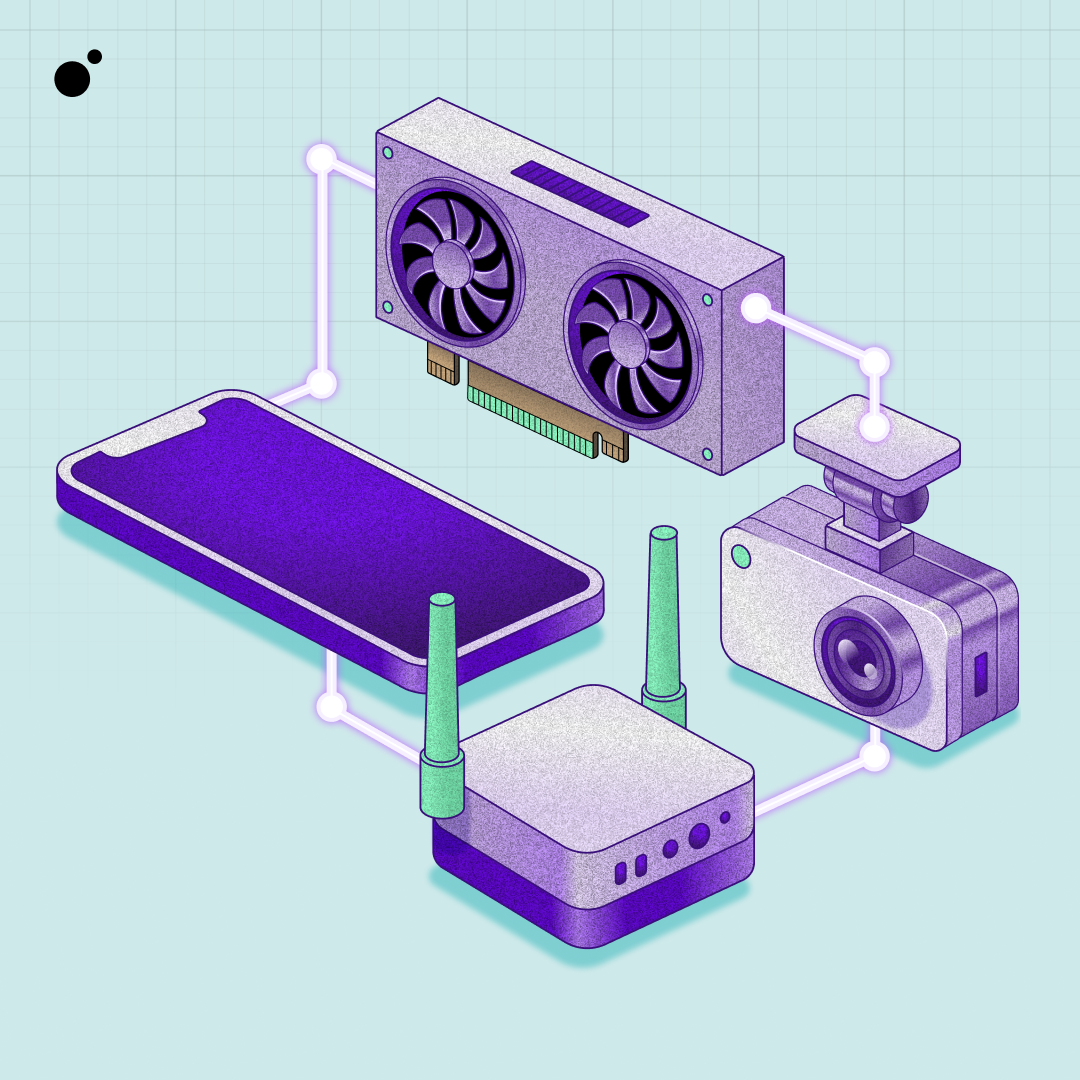
The actual stuff being shared. A hotspot transmitter for wireless coverage. A hard drive with unused capacity. A GPU sitting idle. A dashcam capturing street imagery. A sensor reading air quality.
Token rewards
Each DePIN network issues a native token. Contributors earn tokens for providing resources. The token usually has utility beyond speculation: paying for the service, voting on protocol changes, staking to secure the network.
Off-chain transfer
The service delivery happens off-chain. When you pay a decentralized storage network for file storage, the file doesn't sit on the blockchain. It sits on the contributor's hard drive. The blockchain just records who paid whom and verifies the service was delivered.
Here's a concrete example. Helium runs a decentralized wireless network. Someone buys a Helium hotspot (a small piece of hardware that costs a few hundred dollars), plugs it in at their house or office, and the device provides wireless coverage for IoT devices and 5G phones in the area. The network monitors uptime and coverage quality. The hotspot owner earns HNT tokens for providing coverage. Customers who need wireless data buy “data credits” with HNT to use the network. No central telecom company in the middle.
Why DePIN matters
Traditional infrastructure has three structural problems. DePIN addresses each one.
Capex is brutal
Building a national 5G network costs hundreds of billions of dollars. Building a hyperscale cloud business requires billions in upfront data center investment. That capital cost is one reason a handful of companies own most of the world's infrastructure. DePIN spreads the capex across thousands of small contributors, each buying one piece of hardware. The aggregate matches what a corporation would build, without the corporation.
Latent capacity goes unused
Billions of devices around the world have spare capacity nobody is monetizing. Unused hard drive space. GPUs idling overnight. Solar panels generating more electricity than the house needs. DePIN networks turn this latent capacity into a marketplace. Filecoin aggregates unused storage. Render aggregates unused GPU rendering capacity. Daylight aggregates unused energy from rooftop solar.
Permissionless innovation is hard inside a monopoly
Try building a new feature on top of your local power utility's grid. You can't. Centralized infrastructure operators control the integration surface, which kills the kind of compounding innovation that defines software. DePIN networks expose open APIs and let anyone build on top. That's how you get the equivalent of “money legos” for physical infrastructure.
These aren't theoretical advantages. Helium added wireless coverage to hundreds of thousands of locations without raising the kind of capital a traditional telecom would need. Filecoin coordinates more storage than most centralized storage providers. The model works when the network design is good.
The two flavors of DePIN
DePIN networks split into two categories based on what kind of resource they coordinate.
Physical Resource Networks (PRNs)
PRNs rely on location-dependent, tangible hardware. The provider has to be in a specific place to provide the service. Categories include:
- Wireless networks: 5G, IoT connectivity, Wi-Fi (Helium, XNET)
- Geospatial: mapping, street imagery, positioning data (Hivemapper, Geodnet)
- Mobility: vehicle data, ride sharing, delivery (DIMO, Drift)
- Energy: virtual power plants, peer-to-peer energy trading (Daylight, React)
Digital Resource Networks (DRNs)
DRNs coordinate resources that can come from anywhere. Storage doesn't care about geography. Compute doesn't care about geography. Categories include:
- Storage: decentralized file and data storage (Filecoin, Arweave)
- Compute: general-purpose and AI compute, including GPU rendering (Akash, Render, io.net)
- Bandwidth: VPN, CDN, decentralized web data (Grass, Orchid)
- Databases: indexing, querying, data services (The Graph)
A quick comparison:
Physical Resource Networks | Digital Resource Networks | |
Resources | Tangible, location-dependent | Digital, location-independent |
Example categories | Wireless, mapping, mobility, energy | Storage, compute, bandwidth |
Hardware required | Specialized (hotspots, dashcams, sensors) | Existing hardware (servers, GPUs, hard drives) |
Bootstrapping difficulty | Higher (real-world deployment) | Lower (software install) |
Both PRNs and DRNs share the DePIN logic: decentralized contribution, token incentives, blockchain coordination. The operational details differ a lot.
Top DePIN categories and projects
There are now more than 300 active DePIN projects across the ecosystem, with a combined market cap that has crossed $18 billion. DePINscan tracks the full list. These seven projects give a useful tour of the landscape.
Project | Category | Token | Network | What contributors earn |
Helium | Wireless / IoT and 5G | HNT | Solana | HNT for hosting hotspots that provide coverage |
Filecoin | Decentralized storage | FIL | Filecoin (own L1) | FIL for storing files reliably and proving storage |
Render (RENDER) | GPU compute and rendering | RENDER | Solana | RENDER for completing 3D rendering jobs |
Hivemapper | Mapping and street imagery | HONEY | Solana | HONEY for driving with a dashcam and uploading imagery |
Akash | Cloud compute marketplace | AKT | Akash (Cosmos-based) | AKT for renting out CPU/GPU capacity |
io.net | AI compute and GPU aggregation | IO | Solana | IO for contributing GPU power to AI workloads |
DIMO | Vehicle data and mobility | DIMO | Polygon | DIMO for sharing car telemetry data |
The pattern is consistent across the category. Buy or already own the hardware, plug into the network, prove you're delivering the service, earn tokens. The differences are in what hardware, what proof mechanism, and what economic design.
A few notes on the projects worth flagging. Helium was the first DePIN to reach real scale, with nearly a million hotspots deployed before it pivoted to become a “network of networks” hosting other DePIN projects. Filecoin processes a significant share of decentralized storage and is closely tied to the IPFS ecosystem. Render started on Ethereum and migrated to Solana, which signals where the active DePIN builder community currently sits.
DePIN tokenomics: how the coins actually work
A DePIN token's job is coordinating behavior across thousands of contributors and users. Price appreciation is a side effect of doing that job well. Tokens have four functional roles.
Incentivize supply
The first job is convincing people to contribute hardware before the network has any users. Early contributors take a real risk: they buy equipment, plug it in, and hope the network grows enough that their tokens become valuable. Token rewards subsidize this cold-start problem. Without that subsidy, no one would build the supply side.
Coordinate governance
Most DePIN tokens grant voting rights over protocol changes, reward parameters, and treasury decisions. Decentralized governance is messy in practice, but it's the mechanism that keeps the network from being captured by any one entity.
Function as payment
Users who want the service pay in the token, or in a stable asset that the protocol converts. Helium uses a burn-and-mint model: customers buying data credits burn HNT, while contributors earn newly minted HNT. The supply expands and contracts based on usage, which links token value to actual network demand.
Secure the network
Many DePIN projects require contributors to stake tokens as collateral. If you provide bad service, your stake gets slashed. This is borrowed from proof-of-stake blockchains and adapted for physical service verification.
Good DePIN tokenomics aligns incentives across all four roles. Bad tokenomics ends up with contributors farming rewards without delivering real service, or with token speculation crowding out actual utility. When you evaluate a DePIN token, the design of the reward mechanism matters more than the price chart.
The DePIN flywheel
When the economics work, a DePIN network spins up a self-reinforcing flywheel:
- Token rewards attract early contributors. People buy hardware and join the network because the token rewards look attractive.
- Supply grows. More hotspots, more storage, more GPUs, more coverage.
- Service quality improves. With more supply, the network can serve more users and serve them better.
- Users grow. Better service attracts paying customers, who pay in the native token.
- Token utility increases. Real demand for the token raises its value, which makes contributing more attractive, which pulls more supply into the network.
The flywheel can also spin backwards. If token rewards inflate faster than network demand, the token loses value, contributors leave, and the network deflates. This is why mature DePIN projects spend a lot of time tuning emission schedules and reward parameters. Tokenomics is the engine. Get it wrong and nothing else matters.
DePIN and Solana
If you look at the top DePIN projects by activity, a pattern shows up quickly. Helium runs on Solana. Render migrated to Solana. Hivemapper is on Solana. io.net is on Solana. Grass is on Solana.
Why? Three reasons. Solana processes tens of thousands of transactions per second with sub-cent fees, which matters when you're routing thousands of micropayments per minute between contributors and users. The builder ecosystem skews technical and crypto-native, which fits DePIN's hardware-and-tokenomics complexity. And Solana Labs has actively courted DePIN projects with developer support, marketing partnerships, and infrastructure investment.
DePINscan currently tracks more than two dozen active DePIN projects shipping on Solana, including most of the high-profile names in wireless, mapping, and AI compute. Other chains host DePIN projects too. Filecoin runs on its own L1. Arweave has its own chain. DIMO runs on Polygon. Akash runs on a Cosmos-based chain. The center of gravity for new DePIN launches in 2025 and 2026, though, has been Solana.
DePIN and AI: the compute frontier
The fastest-growing subcategory inside DePIN is decentralized AI infrastructure. The reason is simple math. Training and running modern AI models requires enormous GPU capacity. Centralized cloud providers can't keep up with demand, hyperscalers charge premium rates, and a lot of GPU capacity sits idle outside the big clouds.
Decentralized GPU networks fill that gap by aggregating compute from data centers, mining operations transitioning away from proof-of-work, and individual operators with high-end consumer hardware.
A few projects to know:
- Render connects creators and studios needing 3D rendering capacity with GPU owners. Original use cases were visual effects and 3D animation. AI inference is the newer demand.
- io.net built a decentralized cluster specifically for AI training and inference, pooling thousands of GPUs across the network.
- Akash offers a general-purpose decentralized cloud where AI workloads are now the dominant use case.
- Grass crowdsources unused residential bandwidth to feed AI training data pipelines, which run on the Grass network.
AI demand has validated the DePIN model in a way no other use case has. The pitch is no longer about future cost savings. The networks are meeting real AI builder demand today.
Challenges and the verification problem
DePIN networks face real obstacles. The biggest is verification: how does the blockchain confirm that a contributor actually delivered the service they're getting paid for?
In a centralized system, this is trivial. The company audits its own infrastructure. In DePIN, the network has to verify thousands of contributors providing physical services in the real world. The blockchain can't directly see a hotspot's signal coverage or whether a hard drive really stored the file.
Different projects solve this differently. Helium uses random challenges where the network sends test transmissions to verify hotspots are actually online. Filecoin uses cryptographic proofs of storage that contributors must regenerate periodically. Some projects use trusted hardware with embedded signing keys. Some use human auditors as a backstop. None of these is perfect, and verification design is where most DePIN protocols win or lose.
A related risk is self-dealing. If a contributor can earn more in token rewards than they spend on service costs, they have an incentive to fake demand by paying themselves. Most networks defend against this by tying rewards to verified external usage, requiring stake to participate, or capping rewards relative to demonstrated demand.
Beyond verification, DePIN faces standard early-stage challenges:
- Regulatory uncertainty. Token classification, telecoms licensing, energy market rules, data privacy. DePIN sits at the intersection of crypto regulation and sector-specific regulation in every market it touches.
- Hardware coordination. Real-world infrastructure means real-world maintenance, supply chain issues, and physical security. A bug in a smart contract is recoverable. A flood in a data center hosting half your storage providers is not.
- Adoption barriers. Most DePIN networks require some technical skill to contribute. Plugging in a Helium hotspot is easier than running a Bitcoin node, but it's still more involved than installing an app.
These are solvable, but they're also why most DePIN projects take years to reach meaningful scale.
Is DePIN a good investment?
DePIN is one of the more interesting categories in crypto right now, but interesting and profitable are different things. A few things to weigh before buying tokens.
Look at real network usage, not just token price. A DePIN network with $500 million in token market cap and almost no paying customers is a different proposition from one with the same market cap and real revenue from real users. Check on-chain metrics: paid transactions, active contributors, growth in supply and demand over the past year.
Read the tokenomics carefully. How fast are tokens emitted to contributors? How is that supply absorbed? Is there real demand for the token from paying users, or is most demand speculative? A network where token rewards exceed network revenue can run for a long time, but the math has to close eventually.
Understand the verification design. Networks with weak verification can be gamed. If self-dealing is profitable, the contributor count will look great and the actual service quality will be terrible.
Treat early-stage DePIN like venture investing. Most DePIN projects will fail. The ones that succeed could be very large. Sizing positions accordingly matters more than picking the right project.
The category is volatile and the time horizons are long. DePIN tokens carry the volatility and timeline of early-stage tech equity rather than the stability you would want in a retirement account.
How to get started with DePIN
Three paths to engage with the DePIN category, ranked by how much commitment they require.
Path 1: Buy a DePIN token. The lightest-touch way to gain exposure. Pick a project whose thesis you understand, buy the token through a crypto on-ramp, and hold it. You're betting on the network growing without doing the work of contributing yourself.
Path 2: Contribute hardware. If you want to earn rewards instead of just speculating, buy or repurpose the hardware the network needs. A Helium hotspot for wireless coverage. A Hivemapper dashcam if you drive a lot. Existing storage or GPU capacity if you're running a server. The economics depend on your local conditions (electricity costs, bandwidth, network density), so do the math before buying equipment.
Path 3: Learn before doing. DePIN is still maturing fast. Reading the project's documentation, watching the developer forums, and tracking active builder communities on the major DePIN chains tells you a lot about which projects have real momentum and which are mostly marketing. DePINscan and project Discord servers are good starting points.
For most people, Path 1 is enough. The category is interesting to follow, the tokens are accessible, and the contributor path makes sense only if you're already inclined toward hardware tinkering.
Frequently asked questions
What does DePIN stand for?
DePIN stands for Decentralized Physical Infrastructure Networks. The name covers two related categories: physical resource networks (like wireless coverage, mapping, and energy) and digital resource networks (like storage, compute, and bandwidth). Both use blockchain to coordinate and tokens to incentivize.
How do DePIN tokens work?
DePIN tokens have four jobs: rewarding contributors who provide hardware or services, serving as payment when users access the network, granting governance rights over protocol changes, and securing the network through staking. Specific designs vary widely. Helium uses a burn-and-mint model. Filecoin uses cryptographic proofs of storage. Most networks emit tokens to contributors and earn revenue when users pay for the service.
What are the top DePIN projects?
The most established DePIN projects span several categories: Helium for wireless, Filecoin for decentralized storage, Render for GPU rendering, Hivemapper for mapping, Akash for cloud compute, io.net for AI compute, and DIMO for vehicle data. DePINscan tracks the full ecosystem of more than 300 active projects.
Is DePIN a good investment?
DePIN tokens are high-risk, early-stage assets. Real network usage, sound tokenomics, and strong verification design are better signals than token price charts. Most DePIN projects will not succeed long-term. A few could become very large. Size positions accordingly and treat the category like venture investing rather than core portfolio holdings.
What is the difference between DePIN and DeFi?
DeFi (decentralized finance) uses blockchain to coordinate financial services: lending, trading, derivatives, payments. DePIN uses blockchain to coordinate physical and digital infrastructure: wireless networks, storage, compute, mapping. Both rely on smart contracts and token incentives. The resources being coordinated are different. DeFi handles digital money. DePIN handles real-world stuff.


.png?w=3840&q=90)
.png?w=3840&q=90)

.png?w=3840&q=90)